Hammond's School City enrolled 13,860 students in 2016. By fall 2025, it had 10,507. Then it lost another 802 in a single year, dropping to 9,705 and falling below 10,000 for the first time in the district's modern history.
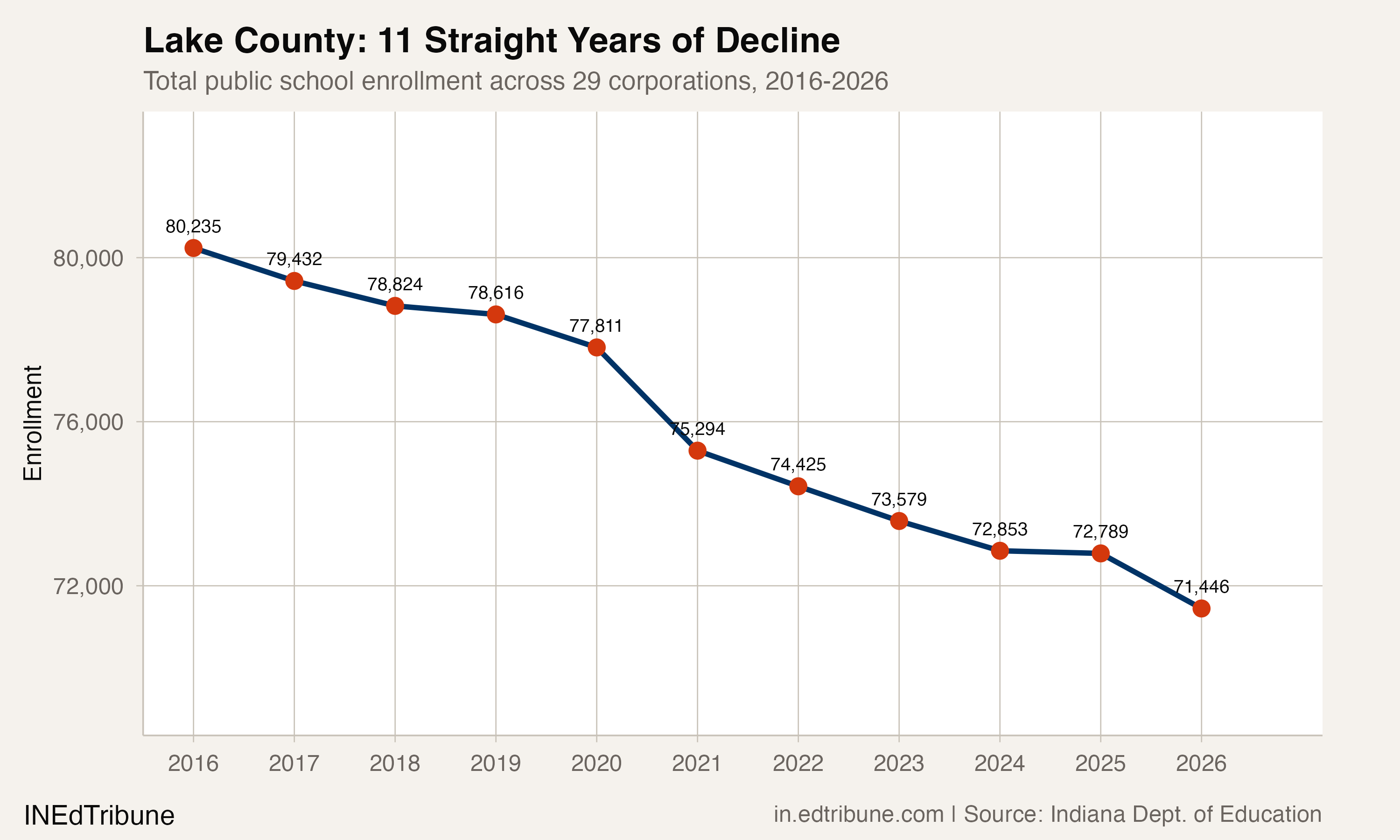
That collapse is not an outlier. It is the sharpest edge of a county-wide pattern that has now persisted for 11 consecutive years. Lake County's 29 public school corporations enrolled 80,235 students in 2016. In 2026, they enrolled 71,446, a loss of 8,789 students, or 11.0%. The county has not recorded a single year of growth in the past decade.
The geography of the loss
The aggregate number obscures a stark internal divide. Lake County is effectively two school systems occupying the same county: a northern tier of aging industrial cities losing students at rates that threaten institutional viability, and a southern tier of suburbs that has barely budged.
The five northern corporations anchored by Gary Community School Corp↗ET, School City of Hammond↗ET, School City of East Chicago↗ET, Lake Station Community Schools↗ET, and Lake Ridge New Tech Schools enrolled 28,551 students in 2016. In 2026, they enrolled 19,528, a loss of 9,023 students, or 31.6%. That group alone accounts for more than the entire county's net loss, because southern suburbs partially offset it.
The eight southern corporations, including Crown Point Community School Corp↗ET, Lake Central School Corporation↗ET, Hanover Community School Corp↗ET, and Merrillville Community School Corp↗ET, went from 38,713 to 38,891 over the same period. A gain of 178 students. Essentially flat.
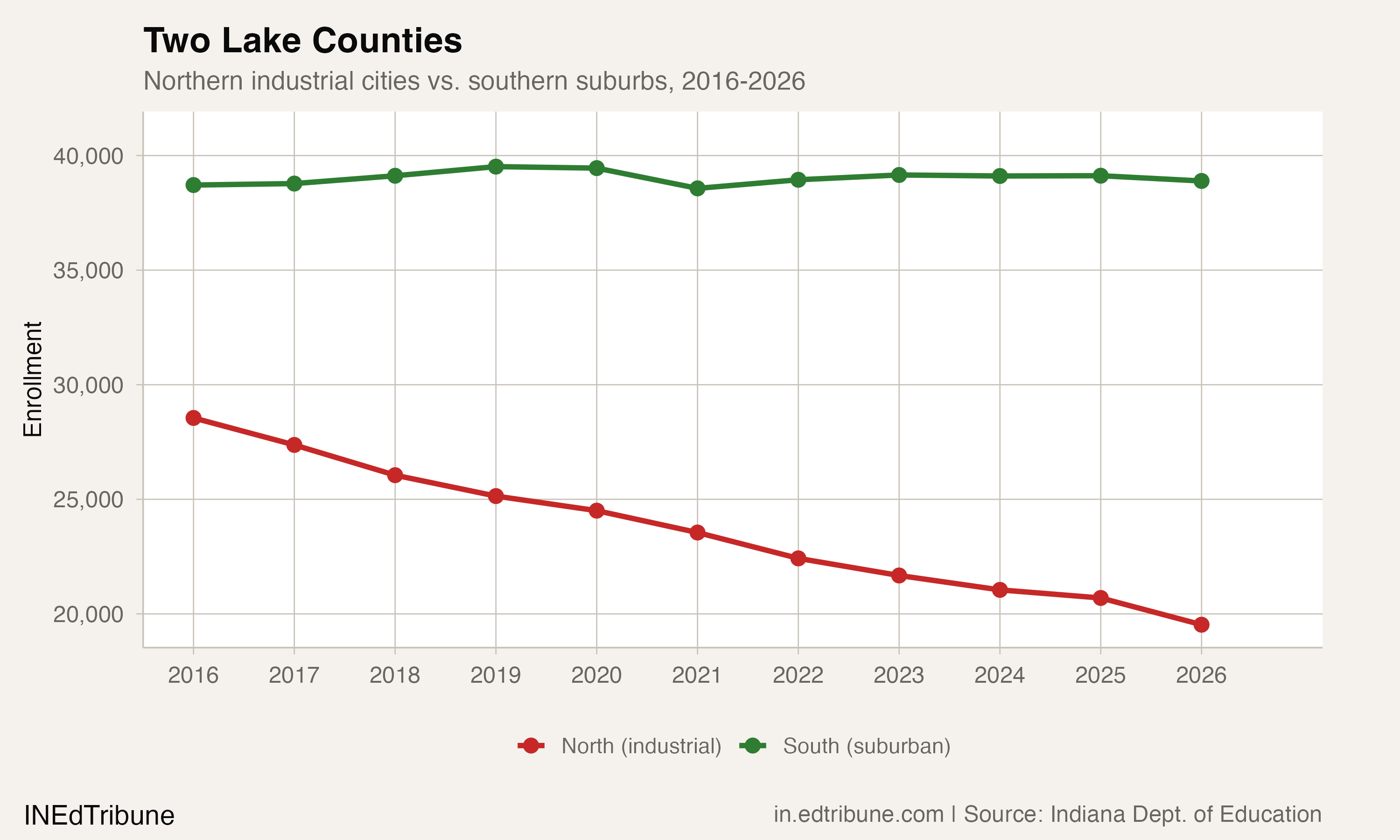
The divergence is not subtle. Since 2016, the northern industrial tier has lost nearly one in three students. The southern suburban tier has lost none. A county that once had a rough two-thirds/one-third suburban-urban split now looks closer to a two-to-one ratio, with the suburban south enrolling twice the students of the urban north.
Hammond's accelerating spiral
Hammond is the largest district in the county and the one losing students fastest in absolute terms. The 4,155 students it shed between 2016 and 2026, a 30.0% decline, represent nearly half of the county's entire net loss.
The pace has worsened. From 2017 through 2019, Hammond lost between 100 and 529 students per year. In 2025, it lost 768. In 2026, it lost 802. The two-year loss of 1,570 students between 2024 and 2026 exceeds what the district lost in the four years from 2016 to 2020 combined.
The fiscal consequences arrived before the enrollment floor did. After voters rejected a $15 million operating referendum in November 2023 by a more than seven-to-one margin, the state's Distressed Unit Appeals Board placed Hammond on a corrective action plan. The plan, approved in August 2024, requires nearly $30 million in annual spending cuts, including the closure of three elementary schools, the elimination of 19 teaching positions, and the removal of 40 recess aide and 25 custodian positions.
"These decisions will go a long way to stabilize the School Corporation's finances well into the future." — DUAB Executive Director Peter Miller, Lakeshore Public Media, Aug. 2024
The district has also approved eliminating bus transportation services as early as 2027. With Indiana's tuition support formula allocating roughly $8,409 per student in 2024-25, Hammond's loss of 802 students in a single year translates to roughly $6.7 million in foregone state revenue. The question is whether the spending cuts can keep pace with the enrollment decline, or whether each round of cuts accelerates the next round of departures.
Gary's long collapse
Gary Community School Corp↗ET presents the most extreme case. Its enrollment fell from 6,480 in 2016 to 4,025 in 2026, a 37.9% decline. An Indiana University analysis documented a 75% enrollment loss between 2006 and 2024, placing Gary among the most severely impacted school corporations in the state.
The district has been under state management since 2017, when the Emergency Manager for Gary Community School Corporation was appointed after years of fiscal distress. Gary's enrollment trajectory mirrors its population trajectory: the city has lost residents steadily since the steel industry's decline began in the 1970s, falling from a peak of roughly 178,000 to an estimated 67,199 in 2025.
East Chicago follows a similar pattern, losing 1,602 students (33.0%) since 2016. A 2016 lead contamination crisis in the West Calumet neighborhood displaced hundreds of families and shuttered Carrie Gosch Elementary, compounding the population loss that was already underway. Lake Station lost 395 students (28.3%) over the same period.
Where the students went
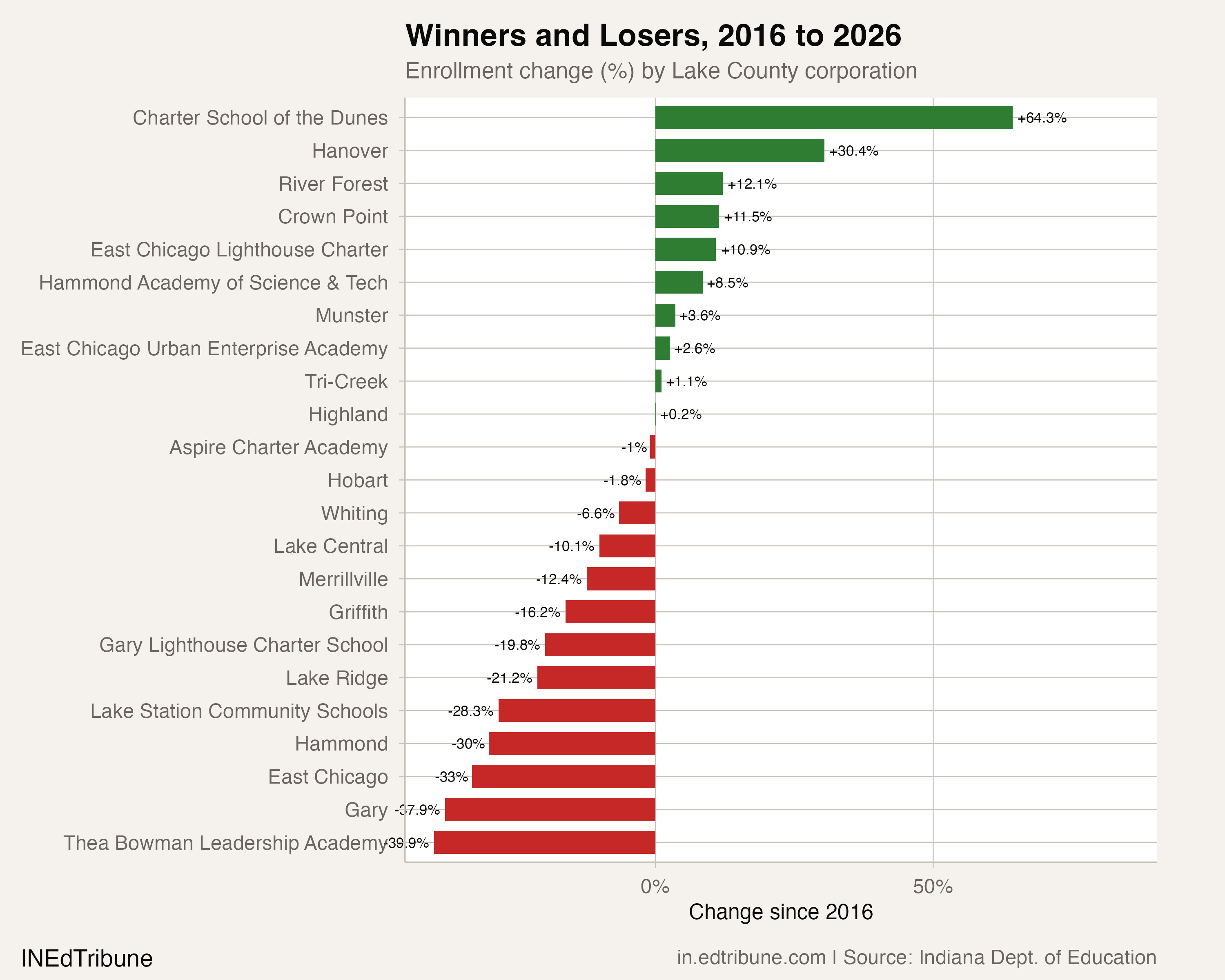
Not all of Lake County's enrollment shifted out of the county. Some moved south within it. Crown Point added 956 students (+11.5%) over the decade, growing in nine of 10 years. Hanover, on the county's southern edge near Cedar Lake, grew 30.4%, from 2,142 to 2,794. Charter School of the Dunes, based in Gary, grew 64.3%, from 504 to 828.
But the southern gains do not come close to replacing the northern losses. Crown Point and Hanover together added 1,608 students. Hammond alone lost 4,155. The net math is unambiguous: families are leaving the northern cities and not all of them are landing in southern Lake County. Some are crossing into Porter or LaPorte counties. Some are leaving Northwest Indiana entirely.
The middle tier tells its own story. Merrillville, which straddles the geographic center of the county, lost 12.4%. Lake Central, in the more affluent St. John and Dyer communities, lost 10.1%, including a 968-student decline that accelerated in the final three years of the decade. Even suburbs are not immune when the region's overall trajectory is downward.
A demographic profile in transition
The enrollment losses have not been evenly distributed by race. White enrollment in Lake County fell from 32,388 (40.4% of the total) in 2016 to 25,710 (36.0%) in 2026, a loss of 6,678 students. Hispanic enrollment held nearly flat in absolute terms, rising from 20,052 to 20,374, which pushed its share from 25.0% to 28.5%. Black enrollment fell in raw numbers, from 23,848 to 21,125, but its share held steady near 29.6%.
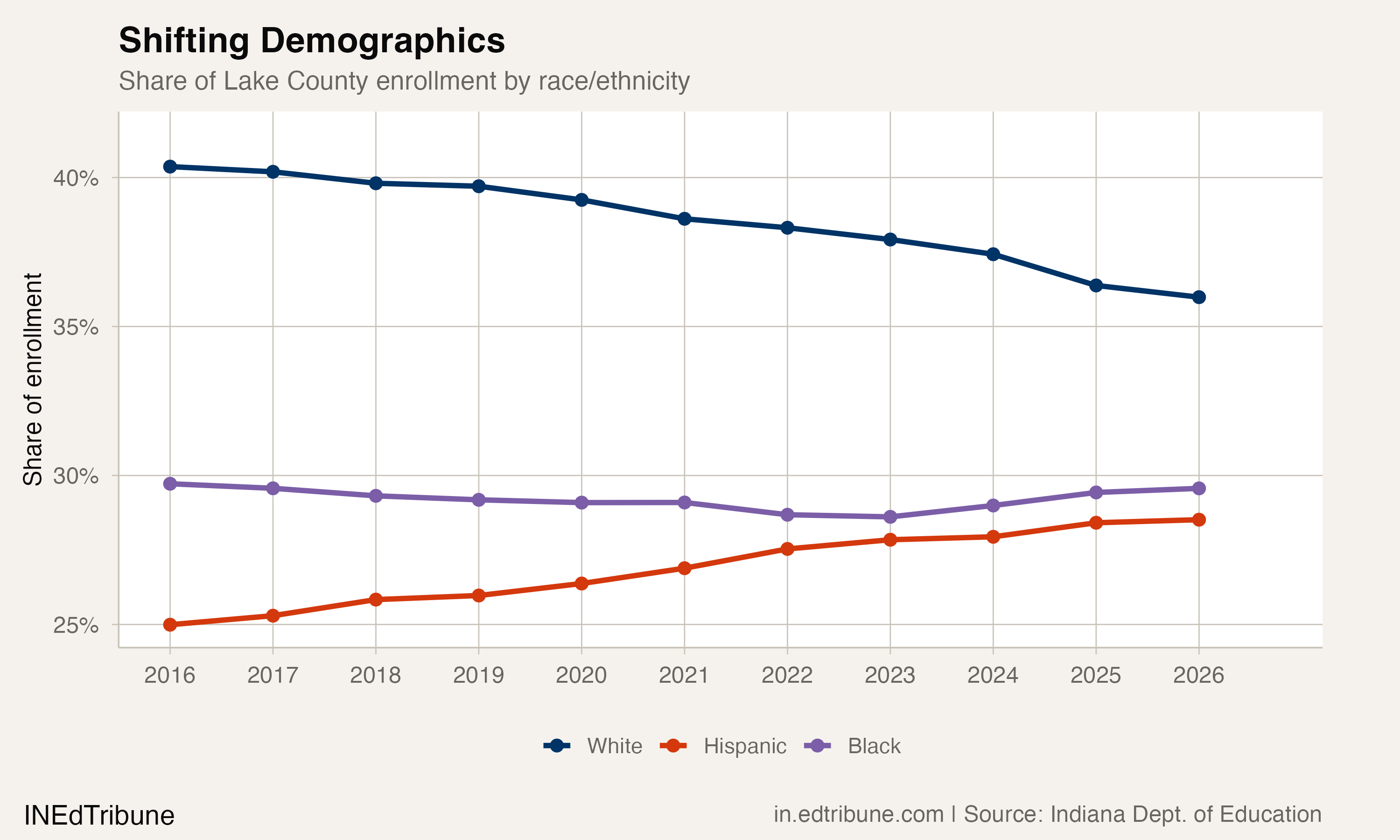
The convergence between the three largest groups is notable. In 2016, a 15-percentage-point gap separated the white share from the Hispanic share. By 2026, that gap had narrowed to 7.5 points. If the current pace continues, Hispanic enrollment will surpass Black enrollment within two to three years and approach parity with white enrollment within five.
The kindergarten signal
Lake County's kindergarten enrollment fell from 5,792 in 2016 to 4,623 in 2026, a 20.2% decline that outpaces the county's overall 11.0% loss. Because kindergarten represents the incoming pipeline, this pattern suggests the decline has not yet reached its floor. Each smaller kindergarten cohort will work its way through the system over the next 12 years, compressing enrollment from the bottom up.
Indiana's statewide birth numbers have fallen nearly 11% since 2007, and Lake County's industrial north has been losing young families at a faster rate than the state average. The kindergarten deficit is both a cause and a consequence: fewer births produce fewer kindergartners, and school closures in response to lower enrollment make the remaining districts less attractive to families with young children.
The year-over-year pattern
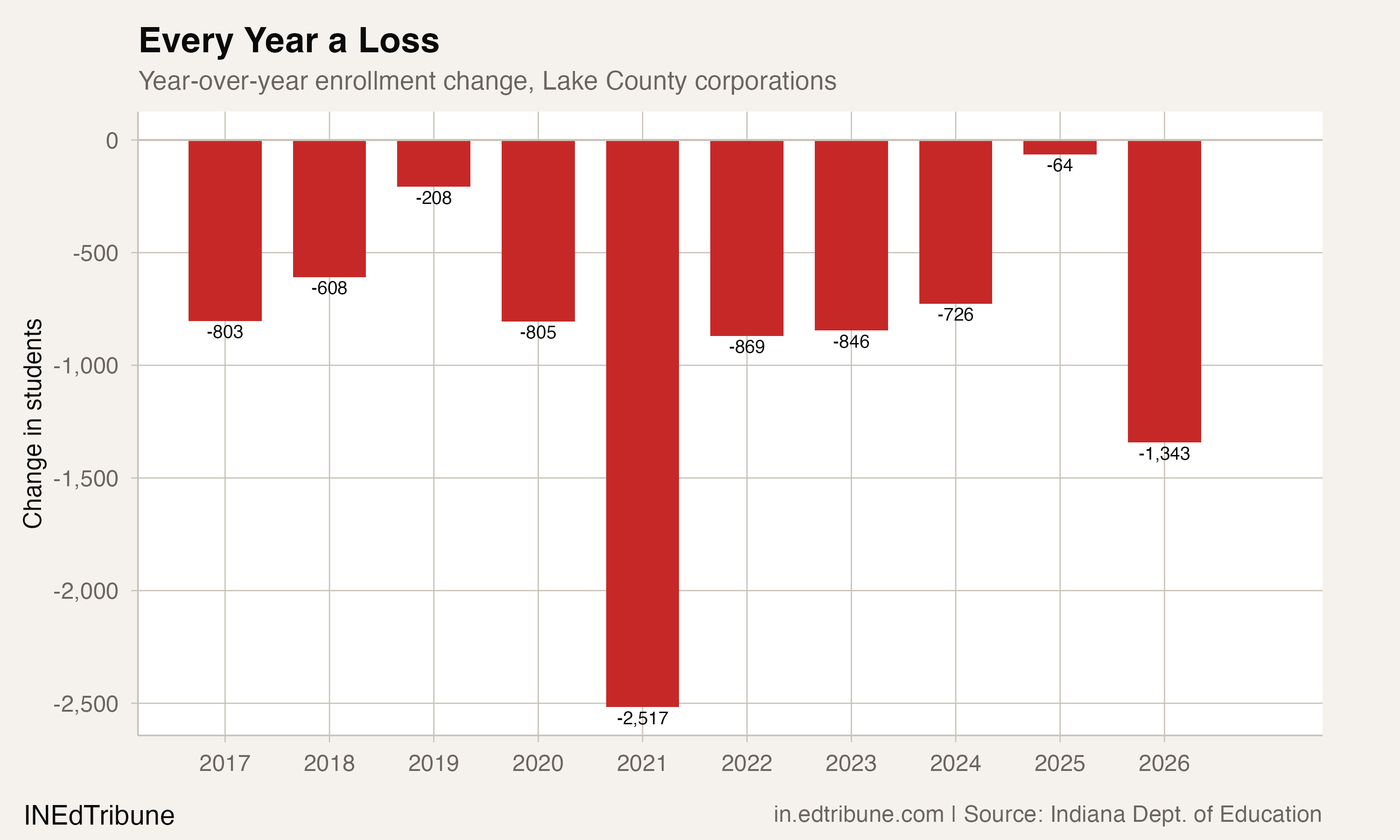
The year-over-year chart reveals a pattern that the trend line partially obscures. The COVID-era loss of 2,517 students in 2021 was by far the largest single-year drop, but the county had been losing 200 to 800 students annually even before the pandemic. After COVID, losses ran between 700 and 870 per year through 2024 before narrowing sharply to just 64 in 2025.
That near-pause in 2025 proved temporary. The 2026 loss of 1,343 students is the second-largest in the decade, smaller only than the COVID year. It suggests that whatever stabilization appeared in 2025 was a one-year anomaly, not a turning point. Hammond accounts for most of the reversal: it lost 802 students in 2026 after losing 768 in 2025, while Gary gave back the 358-student gain it had recorded the prior year, dropping back to 4,025.
Lake County's school infrastructure was built for a county that no longer exists. Hammond is closing three elementary schools under a state-mandated corrective action plan and may eliminate bus service by 2027. Gary has been under state management since 2017. East Chicago never fully recovered from the 2016 lead contamination crisis that closed Carrie Gosch Elementary and scattered families across the region. Crown Point and Hanover keep growing on the county's southern edge, but their combined decade of gains would not fill the seats Hammond emptied in four years. The county is not splitting into winners and losers. It split a long time ago. The enrollment data is just catching up.
Detailed code that reproduces the analysis and figures in this article is available exclusively to EdTribune subscribers.
Discussion
Sign in to join the discussion.
Loading comments...