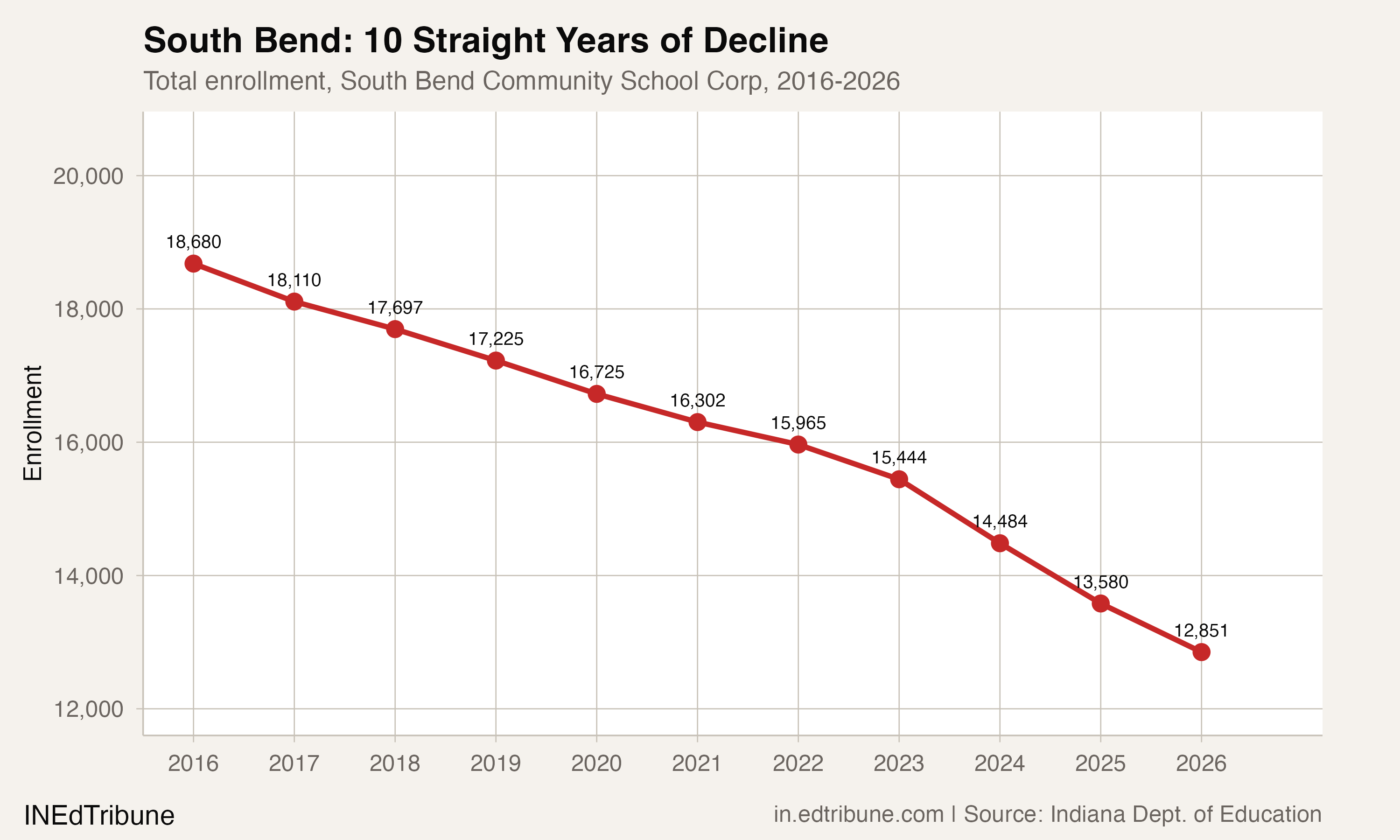
In 2016, South Bend Community School Corp↗ET enrolled 18,680 students and ranked as Indiana's fifth-largest school corporation. In 2026, it enrolled 12,851 and ranked 11th. In between, enrollment fell every single year, 10 for 10, a losing streak with no interruption and no floor.
The 5,829-student loss, a 31.2% decline, happened while the state's total enrollment fell just 1.7%. South Bend is not merely shrinking alongside Indiana. It is shrinking nearly 20 times faster.
The steepening curve
The decline has two distinct phases. From 2017 through 2023, South Bend lost an average of 462 students per year, a painful but manageable pace. Starting in 2024, the losses nearly doubled: 960 that year, 904 the next, and 729 in 2026. The last three years alone account for 2,593 of the district's total 5,829-student decline, or 44% of the entire decade's losses.
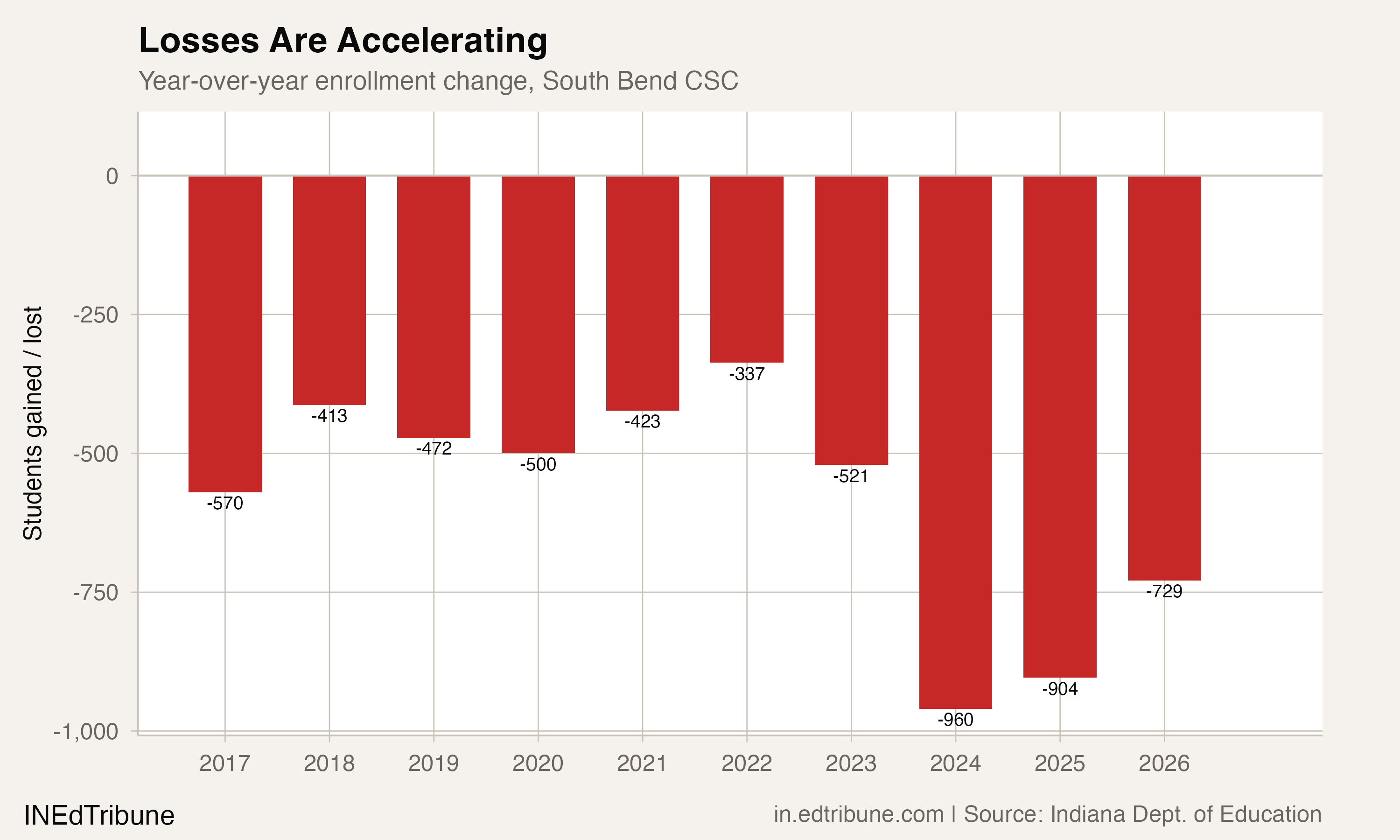
The 2024 acceleration coincided with the closure of Clay High School following the 2023-24 school year. The district's facilities master plan had initially proposed consolidating from four high schools to two. Community opposition scaled the plan back, but Clay still closed, and the district has not stabilized since.
Where 44% of students go
South Bend's enrollment crisis is inseparable from Indiana's school choice ecosystem. A WFYI analysis found that nearly 41% of the 23,259 school-age children living in South Bend's boundaries attend schools elsewhere. Roughly half leave for other public districts or charter schools; the other half use Indiana's Choice Scholarship (voucher) program to attend private schools.
The financial impact is severe. South Bend loses 27.6% of its education fund to vouchers alone, the highest rate of any school corporation in the state, according to the same analysis. Among the 14 districts that lose more than 10% of their education fund to vouchers, the average loss is $12.7 million.
The competitive landscape in St. Joseph County illustrates the dynamic. WSBT reported that 24% of students in South Bend's boundaries transfer to other public or charter schools, while 20% leave for private institutions. Saint Joseph High School alone draws 543 students from South Bend's attendance area. Career Academy's middle and high school campuses in South Bend enrolled a combined 898 students in 2026, up from 626 in 2016.
"As enrollment declines, you have to continually assess your school buildings, your staffing, and adjust accordingly." — WFYI, 2025
Meanwhile, neighboring Penn-Harris-Madison School Corp↗ET grew 4.3% over the same decade, from 10,720 to 11,185 students. The suburban district sits minutes from South Bend's boundaries.
A shrinking pipeline
The kindergarten numbers point to continued decline. South Bend enrolled 1,390 kindergarteners in 2016. In 2026, that number was 868, a 37.6% drop. Pre-K fell even harder: from 1,071 to 459, a 57.1% collapse driven partly by state funding cuts to pre-K programs that forced the district to scale back.
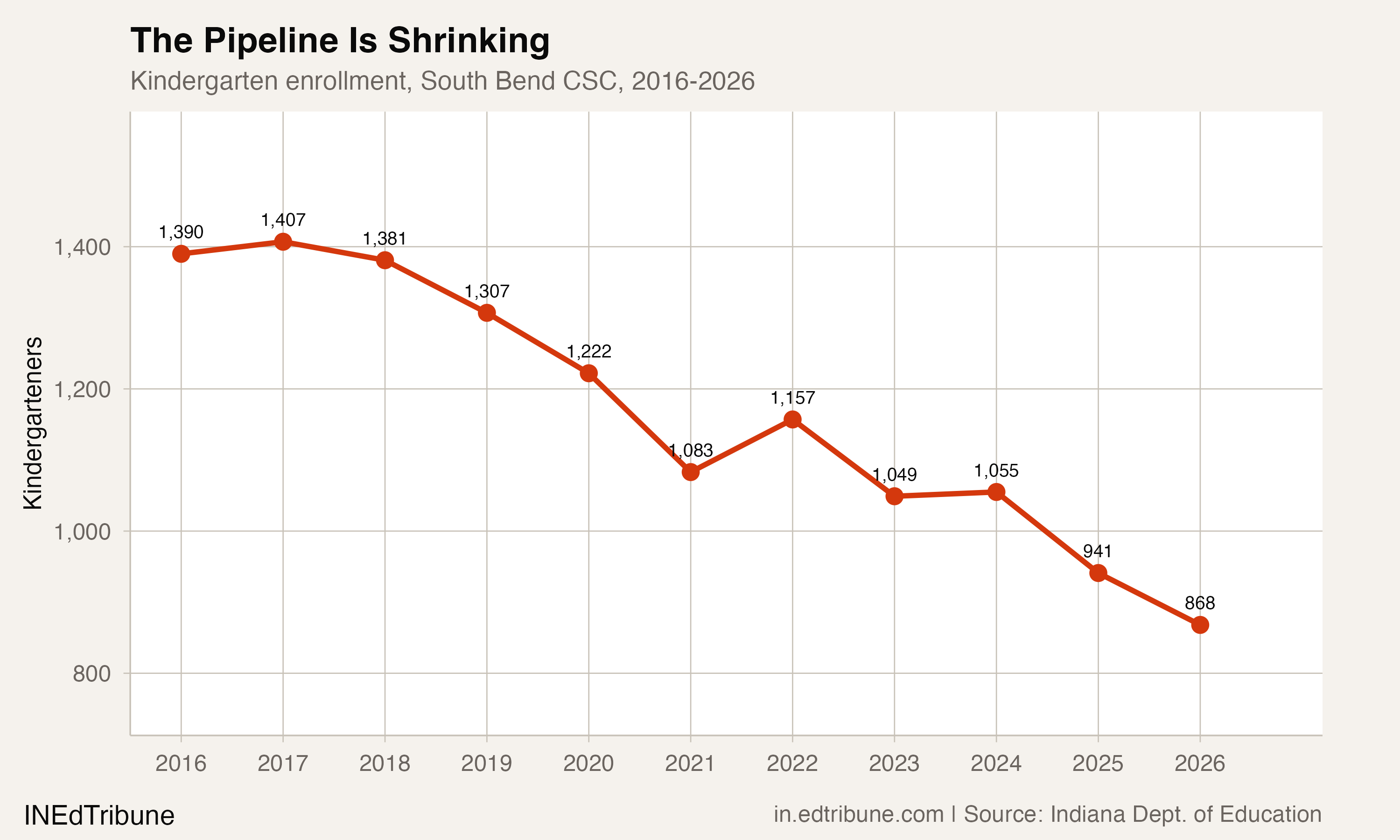
Each smaller kindergarten class locks in a smaller district for the next 13 years. With 868 kindergarteners feeding into a system that graduated 1,070 twelfth graders in 2026, the math is clear: South Bend is replacing larger cohorts with smaller ones, and the gap is widening.
Demographic transformation
Every racial and ethnic group in South Bend has lost students, but not at the same rate. White enrollment was halved, falling from 6,090 to 3,058, a loss of 3,032 students and a 49.8% decline. White students' share of the district dropped from 32.6% to 23.8%. Black enrollment fell 27.9%, from 6,635 to 4,782. Hispanic enrollment, despite a modest absolute decline of 396 students (10.3%), grew as a share of the district from 20.6% to 26.8%.
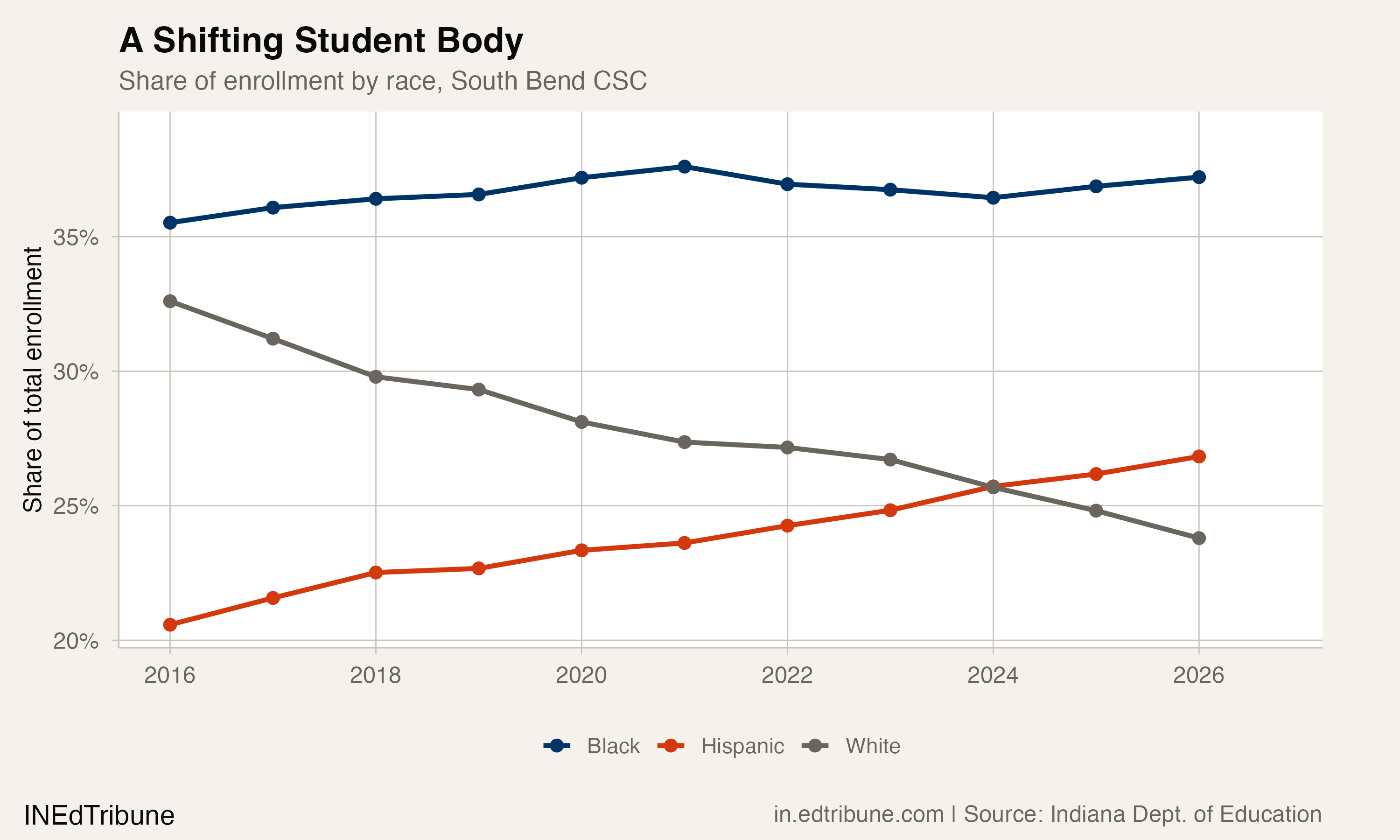
The English learner share has risen from 9.8% to 13.3% over the same period, reflecting both the growing Hispanic share and, separately, the district's changing instructional profile.
In the company of Indianapolis
South Bend's 31.2% decline is not unique among Indiana's large urban districts. Indianapolis Public Schools lost 33.2% over the same period, falling from 29,583 to 19,774. But Fort Wayne Community Schools, a comparable urban district, lost only 4.4%, and Evansville Vanderburgh lost 8.3%.
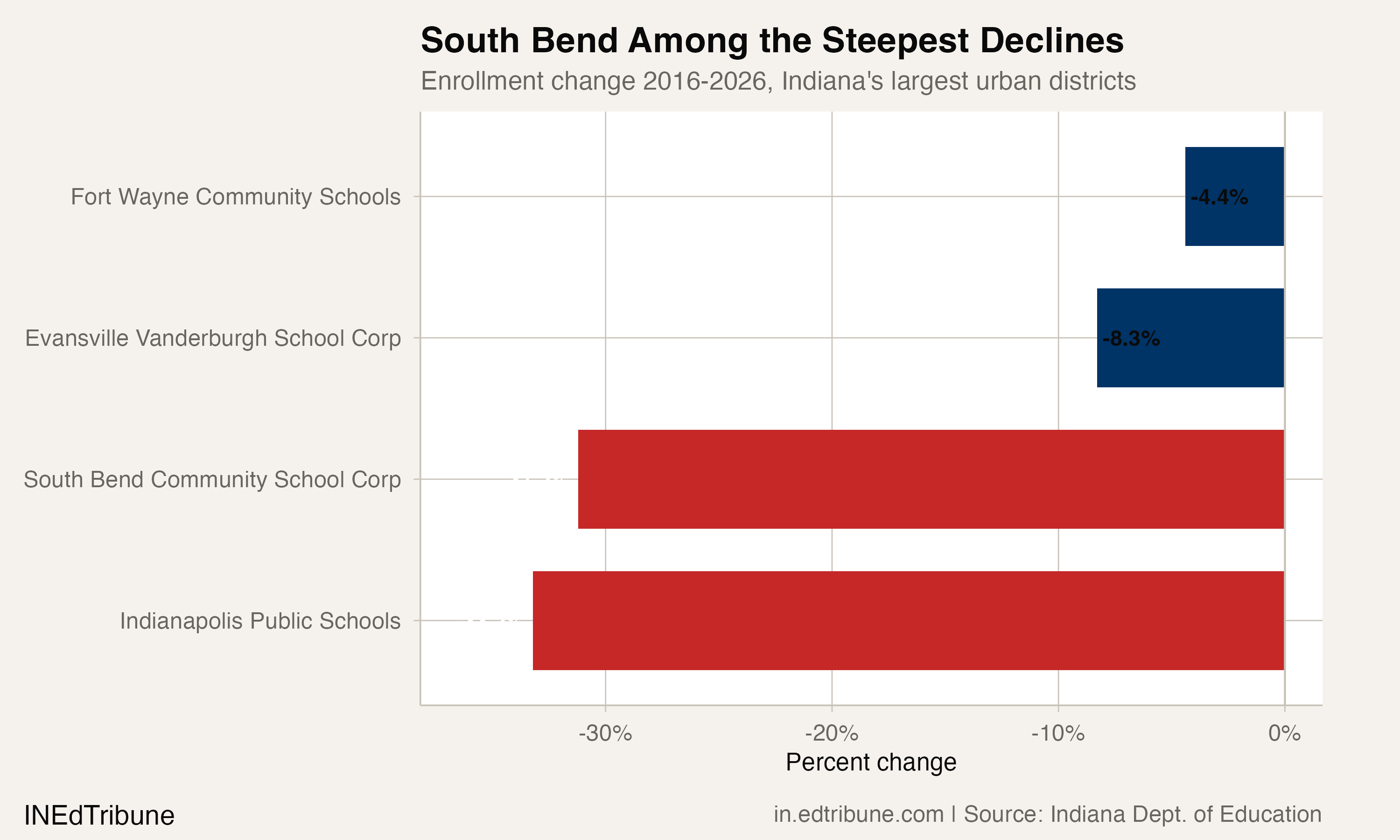
The difference between South Bend and Fort Wayne is not size or geography. It is the intensity of competition. South Bend operates in one of Indiana's most saturated school choice markets, with multiple charter networks, well-resourced Catholic high schools, and a voucher program that now covers families regardless of income.
More fiscal pressure ahead
Indiana's 2025 property tax reform package (SEA 1) is expected to cost school corporations $744.4 million in property tax revenue over the coming years. For districts already losing students, the reform compounds the enrollment-driven funding decline with a separate revenue cut. Beginning in 2028, districts must also share property tax revenue with local charter schools, phasing in over four years.
The Purdue Polytechnic High School board voted in February 2026 to close its South Bend campus, citing financial challenges and declining enrollment. The campus served just 112 students, far short of its planned 500-student capacity. Students were directed to Career Academy schools for priority enrollment. Even charters are finding South Bend a difficult market.
The district itself has made operational progress. After dissolving the South Bend Empowerment Zone in 2024, saving roughly $5 million in annual costs, and eliminating outsourcing contracts, SBCSC redirected millions toward teacher compensation, reducing its education-to-operations fund transfer from 9.1% to 5.5%. But fiscal discipline has not translated into enrollment recovery.
Below 10,000 by decade's end
At the last three years' average rate of 864 students lost per year, South Bend would fall below 10,000 students by 2030. Even at the milder pace of the earlier years (462 per year), the district would cross that threshold by 2032.
South Bend has done what fiscal consultants recommend: dissolved the Empowerment Zone, cut outsourcing contracts, redirected money to teacher pay. The operational house is more orderly than it was five years ago. But a tighter budget does not fill a kindergarten class of 868 when the graduating class is 1,070, and it does not keep a family in its attendance zone when Saint Joseph High School, Career Academy, and a fully funded voucher are all within a 15-minute drive. The district's problem is not mismanagement. It is geography, demography, and a state policy framework that treats every student departure as a market signal rather than a revenue crisis for the system left behind.
Detailed code that reproduces the analysis and figures in this article is available exclusively to EdTribune subscribers.
Discussion
Sign in to join the discussion.
Loading comments...