School City of East Chicago↗ET graduated 59.6% of its senior cohort in 2017. It was one of the lowest rates in Indiana, 27.6 percentage points below the state average, in a small Lake County district where most students qualify as economically disadvantaged.
In 2025, the district posted 90.0%.
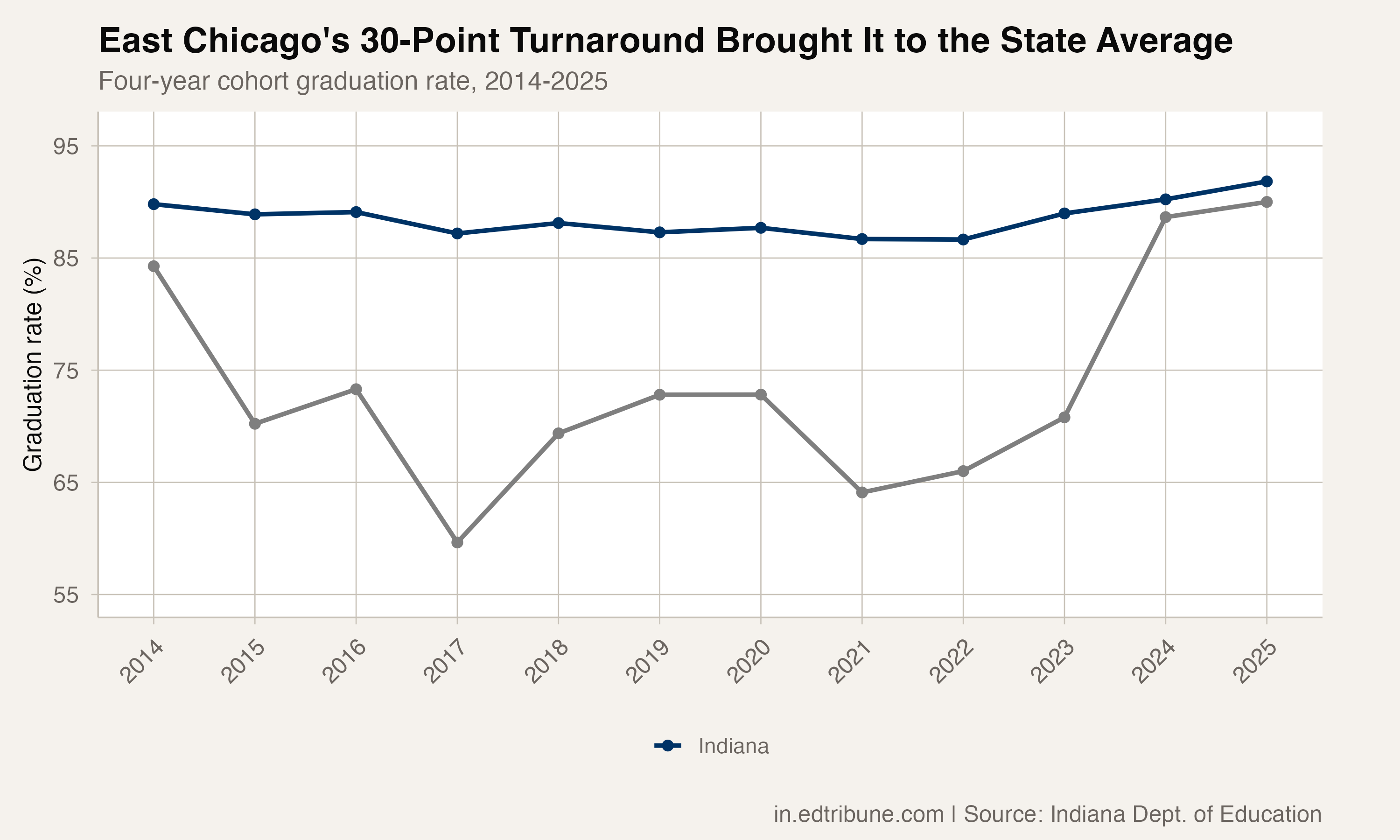
The 30.4 percentage point gain from 2017 to 2025 is the largest improvement of any Indiana school corporation over that span, and the largest among the 166 corporations with cohorts of 100 or more students in both years.
The climb happened in two waves
East Chicago's improvement was not a steady ascent. The first wave brought modest gains: the rate climbed from 59.6% in 2017 to 72.8% in 2019, then slid during the pandemic to a low of 64.1% in 2021, erasing most of that progress before edging back to 66.0% in 2022.
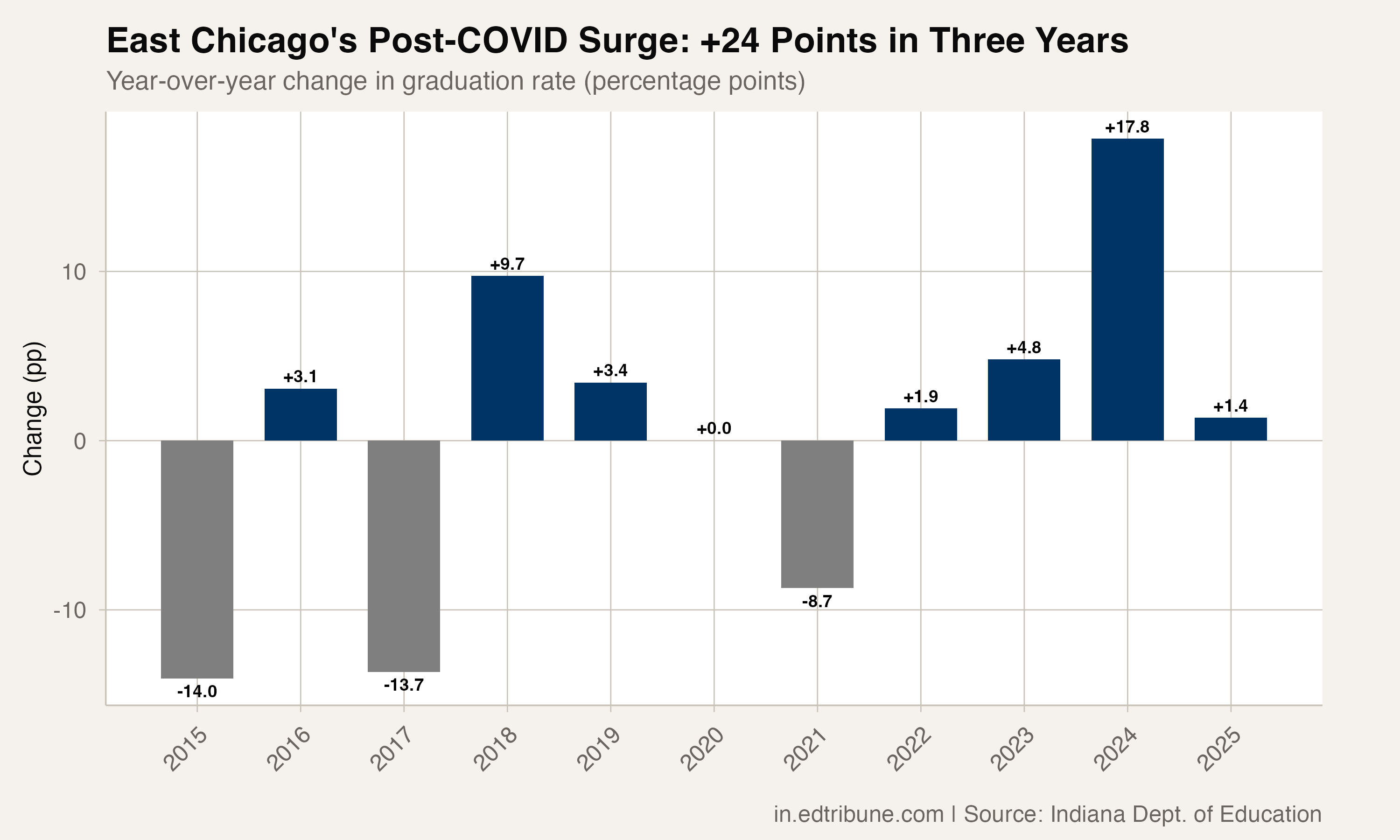
The second wave was steeper. From 66.0% in 2022, the rate climbed to 70.8% in 2023, then jumped to 88.6% in 2024 and 90.0% in 2025. The 24.0 point gain from 2022 to 2025 is one of the largest three-year improvements in the state among corporations with a cohort over 100.
The district went from 27.6 points below the state average in 2017 to just 1.8 points below in 2025.
Not alone, but well ahead
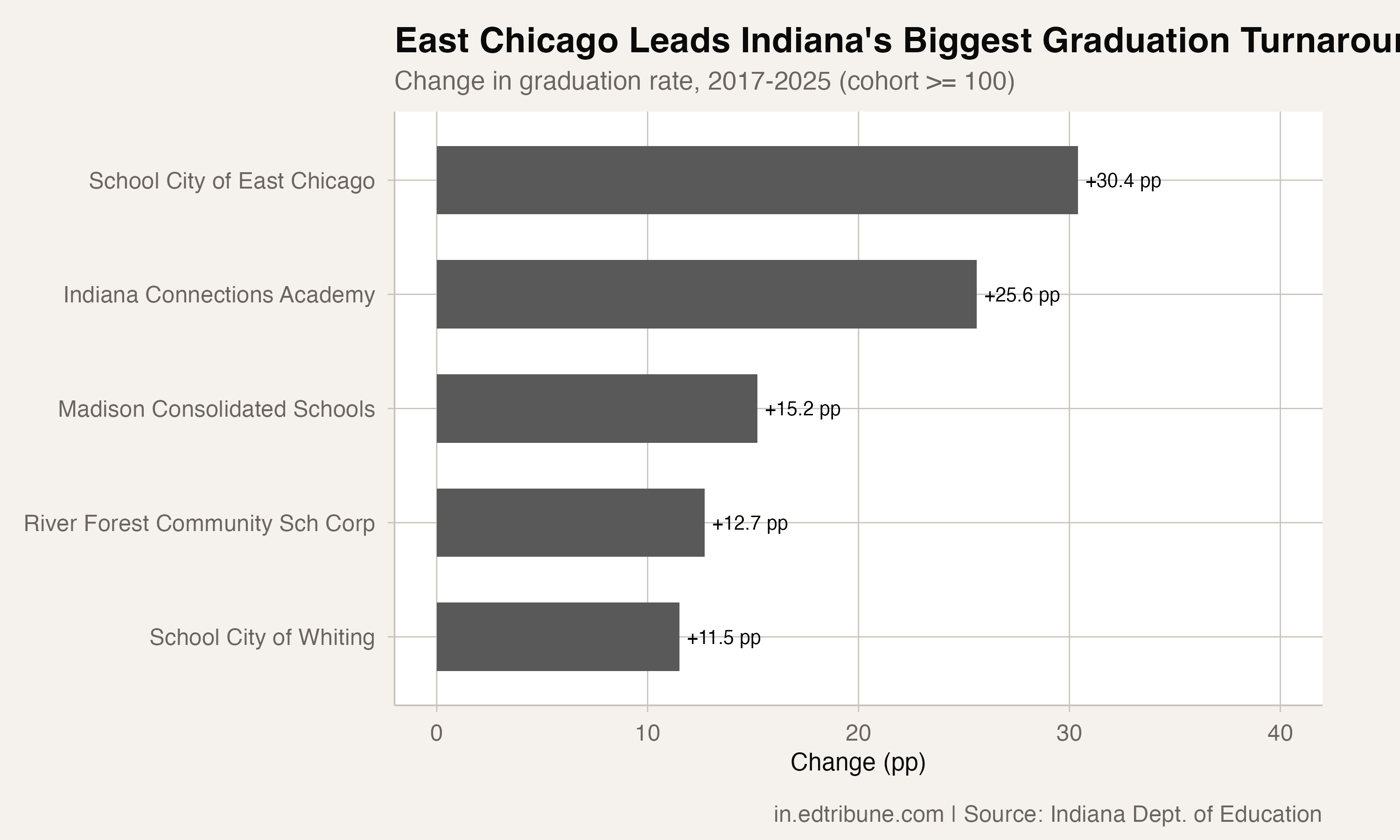
East Chicago's turnaround is part of a broader pattern of improvement among Indiana's struggling districts. Among other notable gains over the same eight years, Muncie added 11.0 points, River Forest, a neighboring Lake County district, added 12.7, and Kokomo added 9.8. East Chicago's improvement was more than double any of theirs.
The cohort is meaningful at roughly 260 students, large enough that the rate cannot be dismissed as a small-sample fluctuation. The district operates one high school, making this a concentrated, school-level turnaround rather than a statistical artifact of aggregation.
The context
East Chicago is a city with large Latino and Black populations in the northwest corner of Indiana, a former steel town with persistent poverty and population loss. The district serves roughly the same kinds of students that Gary Community School Corp serves 10 miles away, yet the two districts' trajectories diverged sharply. Gary's graduation rate fell from 89.6% to 57.8% over the same period, while East Chicago's climbed from 59.6% to 90.0%.
Both districts face similar demographics and economic conditions, yet East Chicago gained about 30 points while Gary lost about 32. The divergence suggests that district-level decisions and conditions matter, even when the surrounding context is similarly challenging.
Eight years ago, East Chicago graduated a smaller share of its seniors than almost any corporation in the state. Now it has cleared 90%. The next cohort will tell us whether this is a new baseline or a peak.
Detailed code that reproduces the analysis and figures in this article is available exclusively to EdTribune subscribers.
Discussion
Sign in to join the discussion.
Loading comments...