The number that kept eluding Indiana finally arrived in 2024, and then it arrived again.
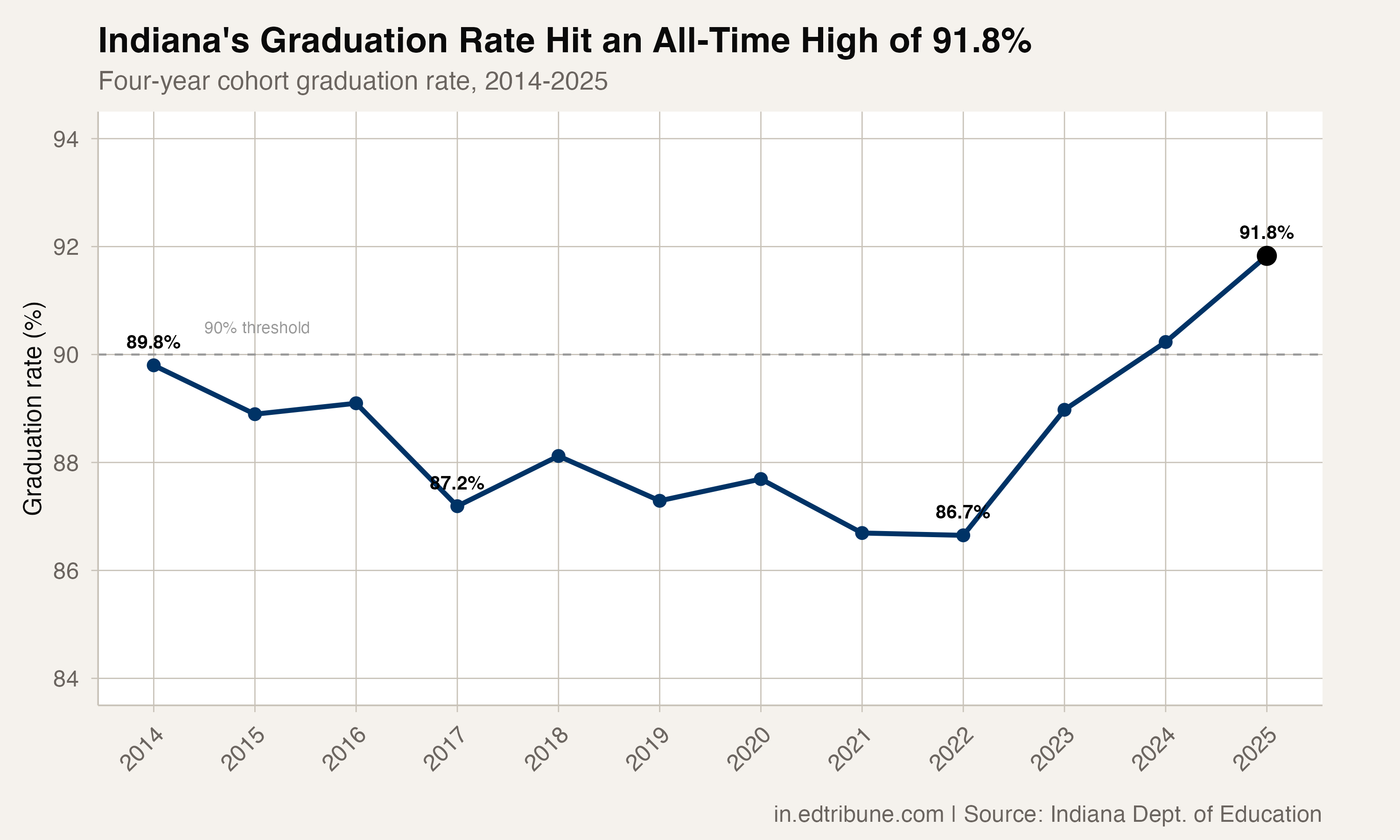
Indiana's four-year cohort graduation rate reached 91.8% in 2025, an all-time high in state records dating to 2014. It was the second straight year above 90%, a threshold the state had never crossed before 2024. And unlike single-year spikes that sometimes vanish with the next cohort, this one came at the end of a three-year improvement streak that added 5.2 percentage points to the rate — the largest sustained gain in IDOE data.
What makes the surge harder to dismiss as statistical noise: the cohort got bigger while the rate climbed. The Class of 2025 had 86,531 students, up from 82,872 two years earlier. Indiana wasn't just graduating a higher share of students; it was graduating a higher share of a larger group.
Three years that rewrote the trend line
For most of the past decade, Indiana's graduation rate wandered a narrow band between 87% and 89%, dipping to a low of 86.6% in 2022. Then something shifted.
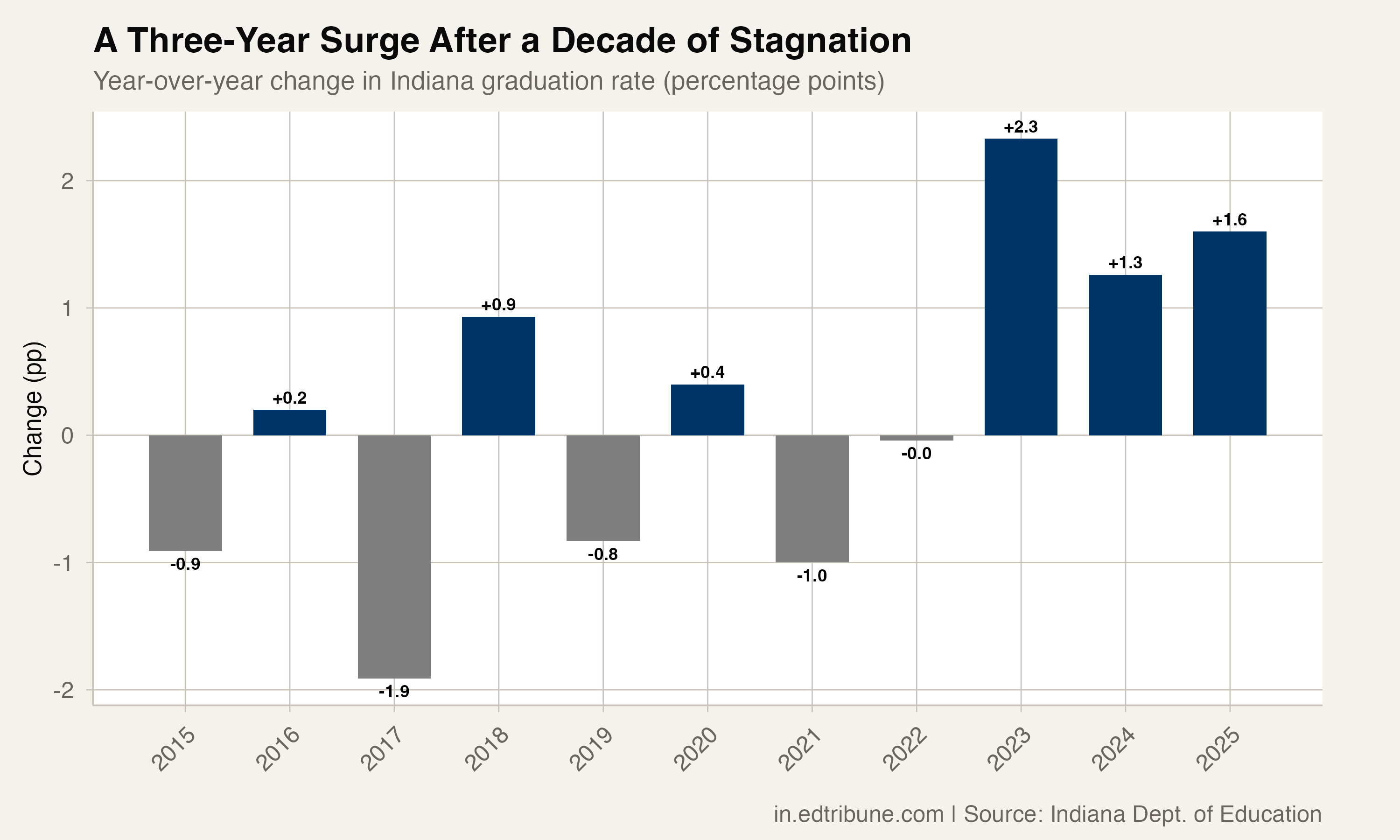
The rate jumped 2.3 percentage points in 2023, then another 1.3 in 2024, then 1.6 more in 2025. Each year's gain would have been notable on its own. Stacked together, they constitute the most rapid improvement since Indiana began publishing cohort graduation rates.
The decade-low in 2022 — 86.6% — coincided with the graduating class most disrupted by pandemic school closures. Those students were sophomores when COVID hit. By 2023, the classes that lost less instructional time began graduating, and the rate started climbing.
But the pandemic explanation only accounts for part of the story. The 2025 rate of 91.8% didn't just recover to pre-COVID levels — it blew past them. Indiana's pre-pandemic rate was 87.3% in 2019.
Beneath the headline: what 91.8% actually looks like
Every major student subgroup posted rates above 85% in 2025.
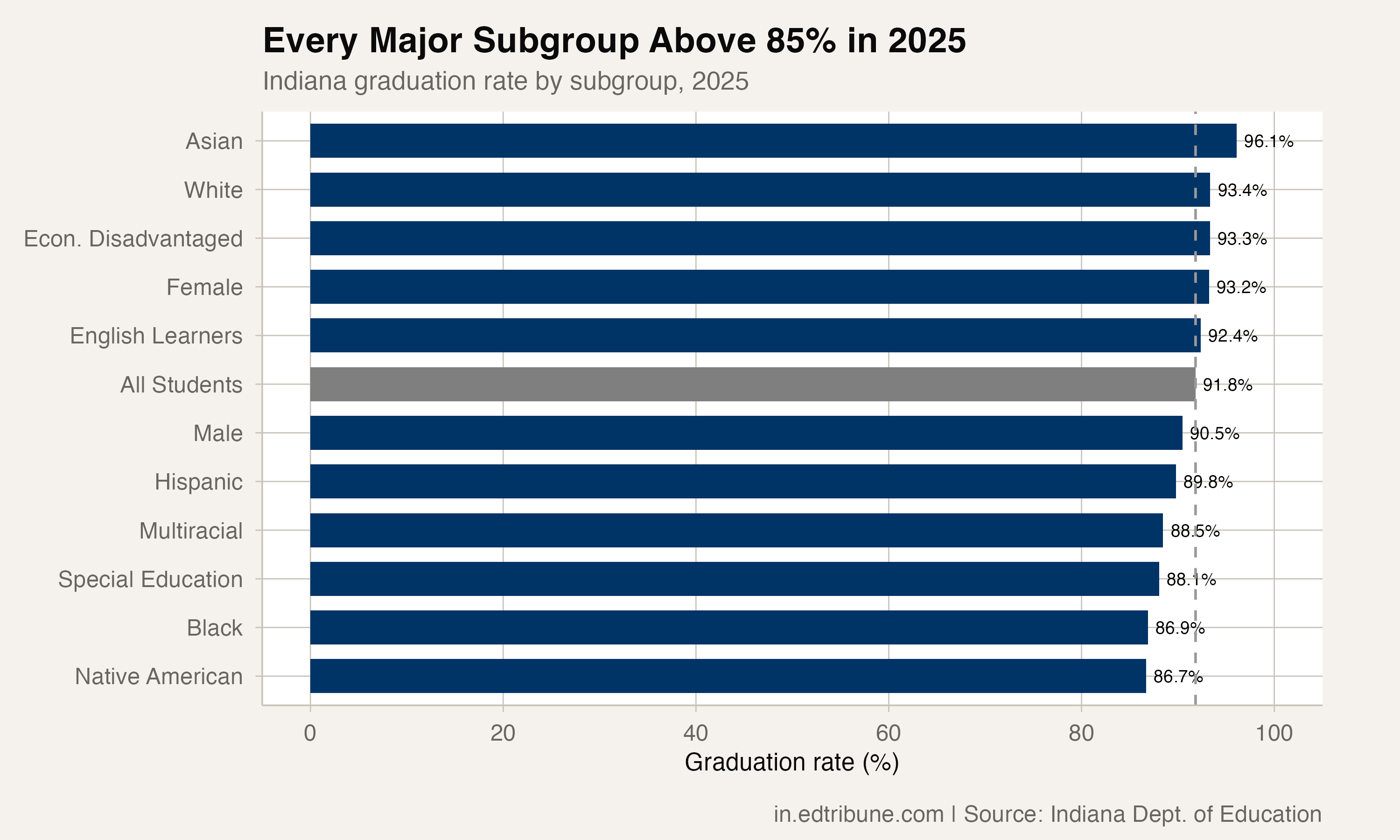
Asian students led at 96.1%. White students graduated at 93.4%. Economically disadvantaged students reached 93.3% — a figure that warrants a caveat, since Indiana's definition of economic disadvantage has broadened in recent years through Community Eligibility Provision adoption.
English learners hit 92.4%, actually surpassing the overall state average. Special education students reached 88.1%, up from 74.9% in 2014. Black students graduated at 86.9%, their highest rate on record, though still 6.5 percentage points behind white peers. Native American students sat at 86.7%, the lowest of any racial group and a rate that has barely moved in a decade.
At the district level, 173 of Indiana's school corporations with cohorts of 50 or more graduated at least 95% of their students. One hundred corporations hit their all-time high. Twenty-four posted a perfect 100%.
Only 26 corporations with meaningful cohort sizes fell below 80%.
The asterisk worth noting
Indiana publishes two graduation rates: a state rate that counts waiver diplomas, and a federal rate that does not. The gap between them has been widening — from 0.7 percentage points in 2020 to 1.9 in 2025. That means roughly 1,600 members of the 2025 cohort earned their diplomas through waivers rather than meeting all postsecondary readiness requirements.
Even the stricter federal rate hit 90% for the first time in 2025 — landing at 90.0%. The record is real by either measure. But the widening waiver gap suggests that an increasing share of Indiana's graduation gains are coming through alternative pathways rather than students meeting the full set of graduation requirements.
More Indiana students are finishing high school than at any point in modern records, across every demographic group, in a cohort that is growing rather than shrinking. The state that spent a decade stuck between 87% and 89% broke through to 91.8%, and it did so while adding 4,000 students to the cohort. Whether the next graduating class sustains the surge or reverts to the old plateau will say a lot about whether 90% is Indiana's new floor or its ceiling.
Detailed code that reproduces the analysis and figures in this article is available exclusively to EdTribune subscribers.
Discussion
Sign in to join the discussion.
Loading comments...