At McKinley Elementary School in South Bend, 292 of the 294 enrolled students were chronically absent in the 2024-25 school year. A rate of 99.3%. Functionally, regular attendance at McKinley is the exception — two students out of nearly 300.
McKinley is an extreme, but it is not a statistical fluke in a district where the overall chronic absenteeism rate is 40.3%. South Bend Community School Corporation↗ET has the highest rate among traditional Indiana corporations enrolling at least 10,000 students. Some smaller or specialized systems are higher, including Gary, but South Bend leads the large-district group. Two in five of South Bend's 14,441 students missed 10% or more of the school year.
A problem that predates the pandemic
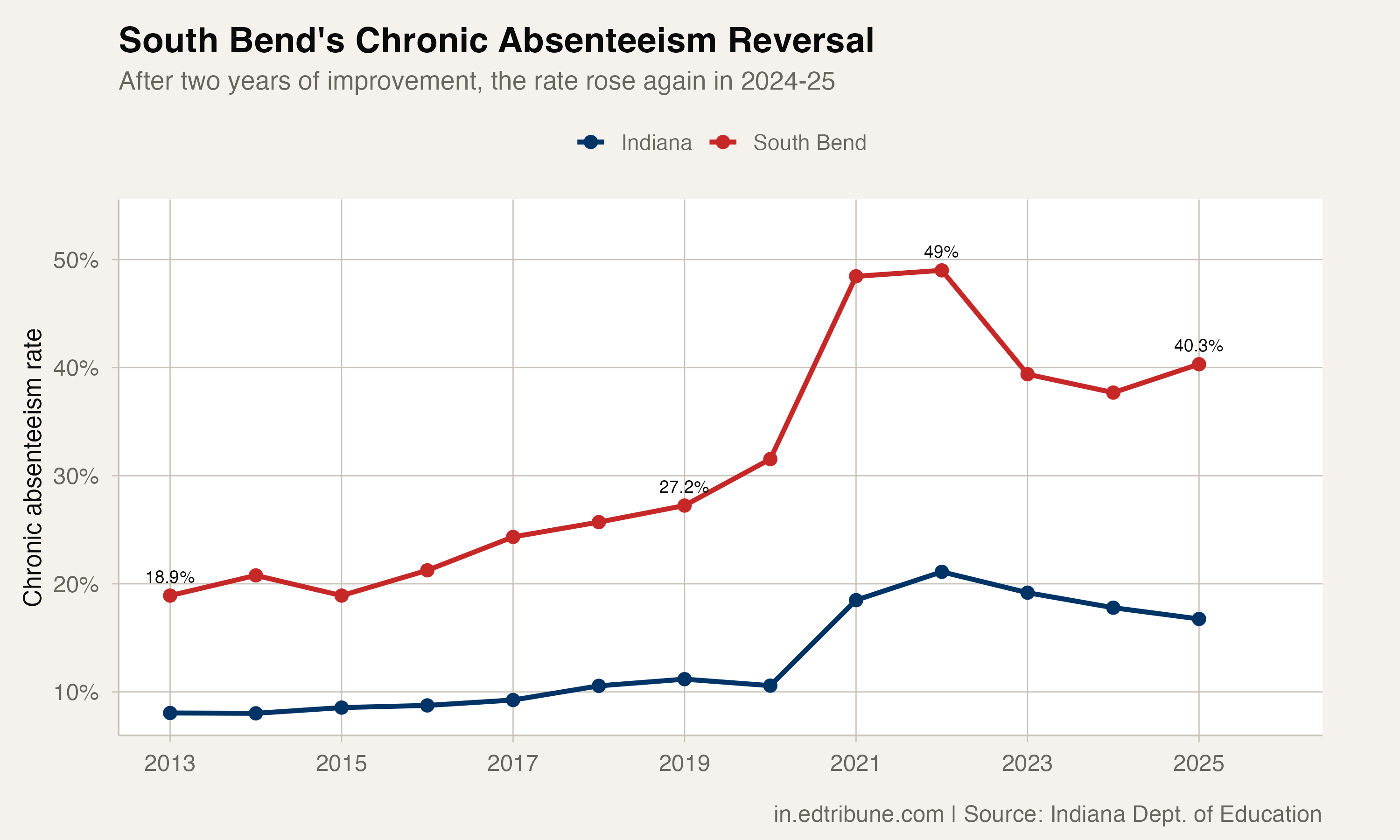
South Bend's chronic absenteeism was already elevated before COVID. In 2013, the rate was 18.9% — higher than the statewide figure of 8.1% but within a range that many urban districts considered manageable. By 2019, it had climbed to 27.2%, a steady deterioration of roughly 1.4 points per year for six years.
COVID then pushed the rate to 48.5% in 2021 and 49.0% in 2022. At the peak, nearly half the student body was chronically absent. The district improved to 39.4% in 2023 and 37.7% in 2024, but 2025 brought a reversal — the rate ticked back up to 40.3%, erasing most of the prior year's gains.
That reversal is concerning. Districts that improve for two or three consecutive years after a crisis peak sometimes hit a floor and stall. South Bend's 2025 increase suggests the floor may not even be stable. The district recovered to 40.3% from a peak of 49.0% — a 39.9% recovery of the gap from its 2019 rate. By comparison, Indiana as a whole has recovered 43.9%.
The school-level picture
The distribution across South Bend's schools is wide. McKinley's 99.3% is the most extreme, but it is not alone at the top.
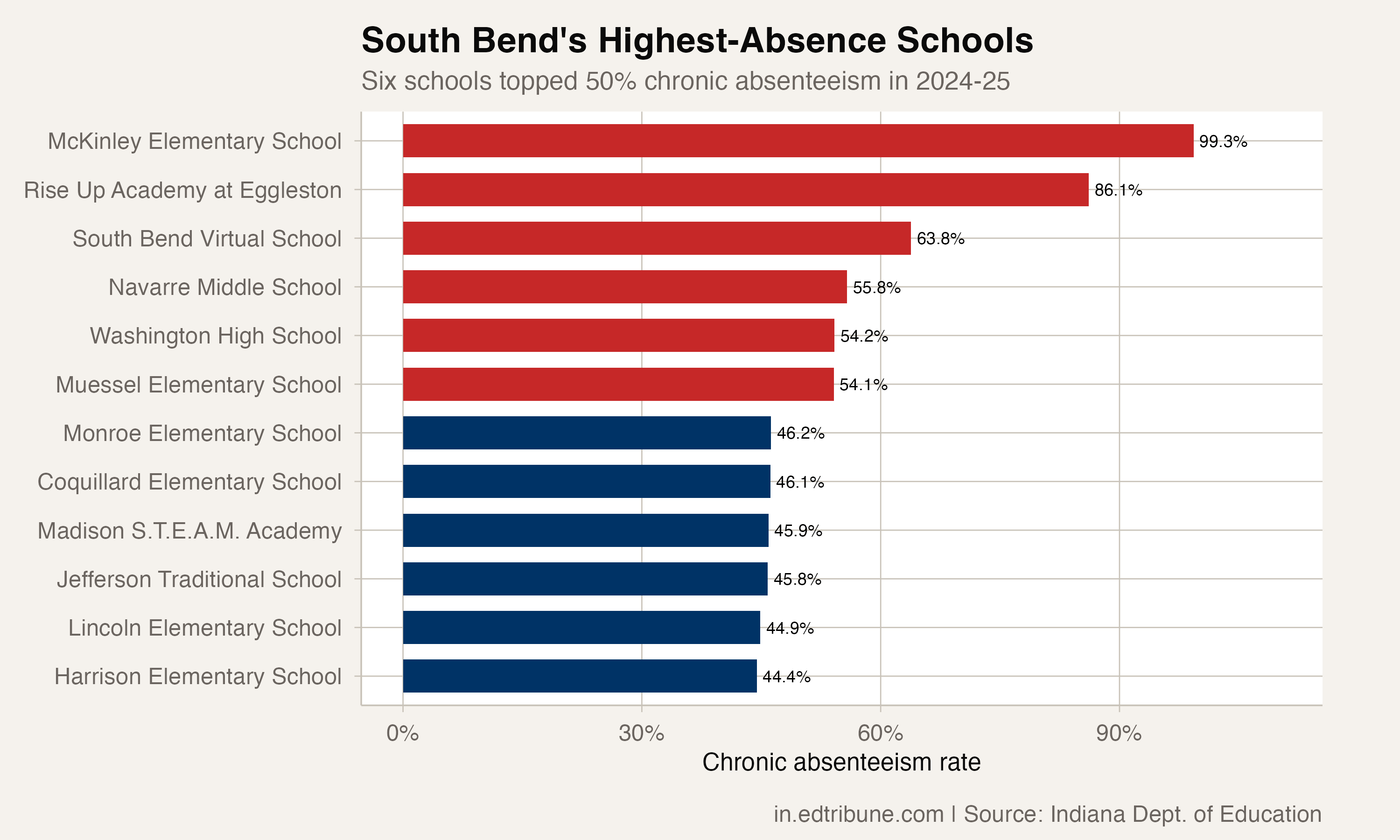
Six schools exceed 50% chronic absence. The pattern is not limited to one grade level or one type of school. Elementary, middle, and high schools all appear among the worst performers. When chronic absenteeism is this pervasive across a system, it points beyond a single building.
Enrollment and absence moving in the same direction
South Bend has lost 5,393 students since 2013, a 27.2% decline from 19,834 to 14,441. The district is both shrinking and experiencing worsening attendance among the students who remain.
This creates a compounding problem for the district. Falling enrollment reduces the number of students over which fixed costs can be spread. Rising absence means the students who remain are missing more school. The data can show those two pressures moving together; it cannot prove why individual families leave or why individual students miss class.
South Bend's enrollment trajectory and attendance trajectory are parallel deteriorations. In 2013, the district had 19,834 students and a chronic rate of 18.9% (3,751 chronically absent). In 2025, it has 14,441 students and a rate of 40.3% (5,822 chronically absent). The total number of chronically absent students actually grew by 2,071 even as the district lost more than 5,000 students. The district got smaller and sicker at the same time.
5,822 students
Each of South Bend's 5,822 chronically absent students missed at least 18 school days in 2025. That is nearly a month of instruction per student, accumulated across an academic year.
For South Bend, 5,822 is 40.3% of enrollment. Two in five students. In a district of 14,441, that means 5,822 students missed a combined 105,000 or more school days in a single year. The pre-COVID trend was upward. The post-COVID trend was briefly downward. The latest data point turned upward again. South Bend has not found its floor.
Detailed code that reproduces the analysis and figures in this article is available exclusively to EdTribune subscribers.
Discussion
Sign in to join the discussion.
Loading comments...