Correction (2026-05-21): An earlier version of this article misstated Fort Wayne Community Schools' chronic absenteeism figures. The 2025 rate is 20.2% (not 17.5%), the 2022 peak was 24.4% (not 24.1%), the enrollment count from the absence data is 29,993 (not 29,619), and the 2019 pre-COVID baseline was 14.1% (not 9.8%). These figures have been corrected.
Indiana's statewide chronic absenteeism rate has improved for three consecutive years. At 16.75%, it is 4.36 percentage points below the 2022 peak. Read the state-level trend and the picture looks like a system healing.
Read the corporation-level data and the picture fractures. Of the 385 school corporations with data for both the pre-COVID era and 2025, only 60 (15.6%) have returned to their pre-pandemic chronic absenteeism rate. The other 325 remain above their baseline, some substantially so.
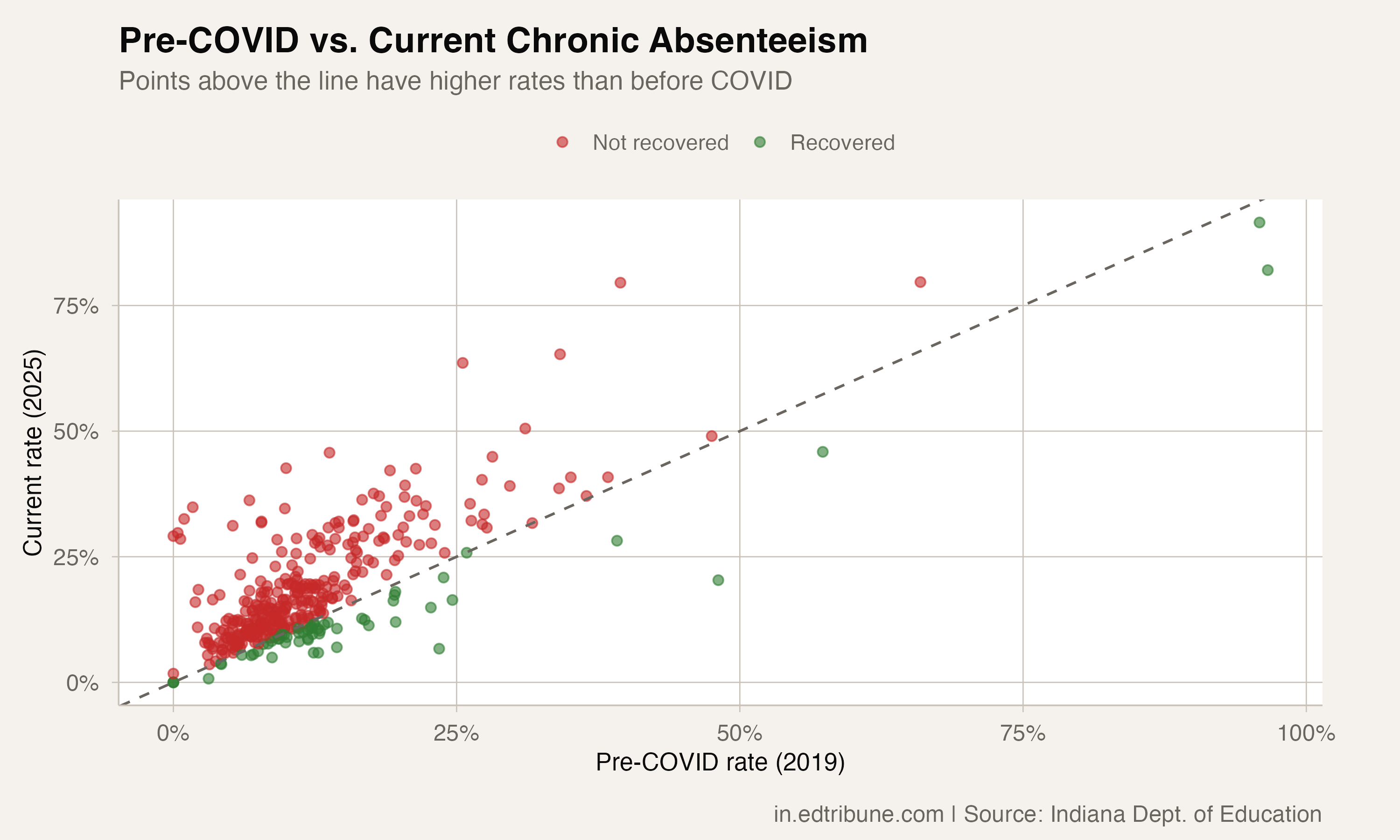
The scatter plot tells the story
Each dot in the chart above represents a school corporation. Those below the diagonal line have recovered to pre-COVID levels. Those above it have not. The overwhelming majority sit above the line, meaning their 2025 chronic absenteeism rate exceeds their 2019 rate.
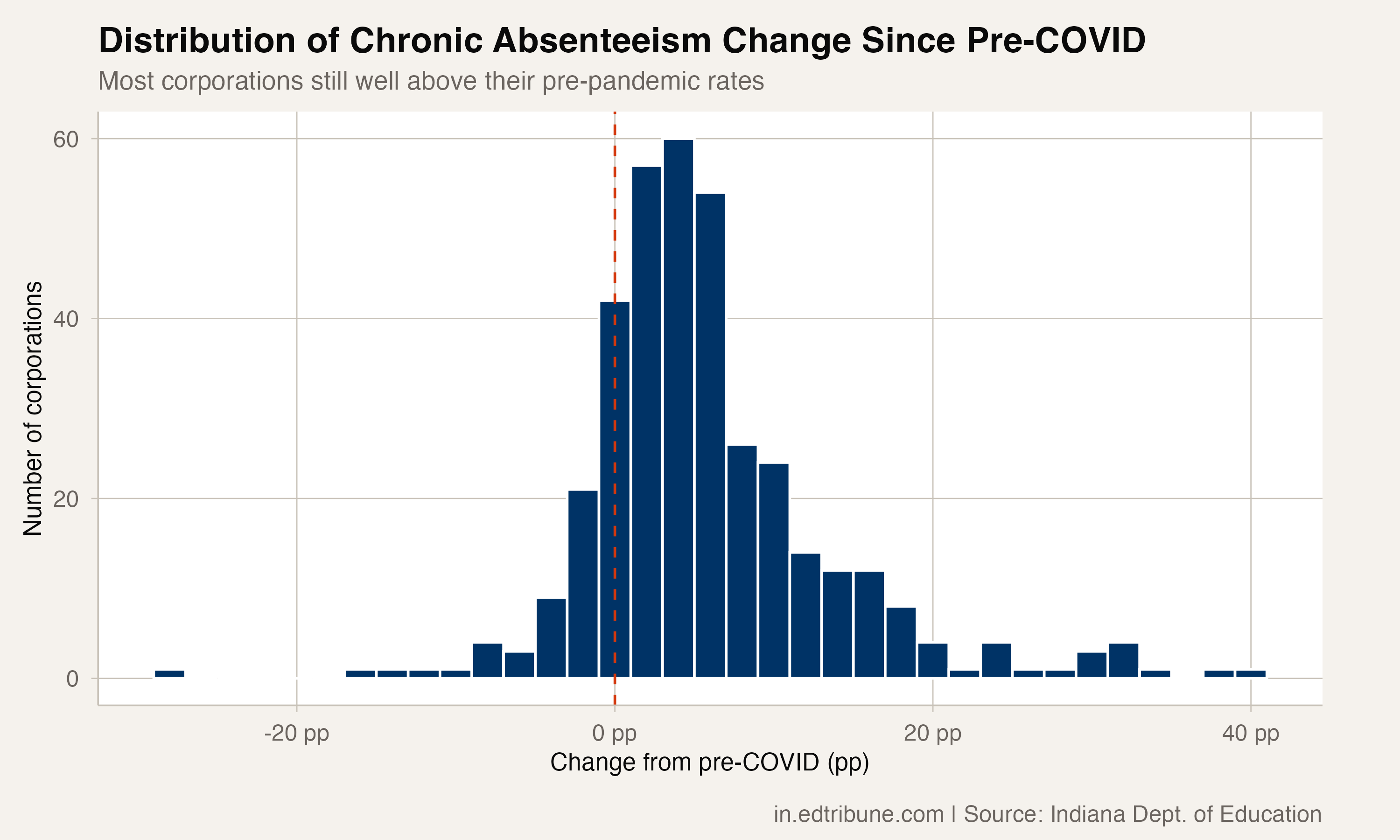
The distribution of change is not symmetric. Most corporations cluster between 2 and 12 percentage points above their pre-COVID baseline. A handful have improved dramatically; a few small corporations managed to cut their rates well below pre-pandemic levels. But those outliers do not represent the typical experience. The median corporation is still 4.8 percentage points worse than it was before COVID disrupted school routines.
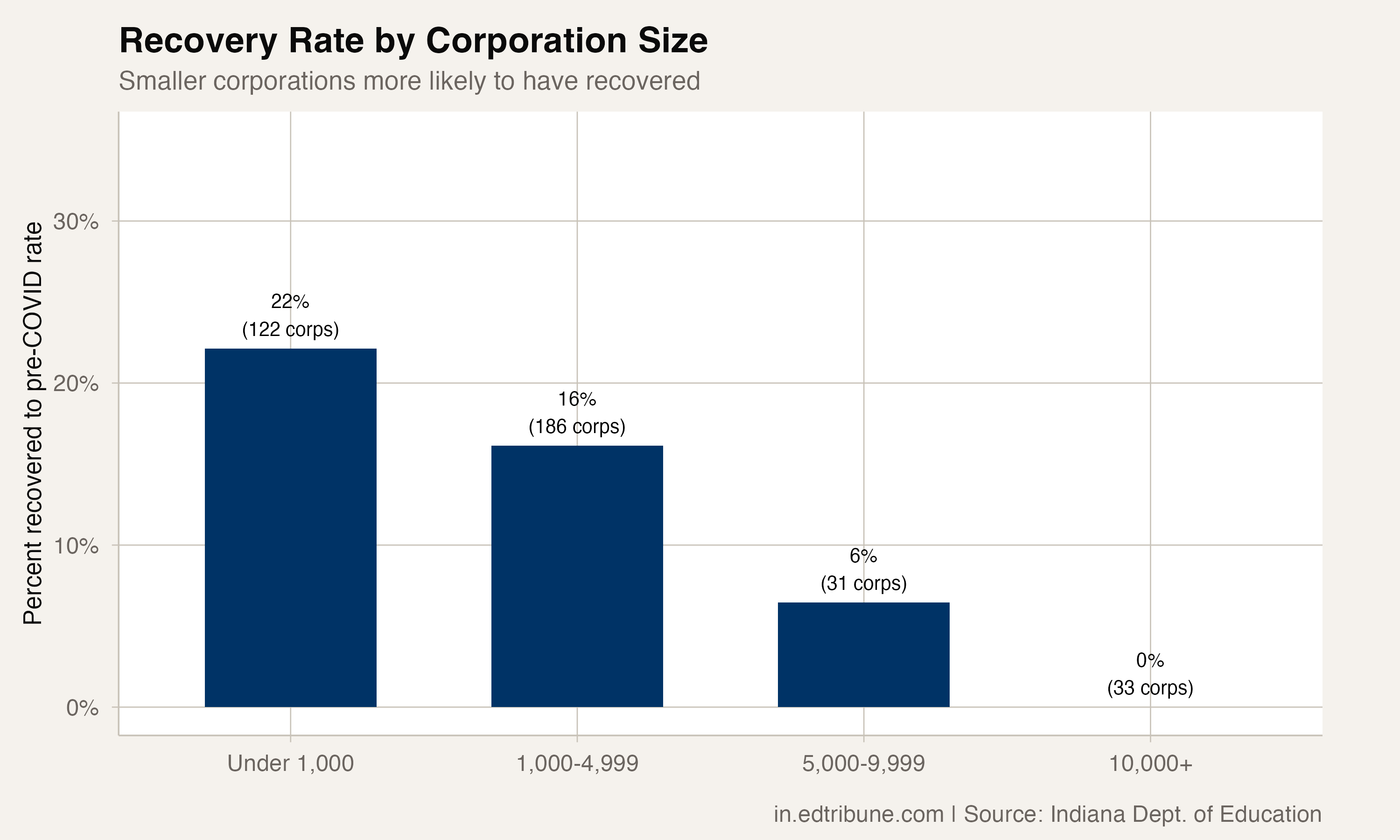
Size works against recovery
Larger corporations are less likely to have recovered. Among corporations enrolling 10,000 or more students, the recovery rate drops further. This is not surprising. Larger systems have more institutional inertia, more diverse student populations with varying barriers, and more neighborhoods where post-pandemic attendance norms took hold.
Fort Wayne Community Schools↗ET, the state's largest traditional corporation with 29,993 students enrolled, has improved from its 2022 peak of 24.4% but still sits at 20.2%, well above its 2019 pre-COVID rate of 14.1%. Indianapolis Public Schools↗ET sits at 32.2%, up from 26.3% in 2019. Evansville Vanderburgh↗ET, at 21.5%, was below 6% before COVID.
The corporations that have recovered tend to be smaller, suburban, or both. They were more likely to have had low pre-COVID rates to begin with, and the pandemic's disruption, while painful, did not fundamentally alter attendance culture in their communities.
Two different Indianas
The non-recovery pattern creates a two-tier system. In one tier, school corporations operate much as they did before 2020: chronic absenteeism in single digits, predictable student attendance, teachers able to plan around a full classroom. In the other, chronic rates of 20% or higher mean that on any given day, one in five students may not be there.
The 325 non-recovered corporations enroll the vast majority of Indiana's students. The 60 recovered ones tend to be smaller. The state's improving average masks this structural divide. The aggregate number moves because the largest systems improved slightly, not because most systems returned to normal.
Indiana's two new attendance intervention laws, SB 282 and SEA 482, apply the same intervention thresholds statewide. For a corporation at 7% chronic absenteeism, the five-missed-days trigger captures a small number of students with acute issues. For a corporation at 30%, the same trigger applies to a structural problem that five-day interventions were not designed to solve.
Five years after COVID first emptied Indiana's classrooms, the attendance damage remains embedded in five of every six school corporations. The state rate continues to improve. The base rate in most communities does not.
Detailed code that reproduces the analysis and figures in this article is available exclusively to EdTribune subscribers.
Discussion
Sign in to join the discussion.
Loading comments...