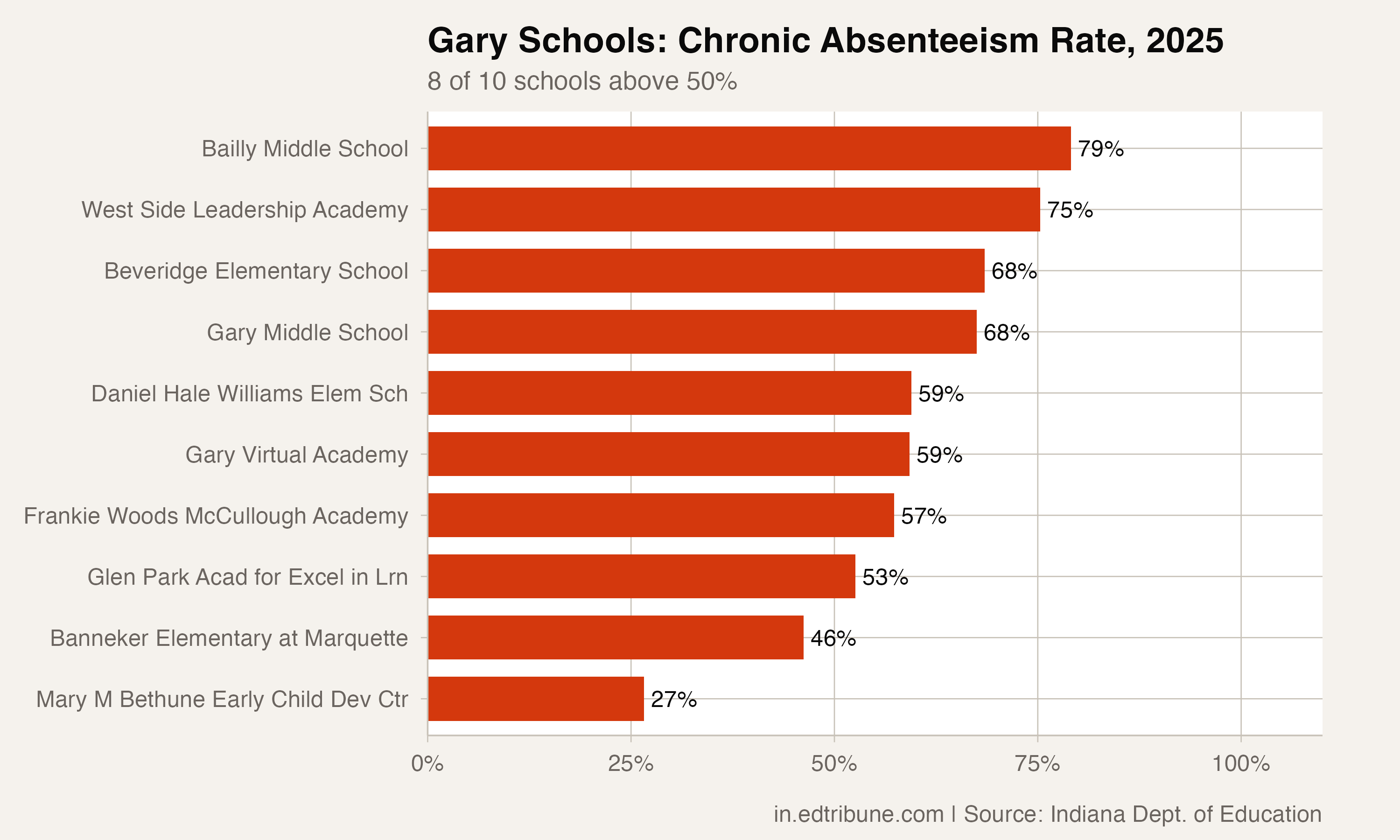
Correction (2026-05-21): An earlier version of this article stated that every Gary school with at least 50 enrolled students had a chronic absenteeism rate above 50%. Two schools did not: Banneker Elementary at Marquette (46.2%) and Mary M. Bethune Early Child Development Center (26.6%). The article has been corrected to reflect this accurately.
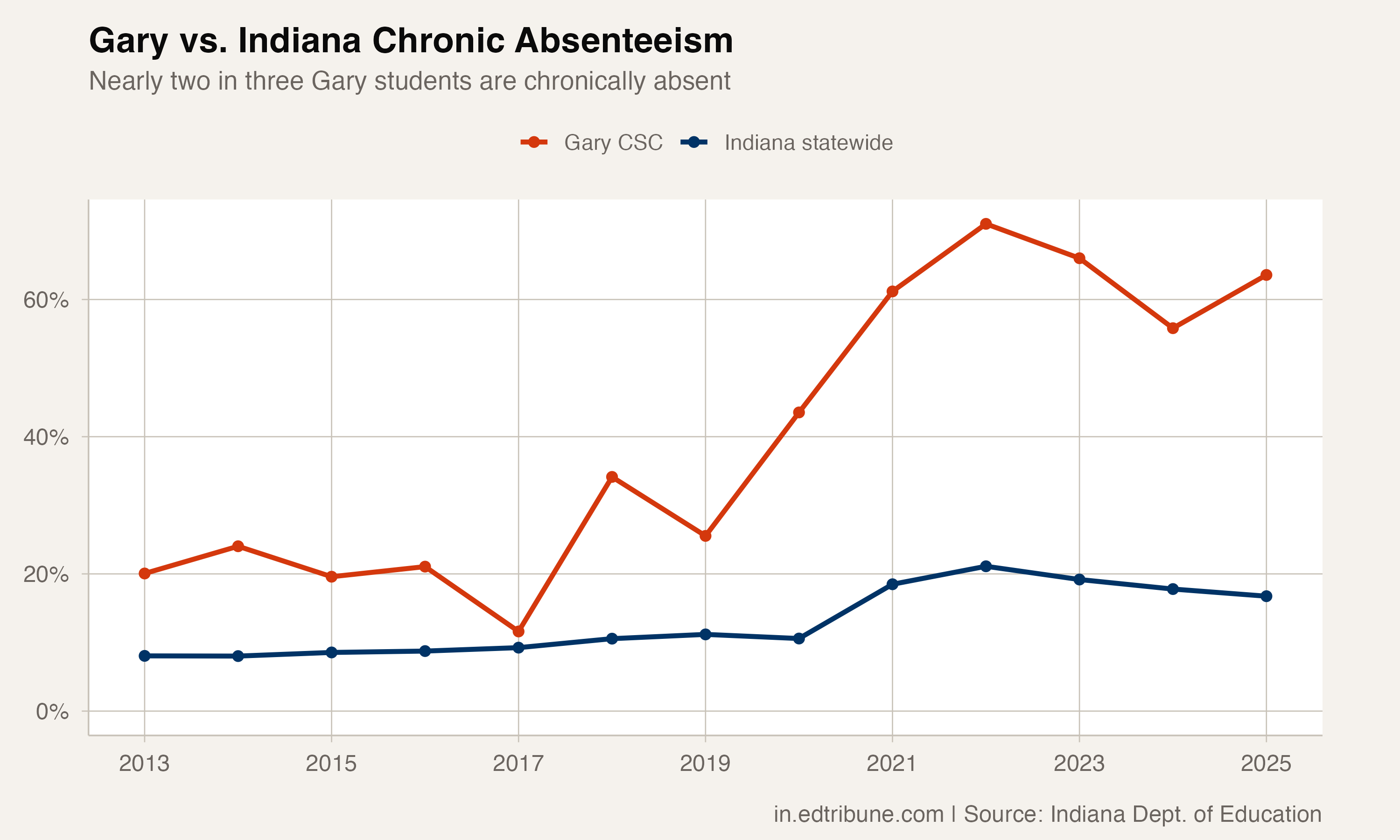
At Bailly Middle School in Gary, 79.1% of the 445 enrolled students were chronically absent in the 2024-25 school year. At West Side Leadership Academy, the city's main high school, the rate was 75.3% among 1,369 students. Across all of Gary Community School Corporation↗ET, 3,214 of 5,055 students (63.6%) missed 10% or more of the school year.
That is the highest chronic absenteeism rate among Indiana's traditional K-12 school corporations, and it is not close. The next-highest large district, South Bend, is 23 percentage points lower.
A city losing students and attendance simultaneously
Gary's chronic absenteeism rate was 20.1% in 2013. It has more than tripled. Over that same period, the district's enrollment fell from 9,446 to 5,055, a 46.5% decline. The district is losing students to departure and losing the ones who remain to absence.
The trajectory has not been linear. Gary's rate dropped to 11.6% in 2017, a year that coincided with the beginning of state oversight. But by 2018 it had spiked to 34.1%, suggesting the 2017 figure may have reflected a reporting change during the transition rather than a genuine improvement. Since 2020, the rate has not fallen below 43.5%.
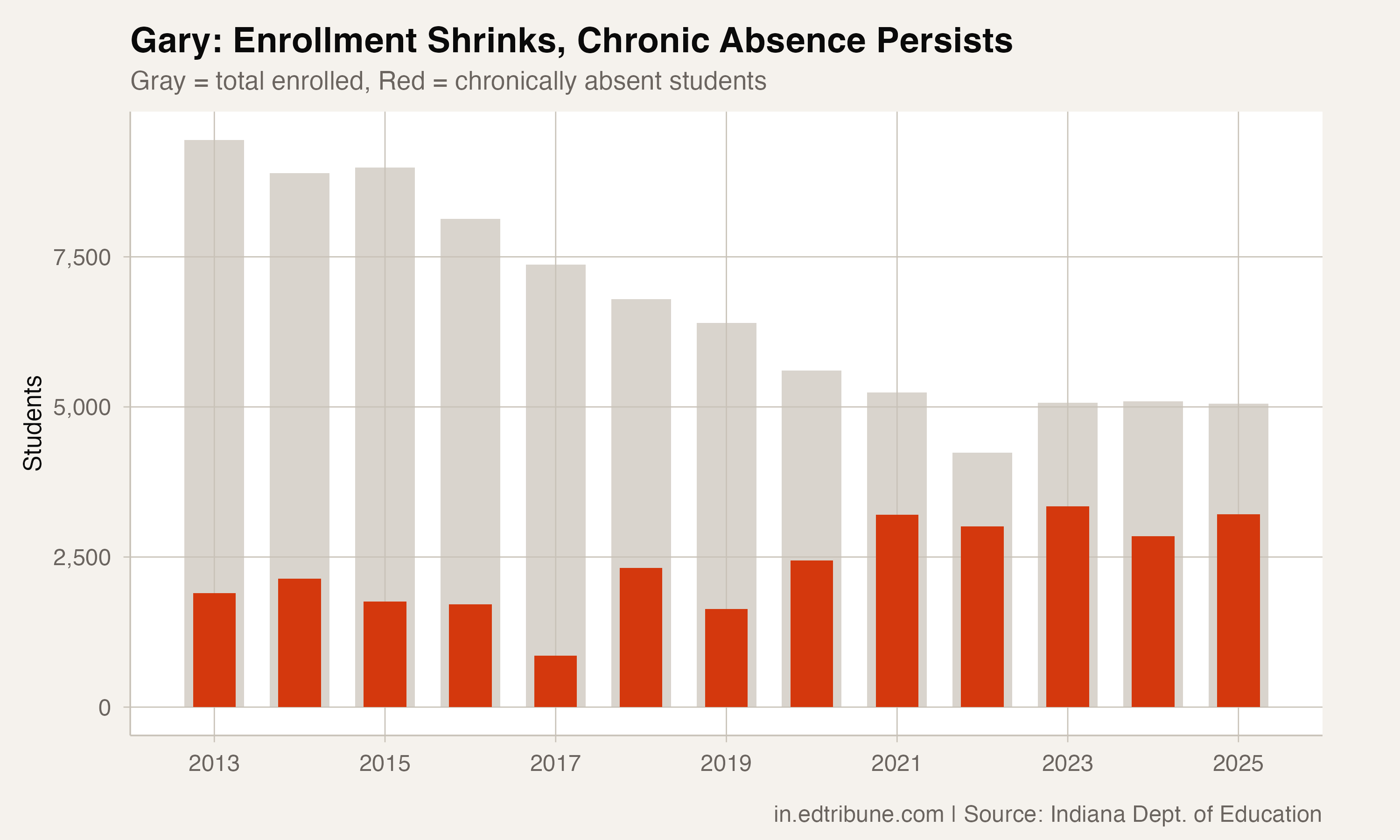
The COVID years broke what remained of Gary's attendance norms. The rate hit 61.2% in 2021 and peaked at 71.0% in 2022, when nearly three in four students were chronically absent. It fell to 55.8% in 2024 before rebounding to 63.6% in 2025, erasing most of that year's progress.
A building-by-building breakdown
In 2025, 8 of the 10 Gary Community School Corporation schools with at least 50 enrolled students had chronic absenteeism rates above 50%. Bailly Middle School's 79.1% means that fewer than one in five students attended school regularly. Beveridge Elementary recorded 68.5%. Daniel Hale Williams Elementary, named for the pioneering Black surgeon who founded Provident Hospital in Chicago, posted 59.5%. Two Gary schools fell below the 50% threshold: Banneker Elementary at Marquette (383 students, 46.2%) and Mary M. Bethune Early Child Development Center (154 students, 26.6%).
These are not abstractions. A student who is chronically absent misses at least 18 school days per year, nearly a full month of instruction. At Bailly, where four in five students cross that threshold, the building is functionally operating without most of its student body on any given day. Teachers prepare lessons for classrooms where the majority of seats may be empty. Cumulative learning loss compounds year after year.
State intervention and persistent barriers
Gary Community School Corporation has been under state oversight and emergency management for years. The district's superintendent has publicly cited students experiencing homelessness, bullying, chronic illness, and transportation as root causes. Gary is a city of roughly 70,000 people, down from a peak of 178,000 in 1960, with a poverty rate above 30% and limited public transit options.
Indiana's new attendance intervention laws, SB 282 requiring K-5 intervention at five missed days and SEA 482 extending requirements to grades 7-12, apply to Gary as they do everywhere in Indiana. But a district where nearly two-thirds of students are already chronically absent faces a fundamentally different challenge than one where the rate is 15%. The intervention thresholds designed for statewide application may be inadequate for a community where missing school is closer to the norm than the exception.
Gary's 5,055 students represent less than 0.5% of Indiana's total enrollment. Its 3,214 chronically absent students represent 1.6% of the state total. The disproportionate burden falls on one of Indiana's poorest communities, in a city that has been losing population for six decades. The U.S. Steel plant that built Gary employed 30,000 workers at its peak. The school district that educated their children and grandchildren now watches two in three of its 5,055 remaining students miss too much school.
Detailed code that reproduces the analysis and figures in this article is available exclusively to EdTribune subscribers.
Discussion
Sign in to join the discussion.
Loading comments...