Indiana published two graduation rates in 2025. By one measure, the state hit 91.8%, a record. By the other, 90.0%, also a record.
Both are at their highest-ever levels. But the gap between them (1.9 percentage points) is also a record, and it has been growing every year.
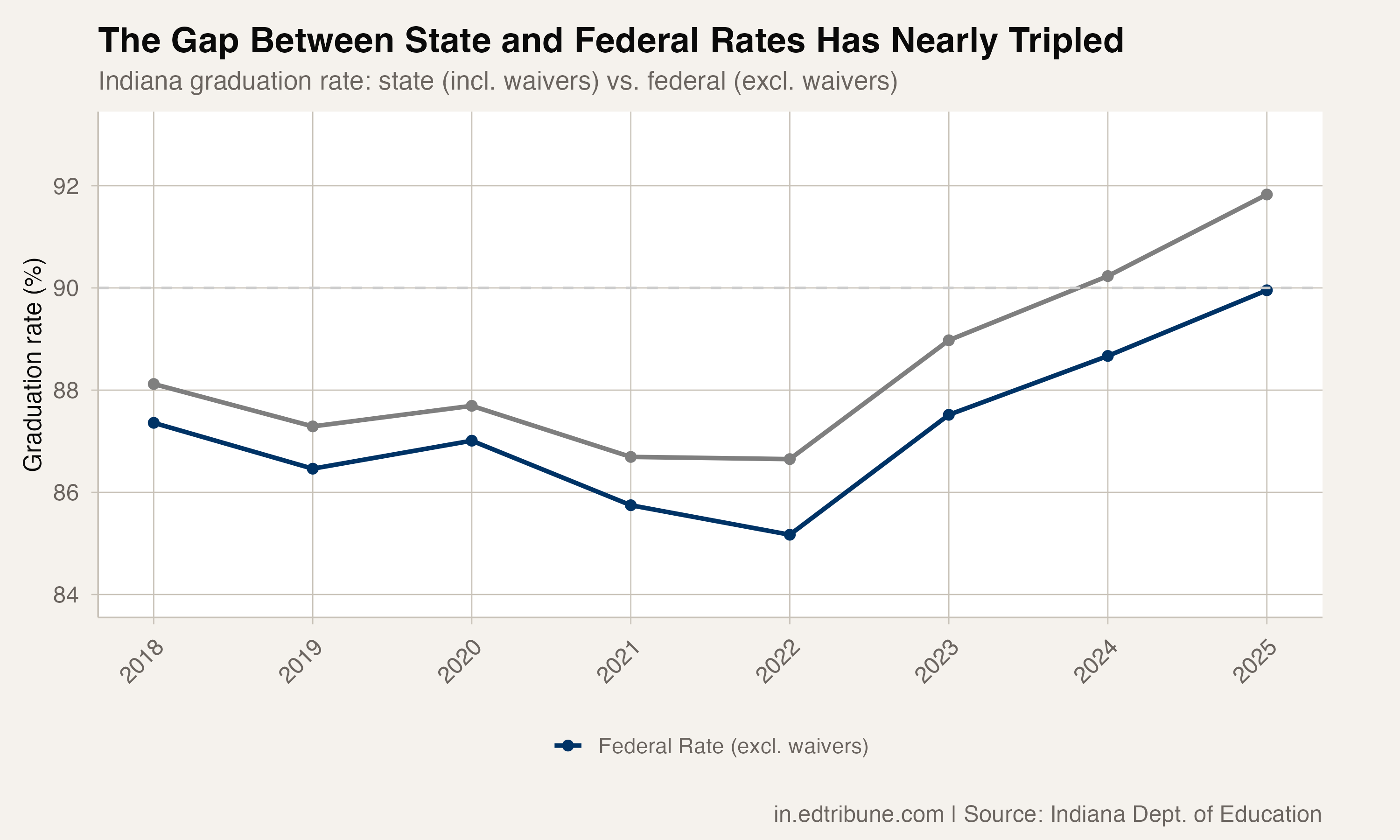
The state rate includes students who earned diplomas through waivers, alternatives to the standard Graduation Qualifying Exam or Core 40 requirements. The federal four-year cohort graduation rate, required under the Every Student Succeeds Act, excludes them. In 2020, the gap between the two was 0.7 percentage points. By 2025, it had nearly tripled.
What the gap means in students
Applied to the 2025 cohort of 86,531 students, the 1.9 percentage point gap translates to roughly 1,644 graduates who completed high school via waivers rather than meeting all postsecondary readiness requirements. These students count in the state's headline number but not in the federal calculation.
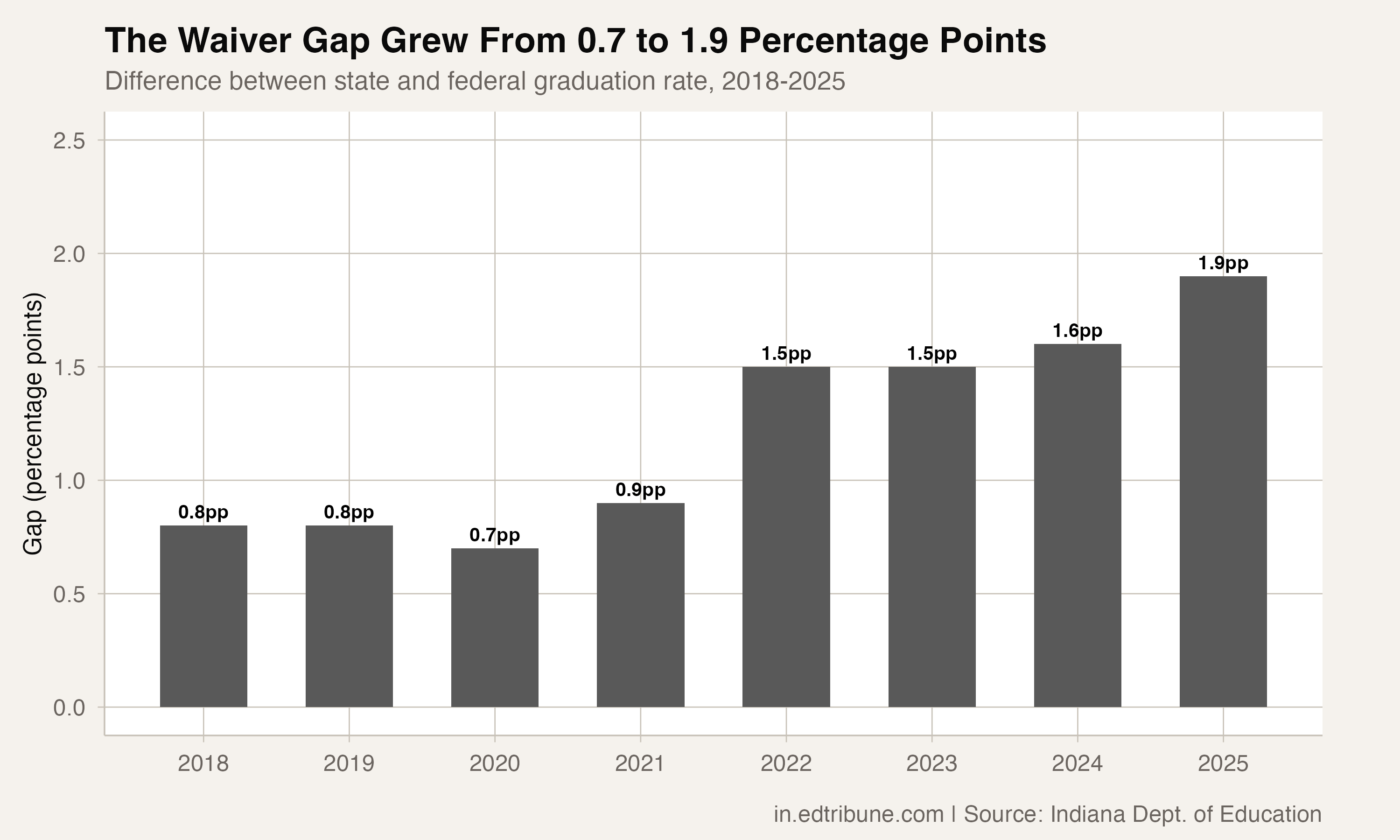
The number is not large relative to the full cohort (roughly 1 in 53 graduates). But its growth trajectory matters. In 2020, the equivalent figure was roughly 600 students. In five years, the waiver population nearly tripled while the overall cohort grew by only 2,255.
Who uses waivers
The waiver gap is not evenly distributed across student groups.
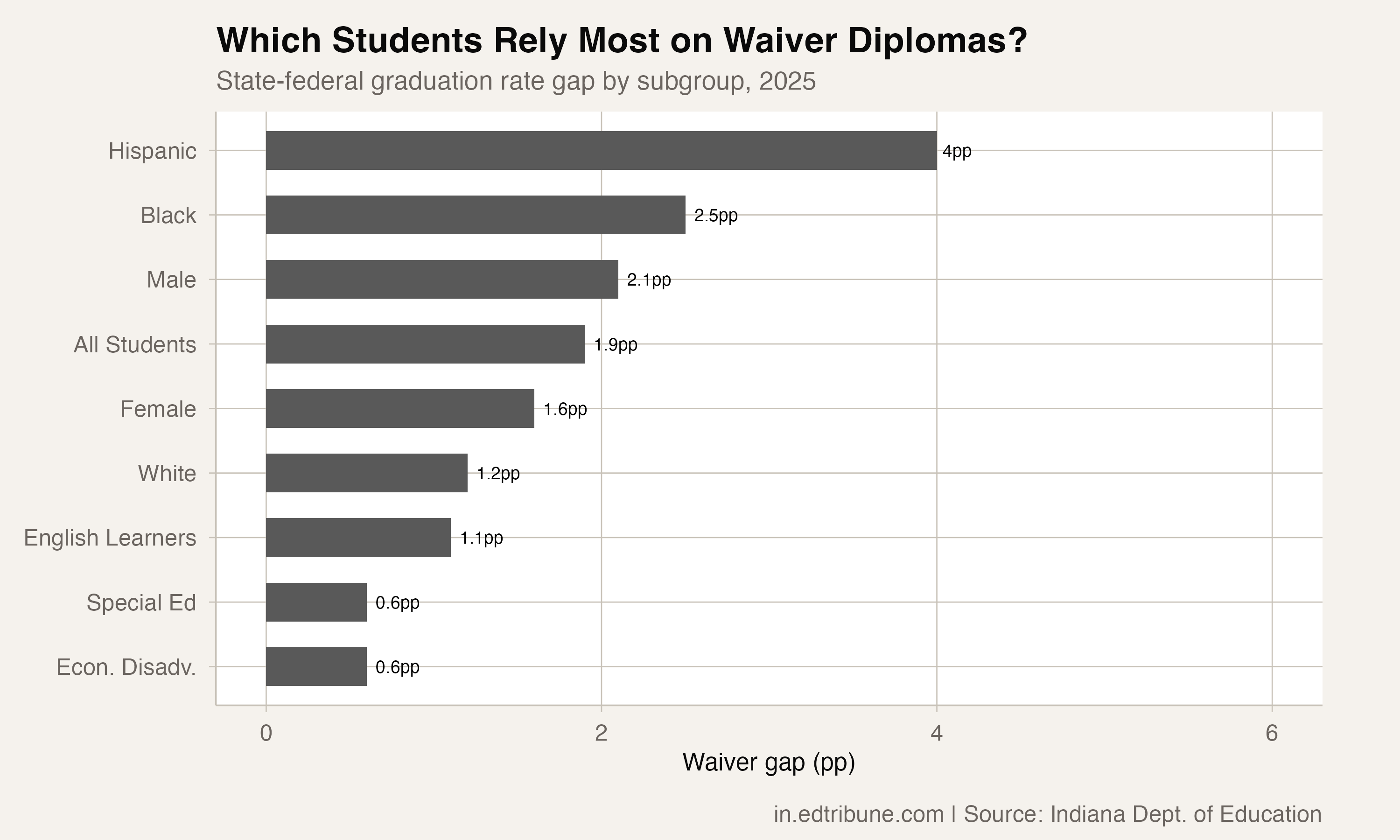
Hispanic students had the widest state-federal rate gap in 2025 at 4.0 percentage points, meaning roughly one in 25 Hispanic graduates earned a waiver diploma. Pacific Islander students followed at 3.0 points. Multiracial students were at 2.7 points. Black students, whose graduation rate has been surging, had a gap of 2.5 points.
White students, by contrast, had a gap of 1.2 points. Asian students were at 0.6. Special education students, despite being the subgroup with the largest overall improvement, had one of the smaller waiver gaps at 0.6 points, suggesting their gains were largely achieved through standard pathways.
The pattern suggests that waiver pathways are disproportionately used by students of color and may account for a meaningful share of the racial gap closure in the headline rate. The federal rate for Black students (84.4%, versus the state rate of 86.9%) is still substantially improved from historical levels, but 2.5 of the 7.4 percentage point gain since 2014 may reflect waivers rather than meeting full graduation requirements.
Both rates are at record highs
It would be a mistake to read the waiver gap as evidence that Indiana's improvement is hollow. The federal rate (the stricter measure) is also at a record high. Even by the toughest standard available in the public data, Indiana is graduating a larger share of students than ever before.
The question is one of composition, not validity. As the state graduation rate climbs higher, what share of additional graduates are completing the same requirements that were expected a decade ago, and what share are completing through alternative pathways? The widening waiver gap suggests the latter group is growing faster.
The new diploma on the horizon
Indiana is overhauling its diploma requirements starting with the Class of 2029. The new Indiana Diploma replaces the current Core 40, Academic Honors, and Technical Honors pathways with a simplified structure centered on readiness seals. Whether the new system narrows or widens the state-federal gap will depend on how it handles alternative completion pathways.
For the current graduating classes, the waiver gap is worth noting alongside the headline rate. Not as a contradiction, but as context. Indiana's 91.8% is real. So is the fact that an increasing share of that number comes through pathways that the federal government does not count.
Detailed code that reproduces the analysis and figures in this article is available exclusively to EdTribune subscribers.
Discussion
Sign in to join the discussion.
Loading comments...