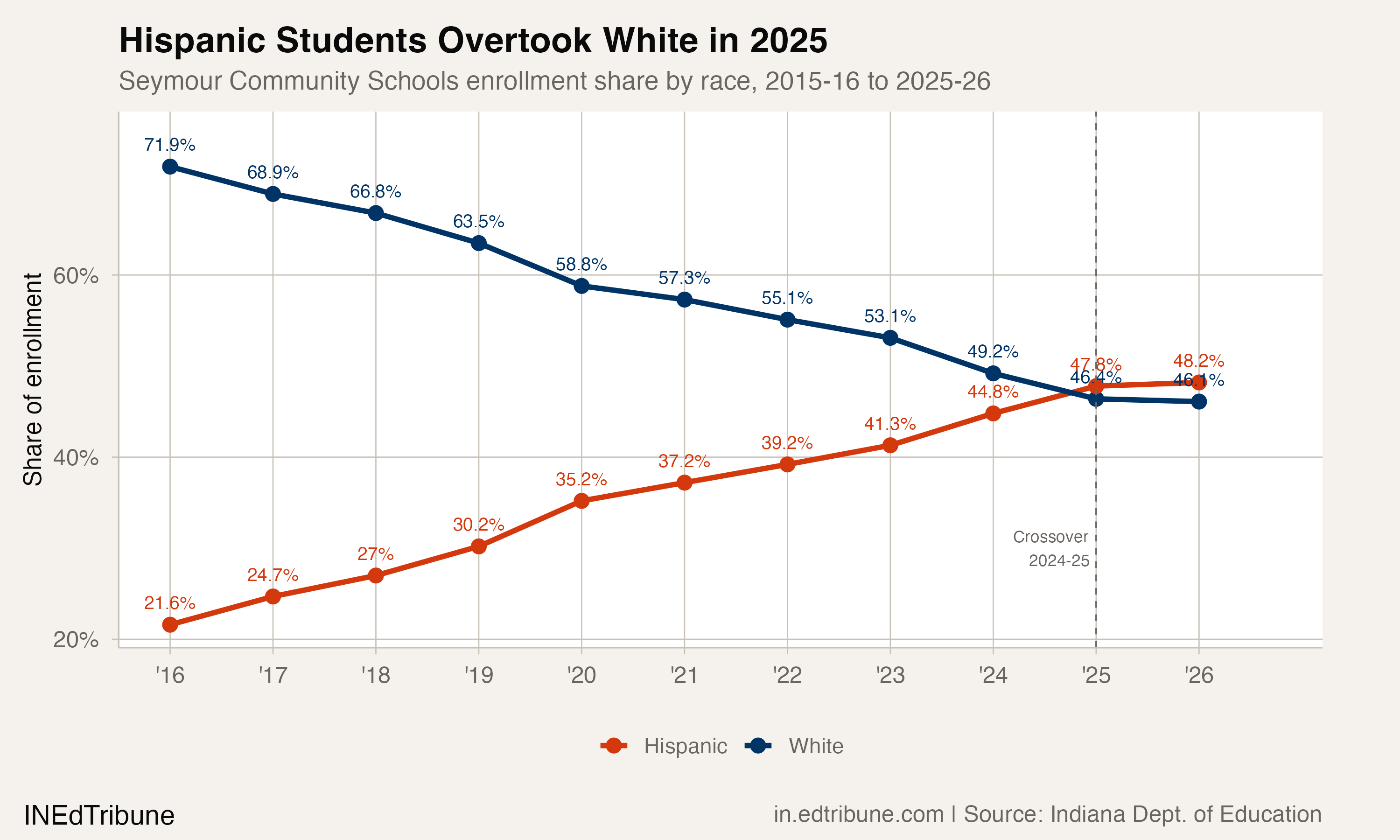
In 2015-16, roughly seven in 10 students in Seymour Community Schools↗ET were white. By 2025-26, that figure had fallen below half. Hispanic students, who made up about one in five a decade ago, now constitute the largest group in the district at 48.2% of enrollment.
No traditional school district in Indiana has undergone a faster demographic transformation. Seymour's Hispanic enrollment share grew by 26.6 percentage points since 2015-16, nearly five points more than the next-closest district. The shift was not gradual: white enrollment dropped every single year, Hispanic enrollment rose every year but one, and total enrollment actually grew 12.6% over the period, from 4,669 to 5,255.
The crossover
The lines crossed in 2024-25. That year, Hispanic students reached 47.8% of enrollment while white students fell to 46.4%. Seymour joined the 93 Indiana school corporations where Hispanic students outnumber white students, but the speed of its transition sets it apart.
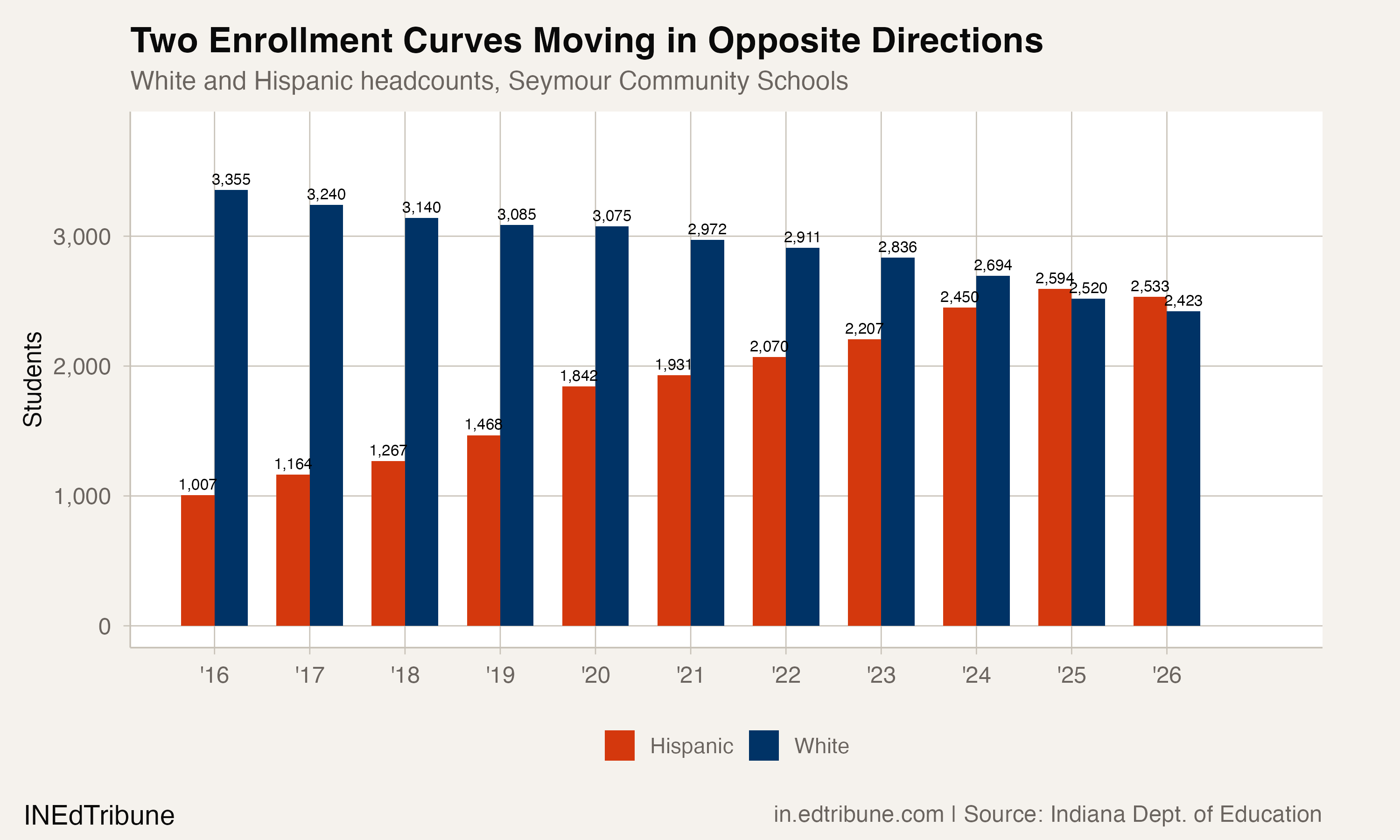
The raw numbers tell a starker story than the percentages. White enrollment fell from 3,355 to 2,423, a loss of 932 students (27.8%). Hispanic enrollment rose from 1,007 to 2,533, a gain of 1,526 students (151.5%). The district did not simply swap one group for another. It added students on net, gaining 586 over the decade, because Hispanic growth outpaced white decline by nearly 600 students.
The statewide context makes Seymour's transformation more striking. Indiana as a whole went from 11.1% Hispanic in 2015-16 to 15.4% in 2025-26, a 4.3 percentage point increase. Seymour's Hispanic share is now more than three times the state average.
Manufacturing, migration, and the Jackson County economy
Seymour is a city of roughly 21,000 people in Jackson County, about 60 miles south of Indianapolis along Interstate 65. Its economy runs on manufacturing. Aisin U.S.A. Manufacturing, a Japanese auto parts maker that began operations in the mid-1980s, employed 1,777 workers as of 2013, making it the county's largest industrial employer. Cummins, Valeo Sylvania, and a Walmart distribution center round out the top employers.
The manufacturing base is the most likely driver of Hispanic population growth. Jackson County's Hispanic population grew 159% between 2010 and 2020, the largest such increase of any Indiana county as a share of total population. The county's minority share jumped from 8.4% to 18.6% over that decade.
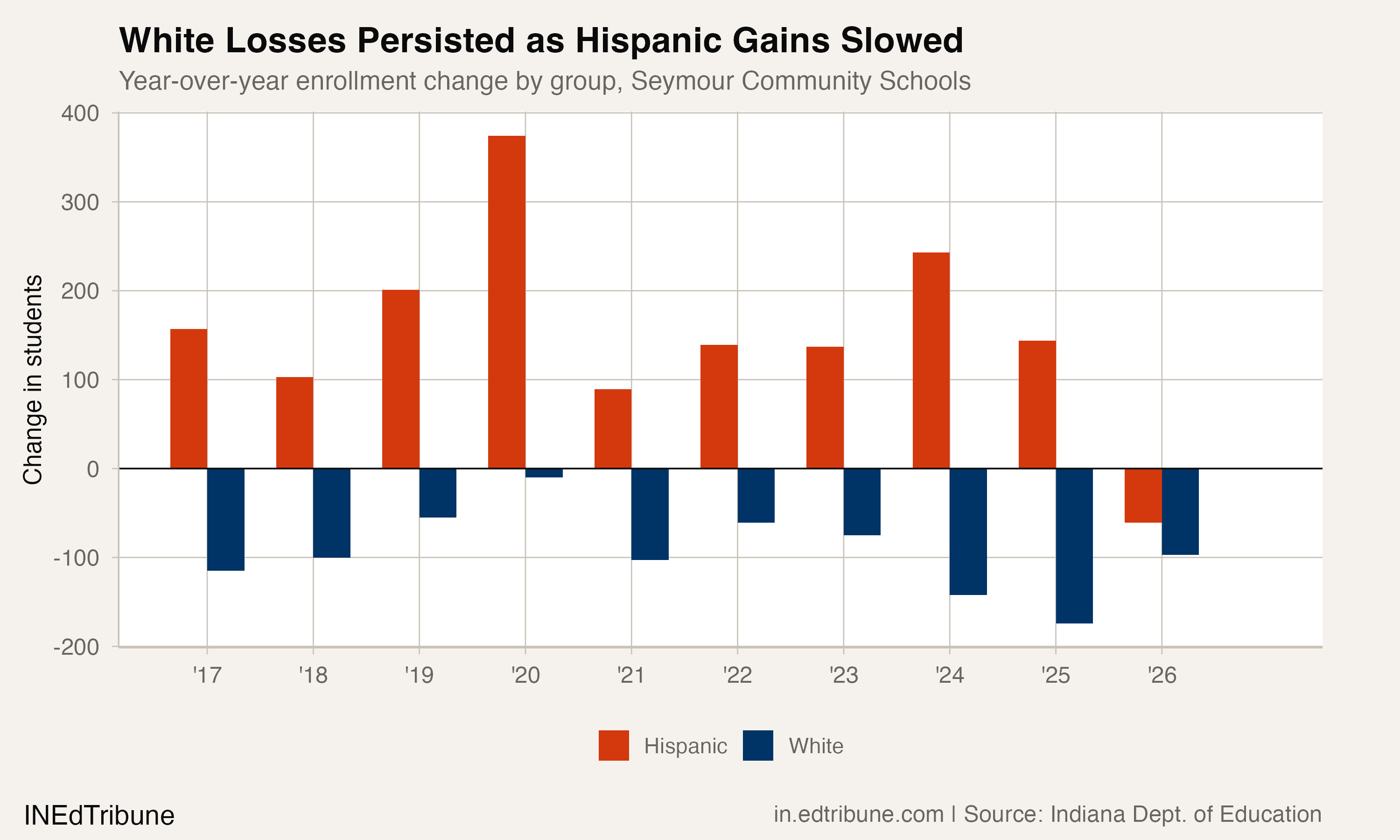
The enrollment data suggests this growth continued and accelerated after the 2020 Census. The single largest year-over-year Hispanic enrollment gain in Seymour came in 2019-20, when 374 Hispanic students were added in one year. Gains of 100 to 243 students per year continued through 2023-24.
Whether the growth reflects new arrivals, births to families already in the community, or both is not distinguishable from enrollment data alone. The steady, decade-long arc of the increase, rather than a sudden spike, is more consistent with chain migration tied to established employment networks than with a single policy event or resettlement program.
The 2025-26 reversal
The most recent year breaks the pattern. In 2025-26, Hispanic enrollment fell by 61 students, the first year-over-year decline in the series. White enrollment continued falling, down 97. Total enrollment dropped 177, from 5,432 to 5,255.
The decline follows a period of political tension. In October 2024, the Indiana Attorney General announced an investigation into whether Seymour was operating as a sanctuary city, and a community meeting drew residents voicing concerns about the city's undocumented population. State Representative Jim Lucas told WFYI that teachers reported having "28 kids in a class and 20 of them are English Learners...seven of them were level ones who speak zero English."
One year of data cannot establish a trend reversal. The decline could reflect normal year-to-year fluctuation, families relocating in response to the political climate, or simply a smaller entering cohort replacing a larger graduating class. The district's total enrollment peaked at 5,473 in 2023-24 before declining in both subsequent years.
An instructional challenge at scale
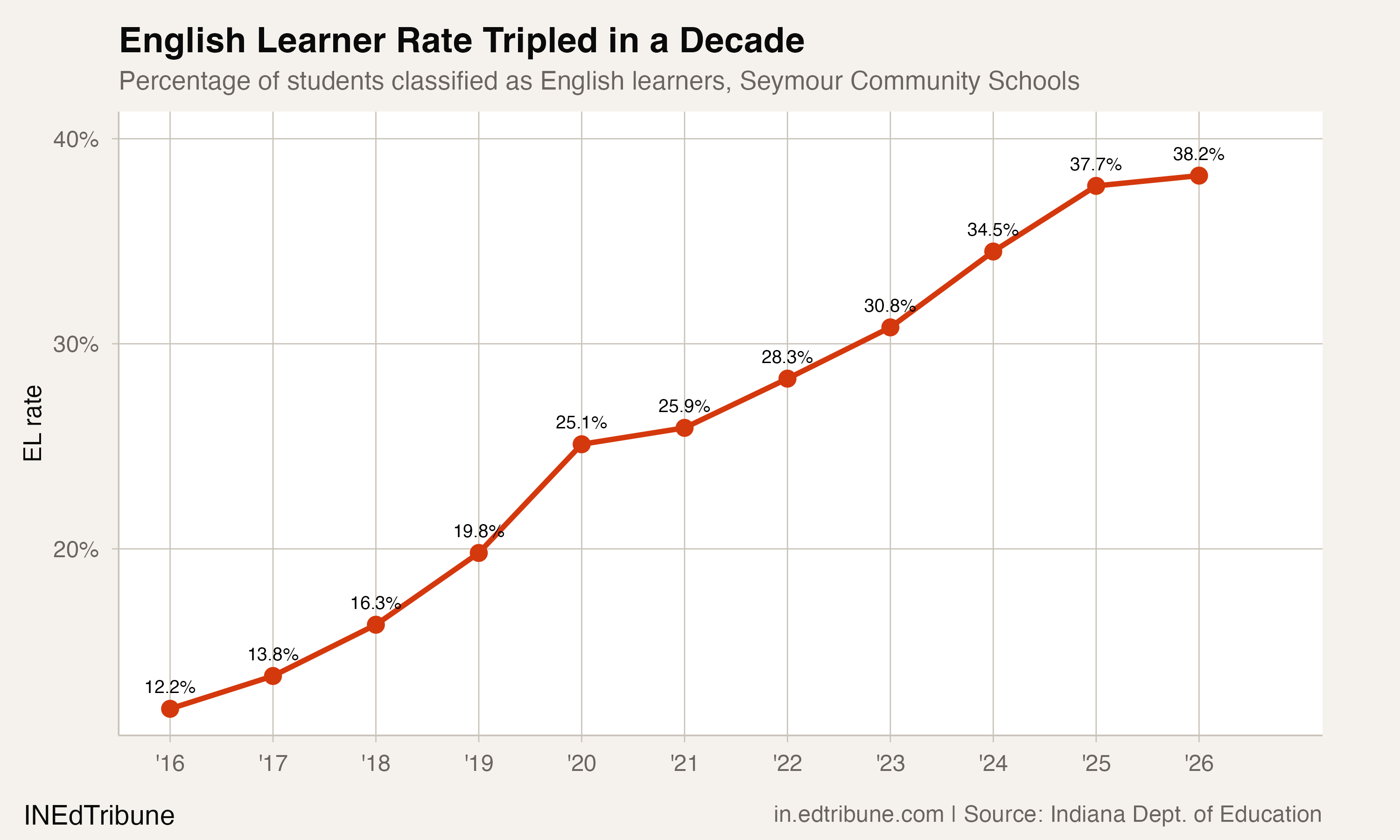
The operational consequence of Seymour's demographic shift shows up most clearly in its English learner rate. In 2015-16, 12.2% of students were classified as English learners. By 2025-26, that rate had reached 38.2%, a 26.0 percentage point increase. Nearly two in five students now receive English language services.
That rate carries direct instructional and staffing implications. English learner services require certified EL teachers, bilingual paraprofessionals, and assessment infrastructure that scales with the number of students served. For a mid-sized district in rural southern Indiana, recruiting bilingual educators competes with every other rural district facing the same shortage.
The district attempted to respond. In early 2024, Seymour Community Schools proposed a dual-language immersion program at Cortland Elementary that would have begun with kindergarten in fall 2025. The school board withdrew the proposal after community pushback, opting to explore alternative approaches.
A county of contrasts
Seymour's transformation is concentrated within city limits. The three other school corporations in Jackson County, Brownstown Central, Crothersville, and Medora, barely registered the same demographic shift. Brownstown's Hispanic share went from 2.2% to 3.6%. Crothersville moved from 4.1% to 5.6%. Medora went from 1.8% to 3.8%.
The pattern is consistent with employment-driven settlement: families cluster near the manufacturing plants in Seymour itself, not across the broader rural county. Those three neighboring districts also lost total enrollment over the decade, a trajectory Seymour avoided precisely because Hispanic enrollment growth more than offset white decline.
The manufacturing corridor's common thread
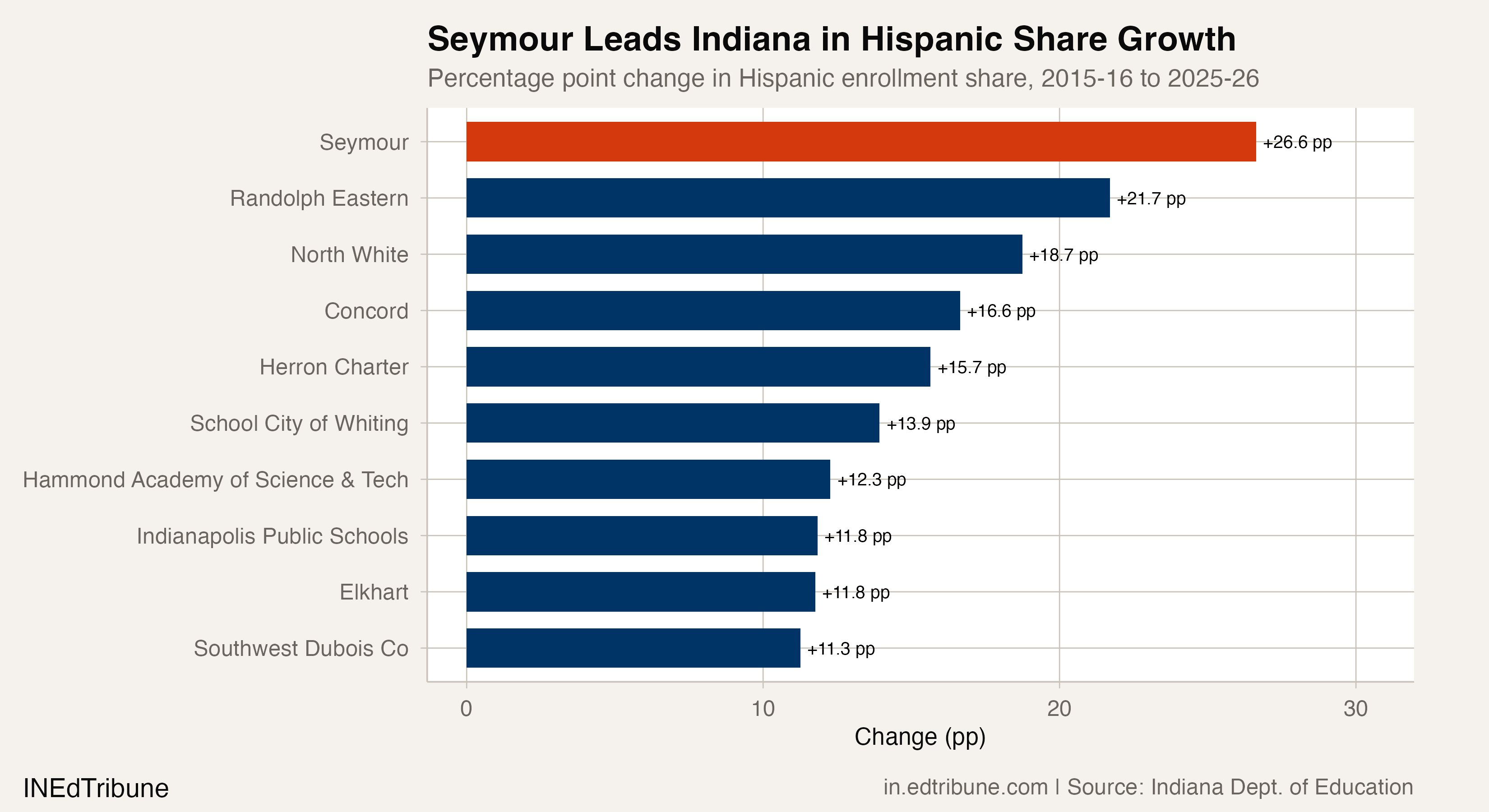
Seymour's demographic trajectory mirrors what has already happened in larger Indiana districts. Concord Community Schools in Elkhart County crossed the Hispanic-plurality threshold in 2020-21. Logansport crossed in the same year. MSD Lawrence Township and MSD Wayne Township in the Indianapolis suburbs followed. The common thread is proximity to manufacturing or food processing employment.
Seymour built capacity for a growing, increasingly multilingual student body over the past decade. It hired EL staff, proposed a dual-language program (before the board withdrew it), and absorbed 1,526 new Hispanic students while its white enrollment fell 932. That investment assumed continued growth. The 2025-26 data, with 61 fewer Hispanic students and 97 fewer white students, raises a harder scenario: a district that retooled for one kind of future and may now face a different one. The Aisin factory and the Walmart distribution center are still running. Whether the families they attract keep arriving, given the state's political climate around immigration, is a question the employment data and the enrollment data will answer together.
Detailed code that reproduces the analysis and figures in this article is available exclusively to EdTribune subscribers.
Discussion
Sign in to join the discussion.
Loading comments...