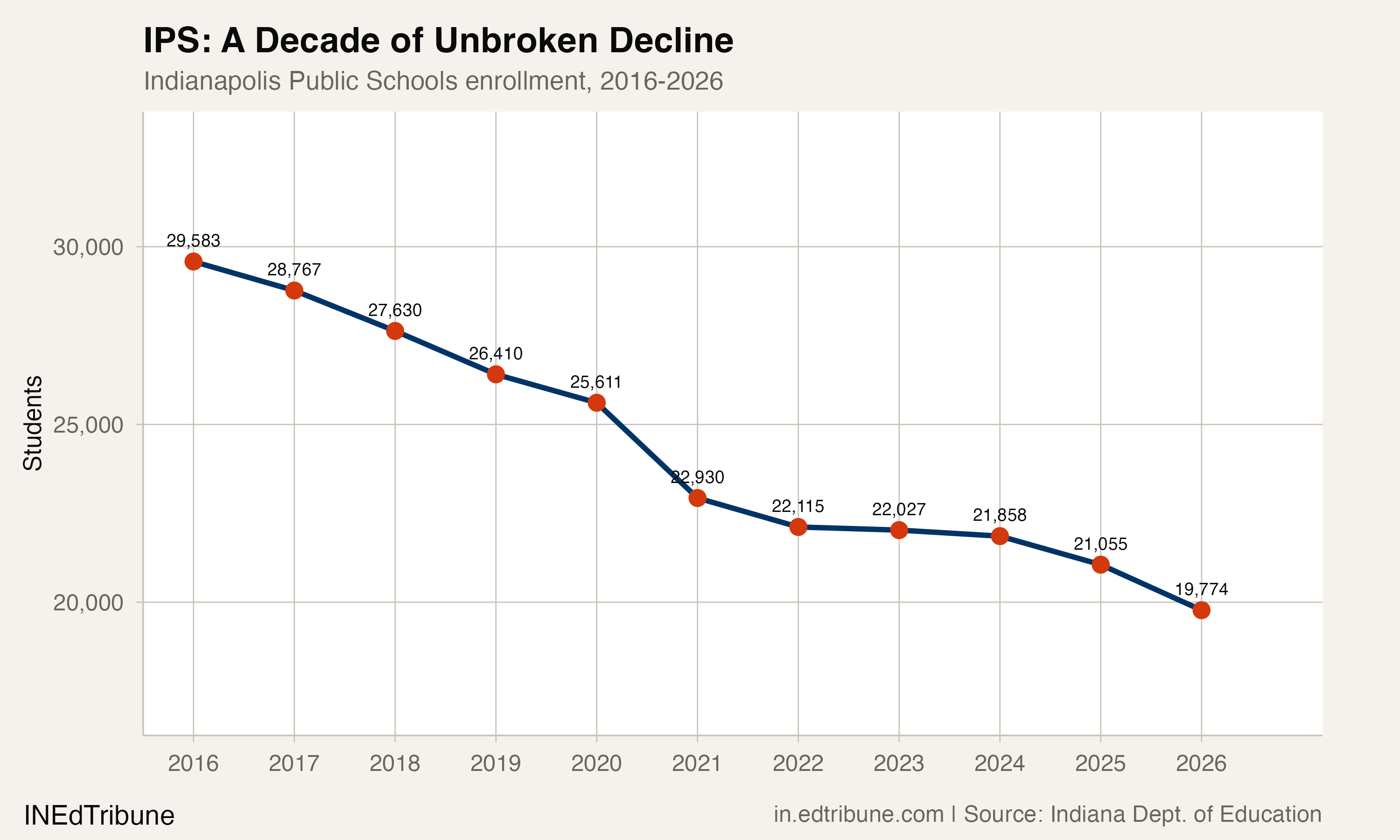
In 2016, Indianapolis Public Schools↗ET was the largest school district in Indiana. It enrolled 29,583 students, edging out Fort Wayne by 100. It had more students than all 28 Marion County charter organizations combined.
None of that is true anymore. IPS enrolled 19,774 students in 2025-26, a loss of 9,809 over a decade, 33.2% of the district. The 2025-26 drop alone, 1,281 students or 6.1%, was the steepest single-year decline since the pandemic year of 2020-21, when 2,681 students vanished. IPS has not gained enrollment in any of the last 10 years.
Ten years, no floor
The shape of IPS's decline has two phases. From 2016 through 2020, the district lost roughly 800 to 1,200 students per year in a steady, pre-pandemic bleed. COVID then blew a 2,681-student hole in 2020-21. What followed looked briefly like stabilization: losses of just 88 and 169 in 2022-23 and 2023-24. Some observers hoped the district had found a floor.
It hadn't. The 2024-25 loss of 803 students broke the plateau. The 2025-26 loss of 1,281 shattered it. Outside of the pandemic year itself, this is the worst annual decline IPS has recorded in the decade-long dataset.
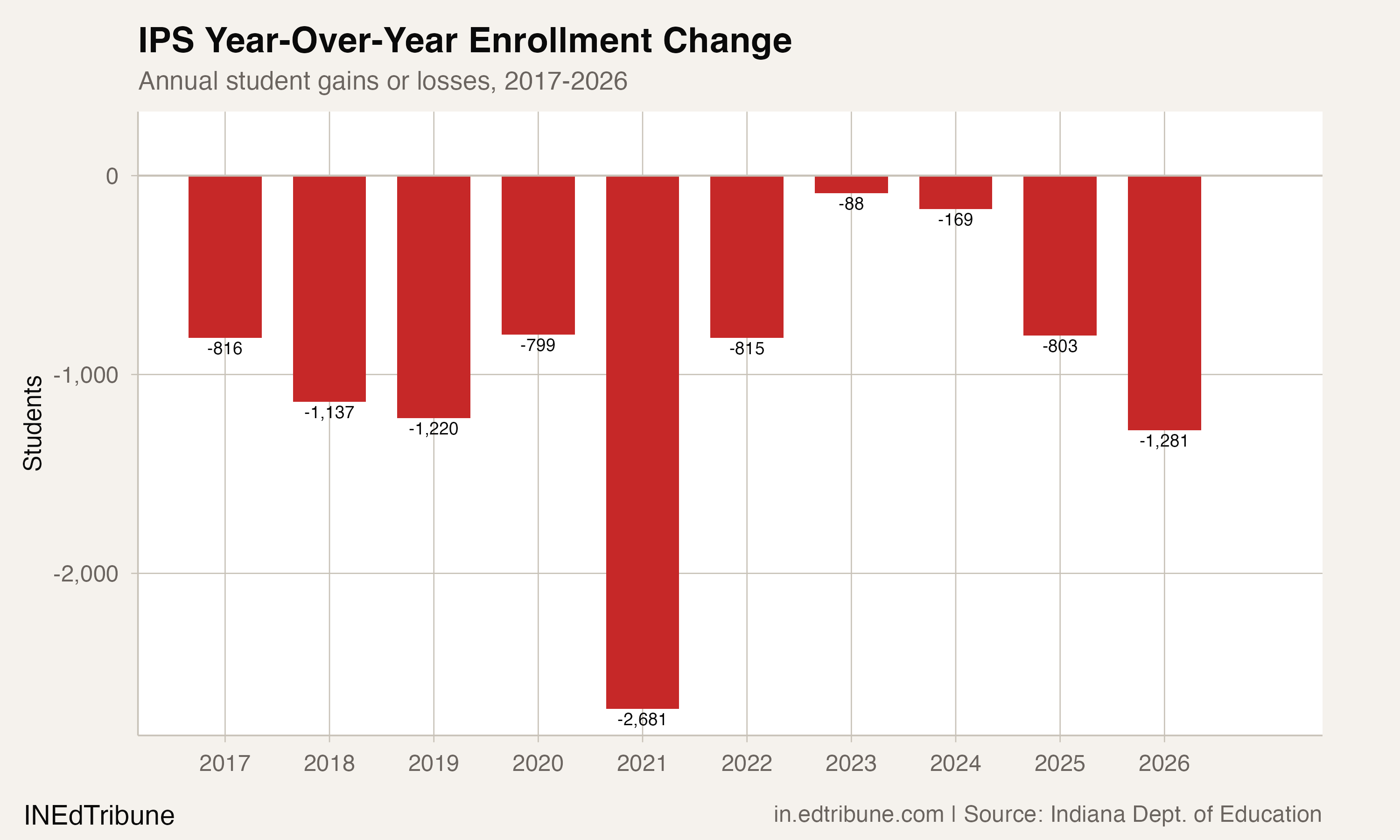
The acceleration is visible in the year-over-year bars: the red columns on the right are growing, not shrinking. IPS is losing students faster now than before COVID, in absolute terms, and the district is a third smaller than it was then.
The charter crossover
The single most consequential line in Marion County education data crosses in 2020. That year, the combined enrollment of charter schools in Marion County, 26,307, surpassed IPS's 25,611 for the first time. By 2026, the gap had widened to 16,124 students. Marion County charters enrolled 35,898 students across 73 organizations, nearly double IPS.
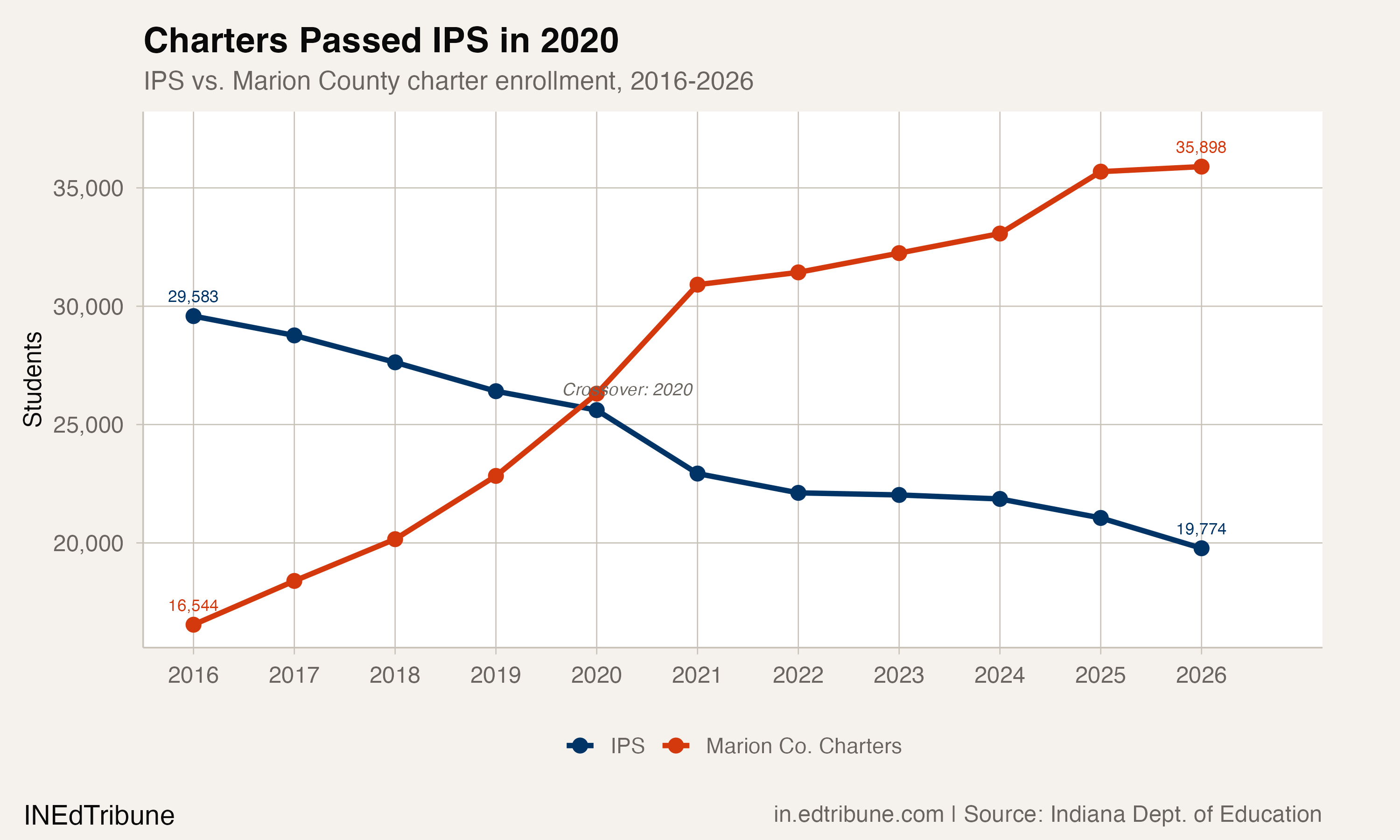
The growth is staggering by any measure. Marion County charters added 19,354 students since 2016, a 117% increase. They did this while IPS lost 9,809. The charter sector's gain is roughly double IPS's loss, which means charters are drawing students from somewhere beyond IPS alone.
That somewhere includes the broader population. Marion County's total public school enrollment rose from 149,187 to 163,464 over the same period. The other traditional school districts in the county, the township MSDs and smaller systems, collectively grew from 103,060 to 107,792. The Marion County education market is not shrinking. IPS is shrinking within it.
Who controls Indianapolis schools?
Indianapolis is unique in its school governance structure, a legacy of deliberate fragmentation. When the city and county merged into a single government in 1969, schools were explicitly excluded. A federal desegregation order in 1971 triggered massive white flight, dropping IPS from 108,000 students to 47,000 by the early 1990s. Indiana's 2001 charter school law then granted the Indianapolis mayor unique power to authorize charter schools, and the sector has expanded aggressively since.
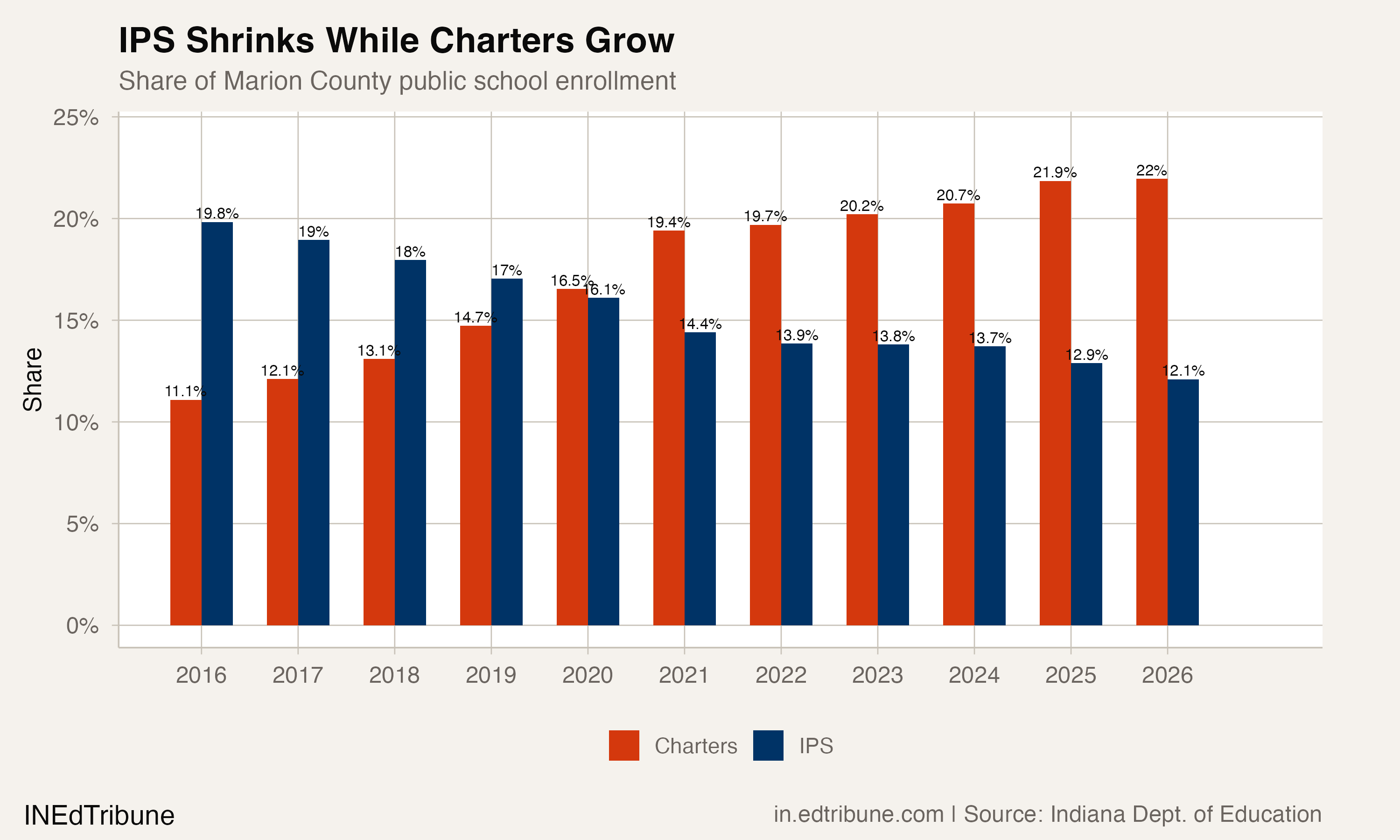
The result is a county where 61% of students within IPS boundaries now attend a charter or Innovation Network school rather than a district-managed school. IPS's share of total Marion County public enrollment has fallen from 19.8% in 2016 to 12.1% in 2026. Charters have risen from 11.1% to 22.0% over the same period.
Indiana's Choice Scholarship voucher program adds another exit ramp. Chalkbeat reported that as of 2020-21, nearly 3,800 students who lived within IPS boundaries were attending private schools using state-funded vouchers.
A district restructuring that backfired
IPS's most recent enrollment acceleration coincides with the district's "Rebuilding Stronger" initiative, which reorganized grade configurations by creating standalone middle schools. WFYI reported that the overhaul drove a 778-student drop in middle school enrollment in 2024-25 alone, with more than 100 families leaving after Broad Ripple Middle School's rocky start in August.
The 2025-26 data showed the losses spreading beyond middle school. High school enrollment fell 9%, with ninth grade alone dropping roughly 20%. The pipeline is not refilling.
The demographic reality inside IPS
The students leaving IPS are disproportionately Black. In 2016, Black students made up 48.9% of the district at 14,454. By 2026, that had fallen to 7,566, a loss of 6,888 students, 38.3% of IPS enrollment. Hispanic students held steadier in absolute terms (7,440 to 7,313) but rose from 25.1% to 37.0% as a share. White enrollment dropped from 6,078 to 3,439.
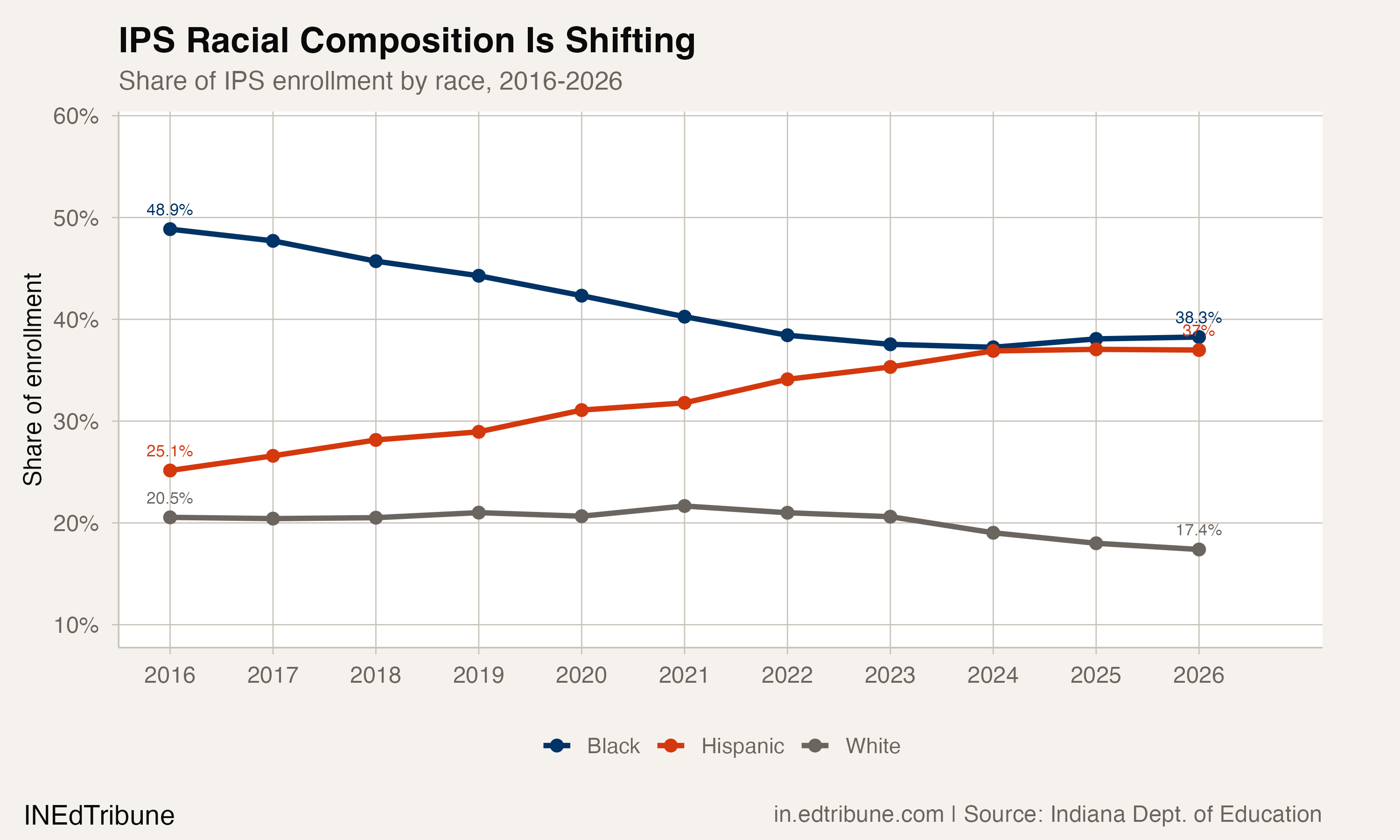
The convergence between Black and Hispanic enrollment shares is approaching a crossover of its own. In 2016, Black students outnumbered Hispanic students by more than two to one. The gap in 2026 was 253 students.
What the pipeline signals
IPS kindergarten enrollment has fallen from 2,797 in 2016 to 1,687 in 2026, a 39.7% decline. First grade dropped 40.1%. These are the students who will fill middle and high school seats a decade from now, and there are far fewer of them.
One grade level moved in the opposite direction. Twelfth grade enrollment rose from 1,004 to 1,252, a 24.7% increase, even as every other grade shrank. The most likely explanation is a growing number of students taking five or more years to complete high school, which would be consistent with the district's expanding alternative and credit-recovery programs.
The fiscal math
Indiana funds schools through a per-student formula. Every student who leaves takes their tuition support with them. IPS's $472 million operating budget for 2025-26 already accounts for continued enrollment decline, but the district faces compounding fiscal pressure. Property tax reform under Senate Enrolled Act 1 will strip an estimated $1.3 million in 2026 and $2.2 million in 2027. Nearly one-third of IPS buildings operate below 60% capacity.
The Indianapolis Local Education Alliance, a task force convened in 2025, voted in December to recommend creating a new Indianapolis Public Education Corporation, a nine-member appointed board that would oversee both district and charter schools within IPS boundaries. The proposal would consolidate three charter authorizers and require all schools to provide transportation. It would also exempt IPS buildings from a state law requiring districts to make unused facilities available to charter schools.
Whether the legislature acts on those recommendations is an open question.
"We are at a really critical juncture as Indianapolis Public Schools. And what do we mean by Indianapolis Public Schools? What do we desire for IPS to be?" — Superintendent Aleesia Johnson, Chalkbeat Indiana, August 2025
A district that may not outlast its buildings
David Griffith of the Thomas B. Fordham Institute put it bluntly to Chalkbeat: if the current trajectory holds, "in 20, 25 years there will not be a district." The enrollment data does not contradict him. IPS lost students at an accelerating rate in 2025-26 after what turned out to be a two-year pause, not a recovery. Its kindergarten class is 40% smaller than a decade ago. Marion County charters now enroll 81% more students than IPS does.
The ILEA's proposed Indianapolis Public Education Corporation would place both sectors under a single nine-member appointed board. The proposal arrived two decades into a governance experiment that split the city's public education across three charter authorizers, one traditional elected board, and a state-funded voucher pipeline to private schools. The IPS buildings at one-third capacity are the physical evidence of what that fragmentation produced. Whether a new board can fill them, consolidate them, or repurpose them will determine what Indianapolis public education looks like in 2040.
Detailed code that reproduces the analysis and figures in this article is available exclusively to EdTribune subscribers.
Discussion
Sign in to join the discussion.
Loading comments...