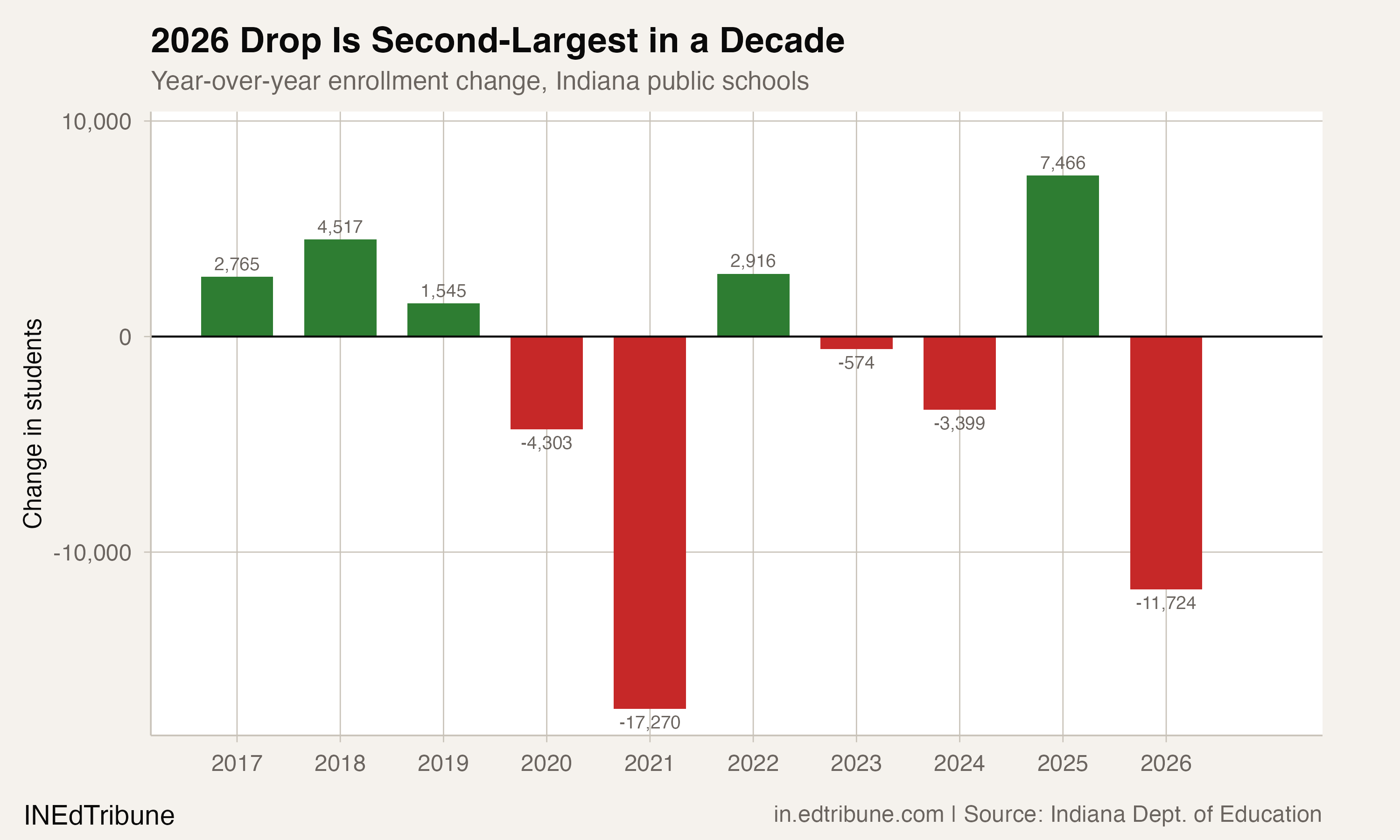
Fort Wayne Community Schools↗ET is Indiana's largest school corporation, with 28,200 students. Evansville Vanderburgh↗ET is the second-largest, with 20,914. Hamilton Southeastern↗ET is third, with 20,633. Indianapolis Public Schools↗ET is fourth, with 19,774. All four are at their lowest enrollment in more than a decade. So are Carmel Clay↗ET, MSD Wayne Township↗ET, and Vigo County↗ET. Seven of Indiana's 10 largest corporations now sit at their 11-year floor.
They are not alone. In 2025-26, 133 of Indiana's 430 public school corporations enrolled fewer students than in any year since 2016. Those 133 corporations collectively serve 444,529 students, 43.2% of the state's total enrollment. The losses are not contained to any one region or size category: 12 of the corporations at record lows enroll more than 10,000 students; 30 enroll fewer than 1,000.
The state itself is at its floor
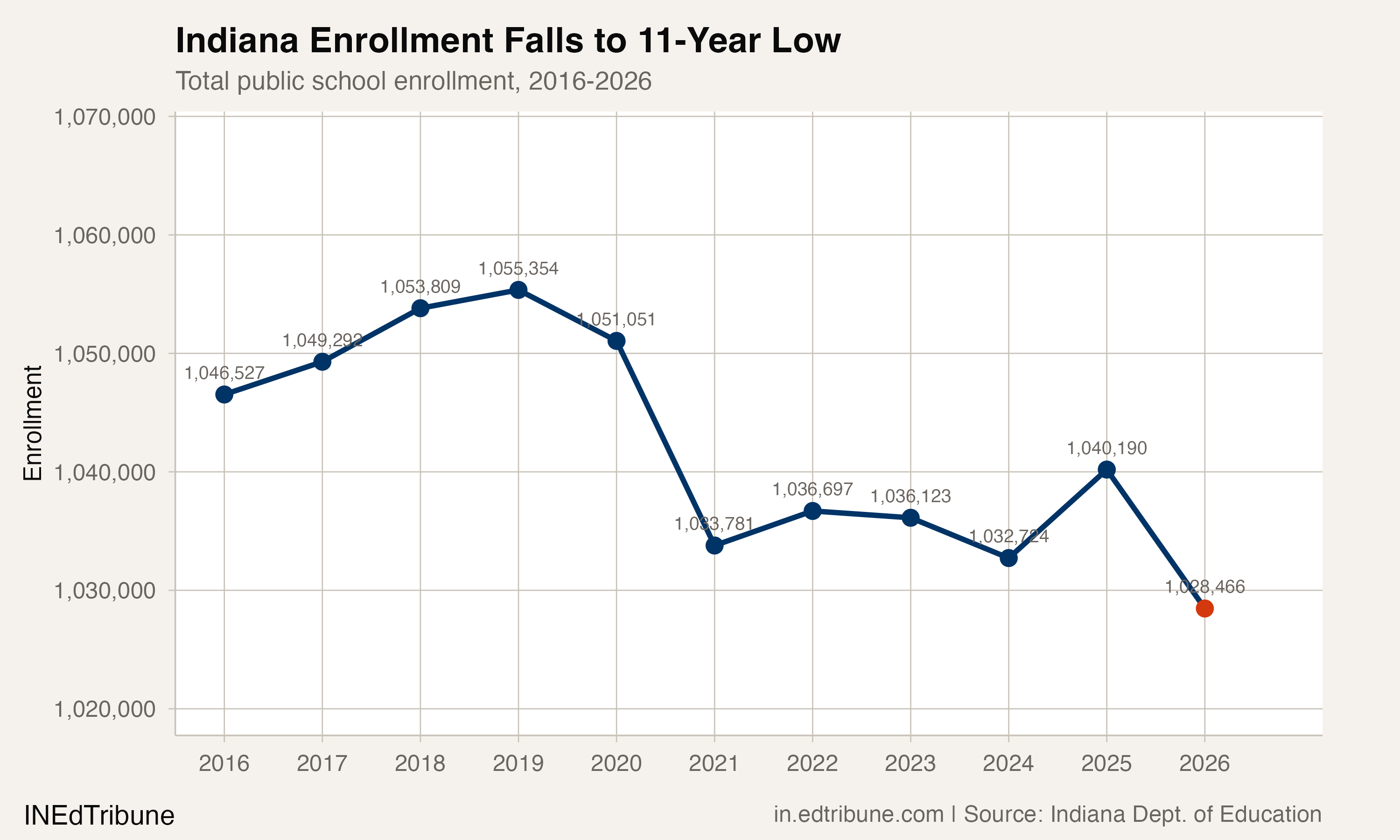
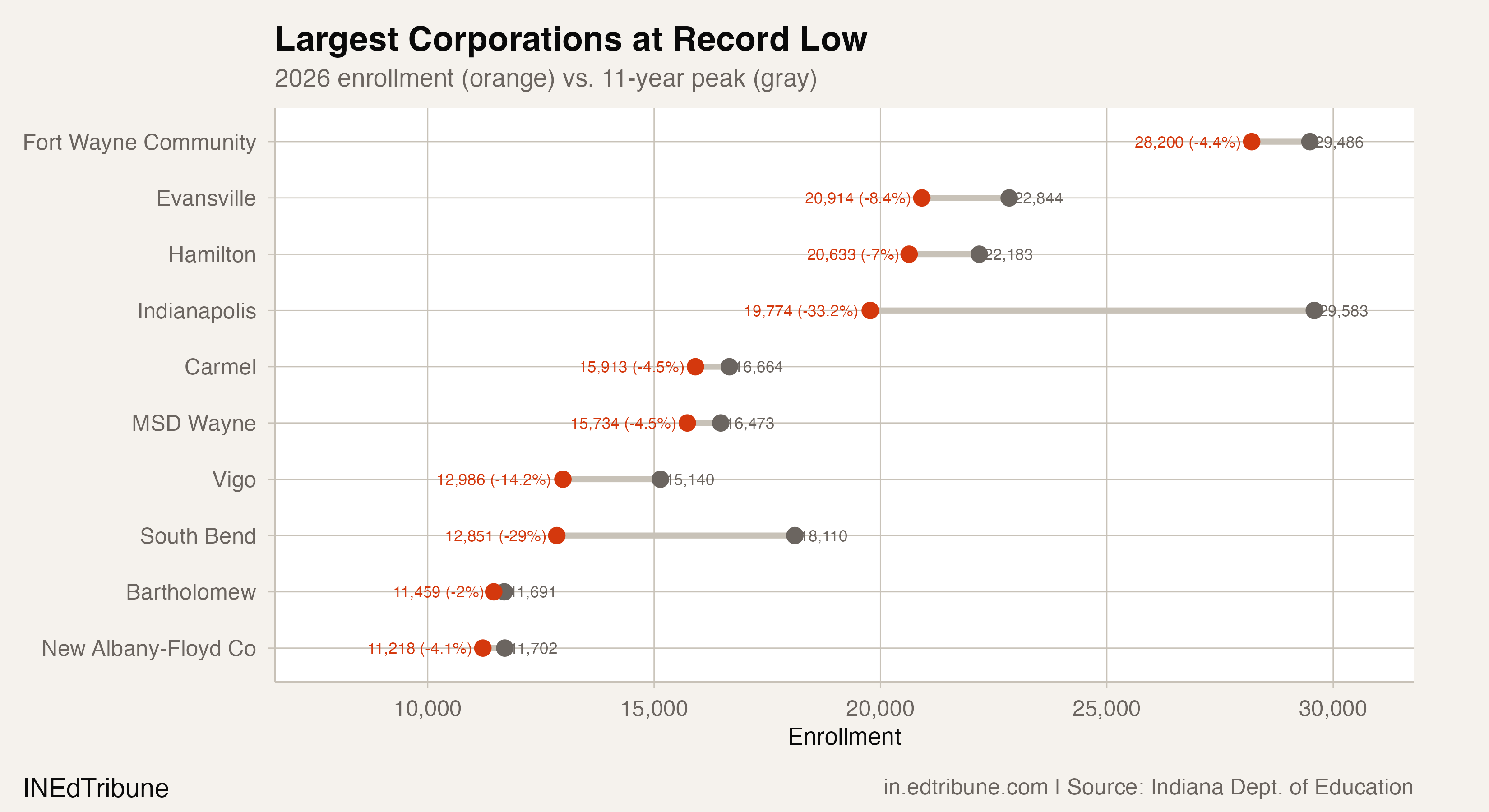
Indiana's total public school enrollment in 2025-26 stands at 1,028,466, the lowest point in the 2016-2026 window. The state lost 11,724 students from the prior year, a 1.1% drop and the second-largest single-year decline of the past decade. Only the pandemic year of 2020-21 was worse, when 17,270 students vanished from rolls.
The 2026 decline hit harder than the numbers suggest. In 2024-25, Indiana had gained 7,466 students, its best year since 2018, creating the appearance of stabilization. That gain evaporated entirely and then some: the state is now 26,888 students below its 2019 pre-pandemic enrollment, a 2.5% deficit that has only widened.
Of the 424 corporations with data in both years, 281 lost students in 2025-26. Only 138 grew.
The big systems are shrinking fastest
What distinguishes Indiana's 2026 enrollment picture is not the number of small rural districts in decline. It is the scale of the corporations being pulled under.
IPS has lost 9,809 students since 2016, a 33.2% decline. That trajectory has not paused for a single year in a decade. South Bend↗ET has shed 31.2% of its enrollment over the same period, falling from 18,680 to 12,851. Vigo County, anchored by Terre Haute, is down 14.2% from its 2016 peak of 15,140.
Even corporations in affluent suburbs are now shrinking. Hamilton Southeastern, which sits in Fishers and one of the state's fastest-growing communities, peaked at 22,183 students in 2020 and has lost 1,550 since. Carmel Clay peaked at 16,664 the same year and is now at 15,913.
Nine corporations have declined every single year for a full decade, from 2017 through 2026: IPS, South Bend, Elkhart, Plymouth, Portage Township, North Adams, Brown County, Whitko, and Maconaquah. For these systems, the pandemic was not a turning point. It was one year in a trajectory that began long before COVID and shows no sign of reversing.
A shrinking pipeline reinforces the slide
Indiana's kindergarten enrollment has fallen 9.3% since 2016, from 77,038 to 69,849. Grade 12, meanwhile, has grown 13.4%, from 74,935 to 85,006. In 2025-26, the state enrolled 15,157 more 12th graders than kindergarteners, a structural deficit that points to continued decline as larger cohorts age out and smaller ones enter.
The most likely driver is Indiana's sustained birth decline. The state recorded its lowest fertility rate on record in 2023, at 58.9 births per 1,000 women of childbearing age. Births fell 12% between 2007 and 2023, with the sharpest drops among non-Hispanic women, whose fertility rates have declined at an average annual rate of 1.6% since 2016. A modest 1.6% uptick in 2024 births will not reach kindergarten classrooms until 2030 at the earliest.
Indiana's Choice Scholarship voucher program, which served 76,067 students in 2024-25, continues to pull students from public rolls. The state is set to expand vouchers to all families beginning in 2026-27, removing income restrictions entirely at an estimated additional cost of $93 million. The program's effect on public enrollment is uneven: rural corporations, where private school options are scarce, face the same demographic decline without the competitive pressure. Suburban and urban corporations face both.
The growth corridor is narrowing
An Indiana University analysis of 2006-2024 enrollment data identified a structural divergence: "Major urban school corporations like Indianapolis Public Schools and Gary Community School Corporation continue to face declining enrollment" while "enrollment growth in suburban corporations such as Hamilton Southeastern, Brownsburg, and Westfield-Washington reflects housing development and shifting population patterns."
The 2026 data complicates that framing. Hamilton Southeastern, cited by IU researchers as a suburban growth example, is now at its record low. So is Carmel Clay. The line between shrinking urban systems and growing suburban ones, which held through most of the decade, is blurring.
The 60 that bucked the trend
Not every corporation is shrinking. Sixty are at their highest enrollment in the 11-year window: Franklin Township↗ET at 11,572 (up 27.6% since 2016), Brownsburg↗ET at 10,627, Westfield-Washington↗ET at 10,396 (up 43.7%), Center Grove at 9,811, and Crown Point at 9,289. These are overwhelmingly outer-ring Indianapolis suburbs and northwest Indiana communities absorbing families priced out of or choosing to leave core urban systems.
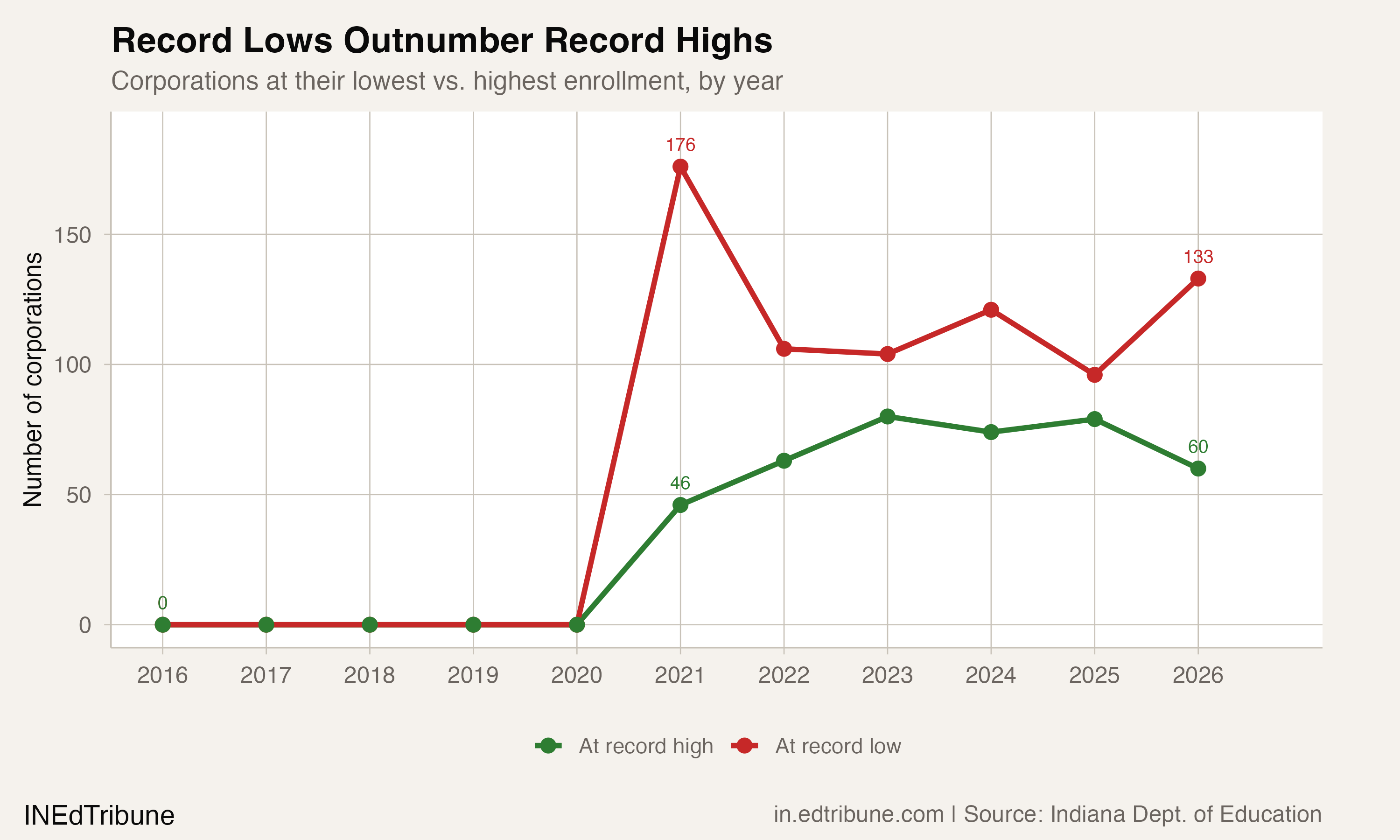
The ratio is lopsided. For every corporation at a record high, more than two are at a record low. That gap has widened since the pandemic: in 2021, 176 corporations hit their low point while 46 hit their high. By 2026, the low count has fallen to 133 but the high count has also fallen, to 60. The state is not splitting into winners and losers so much as producing fewer winners while the losses spread.
The long slide ahead
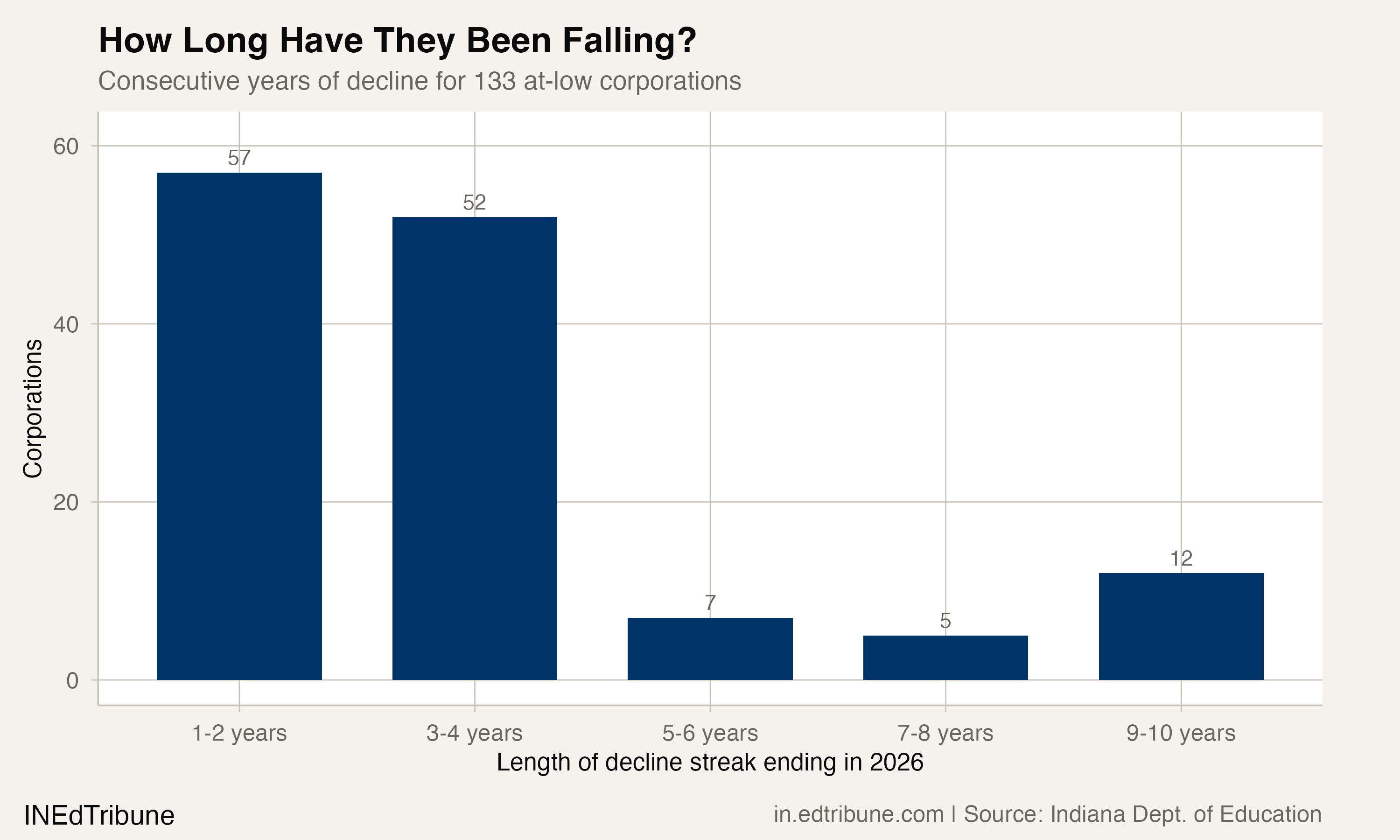
The 133 corporations at record lows are not all in freefall. Fifty-seven have been declining for only one or two consecutive years. But 52 have been falling for three or four, and 12 have been in continuous decline for nine or 10 years straight.
Indiana's per-pupil funding system means each lost student reduces revenue immediately. The state ranks 35th nationally in education spending per pupil and saw the second-lowest growth in per-pupil funding of any state between 2002 and 2020. A recent property tax overhaul will require public school districts to share property tax revenue with charter schools starting in 2028.
The 60 corporations at record highs are nearly all in the same place: the suburban ring around Indianapolis, where new housing subdivisions are still being platted. The 133 at record lows span every other geography in the state. When the next October count arrives, the lopsided ratio will likely persist. But the distinction that matters is not how many are at highs versus lows. It is whether the corporations at their floor still have enough students to sustain a full complement of AP classes, a marching band, and a guidance counselor who knows every senior by name. For the 30 record-low corporations below 1,000 students, those are not abstract questions. They are staffing decisions being made right now.
Detailed code that reproduces the analysis and figures in this article is available exclusively to EdTribune subscribers.
Discussion
Sign in to join the discussion.
Loading comments...