In this series: Indiana 2025-26 Enrollment.
In 2016, Indianapolis Public Schools↗ET enrolled 29,583 students. The 28 charter corporations scattered across Marion County enrolled 16,544. IPS had the numbers, the name, and the buildings. The charter sector had the trajectory.
A decade later, those lines have fully crossed. Marion County's 73 charter corporations enrolled 35,898 students in 2025-26. IPS enrolled 19,774. The charter sector is now 1.8 times the size of the district it grew up alongside. Few metro areas anywhere in the country have seen a school-choice transformation this thorough.
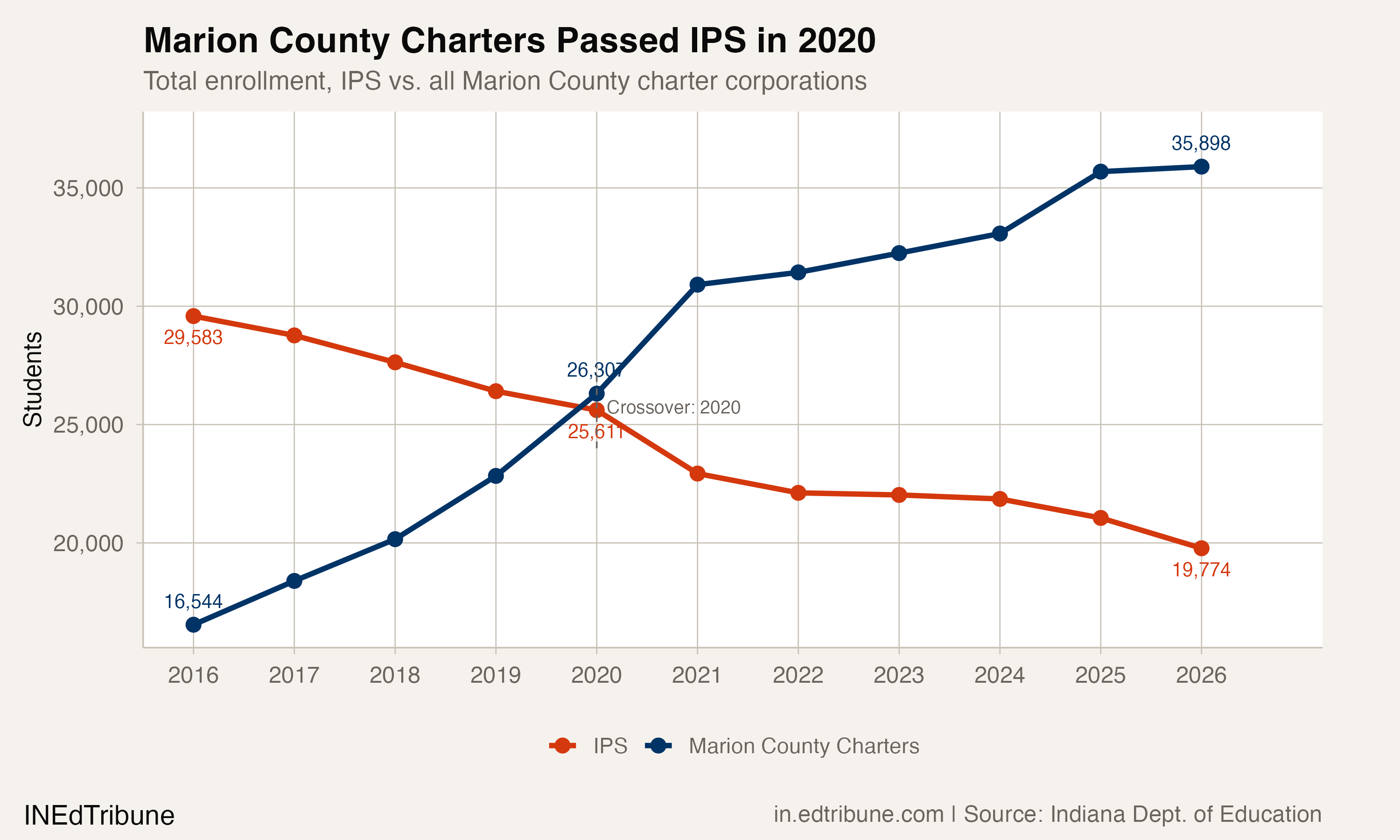
The crossover happened in 2020
The lines crossed in the 2019-20 school year, when charter enrollment hit 26,307 and IPS slipped to 25,611. COVID then widened the divide: charters added 4,604 students in 2020-21 while IPS lost 2,681. By the time the pandemic stabilized, the charter sector was serving 30,911 students to IPS's 22,930, a gap of nearly 8,000.
What happened next is the underappreciated part of the story. Charter growth slowed sharply after 2021, from annual gains of 3,000 to 4,000 students to gains of 500 to 800. The sector appeared to plateau. But IPS kept falling. In 2025-26, IPS shed 1,281 students, its worst non-pandemic loss in the decade. The charter sector added just 212. The ratio still widened to 1.82:1, driven not by charter expansion but by the continuing erosion at IPS.
45 new organizations in a decade
The charter sector's 117% enrollment growth came from two sources: new schools and organic growth at existing ones. Of the 73 charter corporations operating in Marion County in 2025-26, 45 did not exist in 2016. Those 45 new organizations enroll 16,946 students, nearly half of the sector's total.
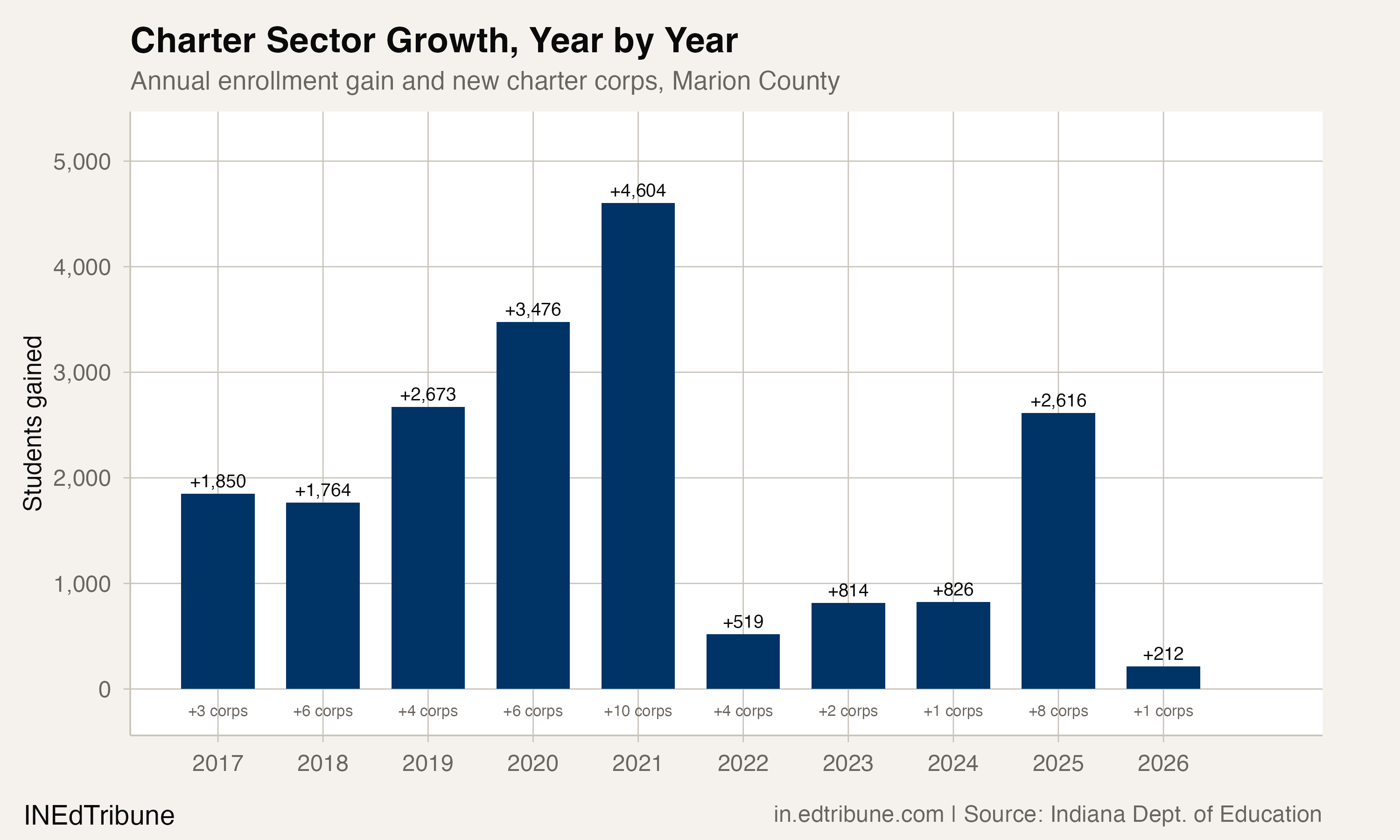
The expansion was not steady. The sector added 10 new corporations in a single year during the pandemic (2020-21), more than any other year. Eight more appeared in 2024-25. Some of these are small, single-school operations. Others are part of national networks: KIPP, Christel House, and Phalen Leadership Academies each operate multiple campuses. The largest single entity is Indiana Connections Academy 7-12, a virtual school with 5,027 students, followed by its K-6 counterpart with 1,631.
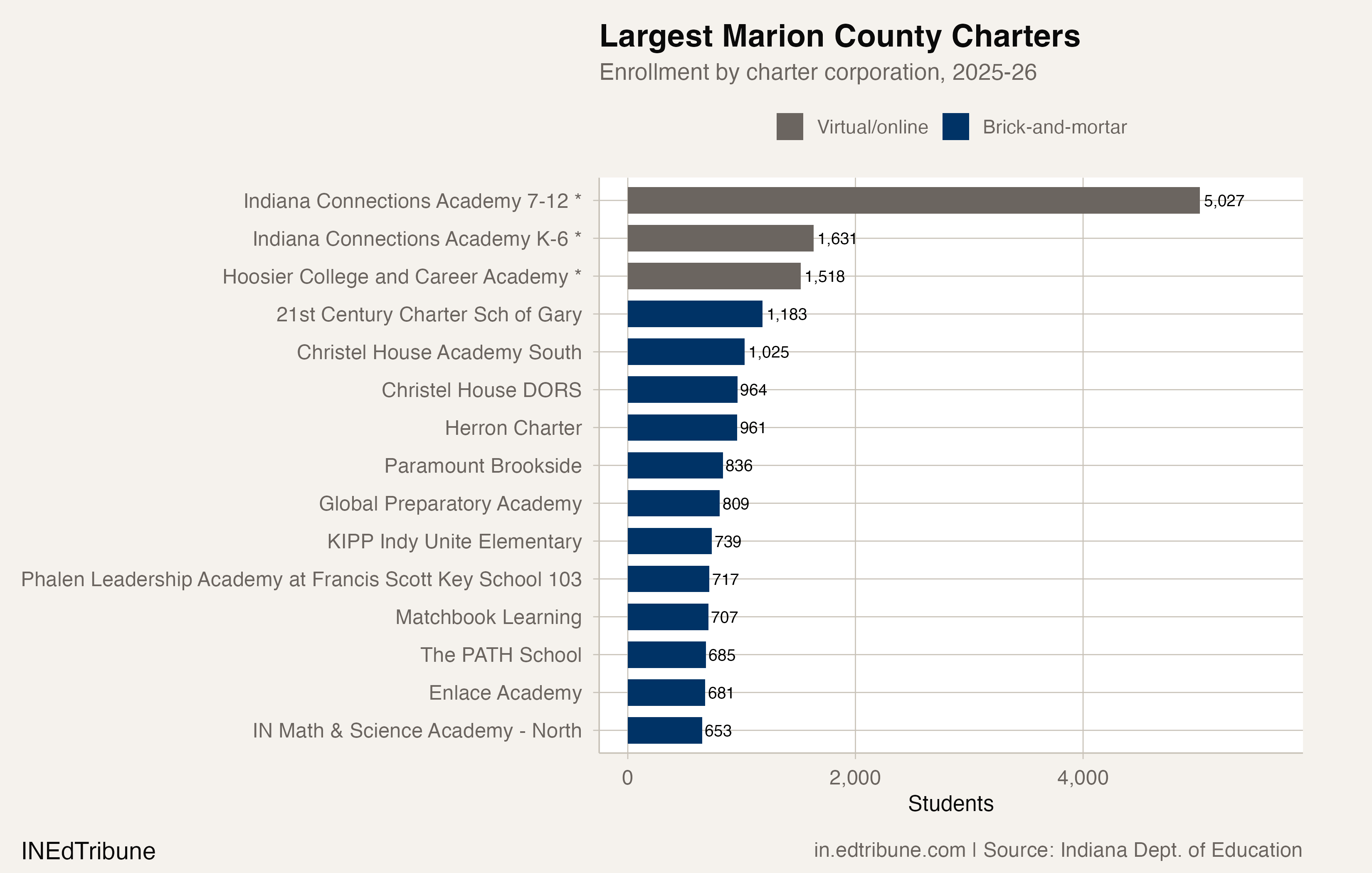
The virtual school asterisk
Five virtual and online charter corporations headquartered in Marion County enrolled 8,582 students in 2025-26, nearly a quarter of the charter total. Indiana Connections Academy alone accounts for 6,658, and Hoosier College and Career Academy adds another 1,518. These students may live anywhere in Indiana.
Strip out virtual and online charters, and the brick-and-mortar charter sector still enrolls 27,316 students, 1.38 times IPS. The dominance is real even after the virtual adjustment, but the 1.82:1 headline ratio overstates how many families physically chose a charter school building in Marion County over an IPS building.
One county, 63% of Indiana's charter sector
Marion County is not just the center of Indianapolis charter schooling. It is the center of Indiana charter schooling. The county's charter corporations enrolled 63.3% of all charter students statewide in 2025-26, up from 55.3% in 2016. The concentration is increasing: as the statewide charter sector grew from 29,906 to 56,675 students, Marion County captured a disproportionate share of that growth.
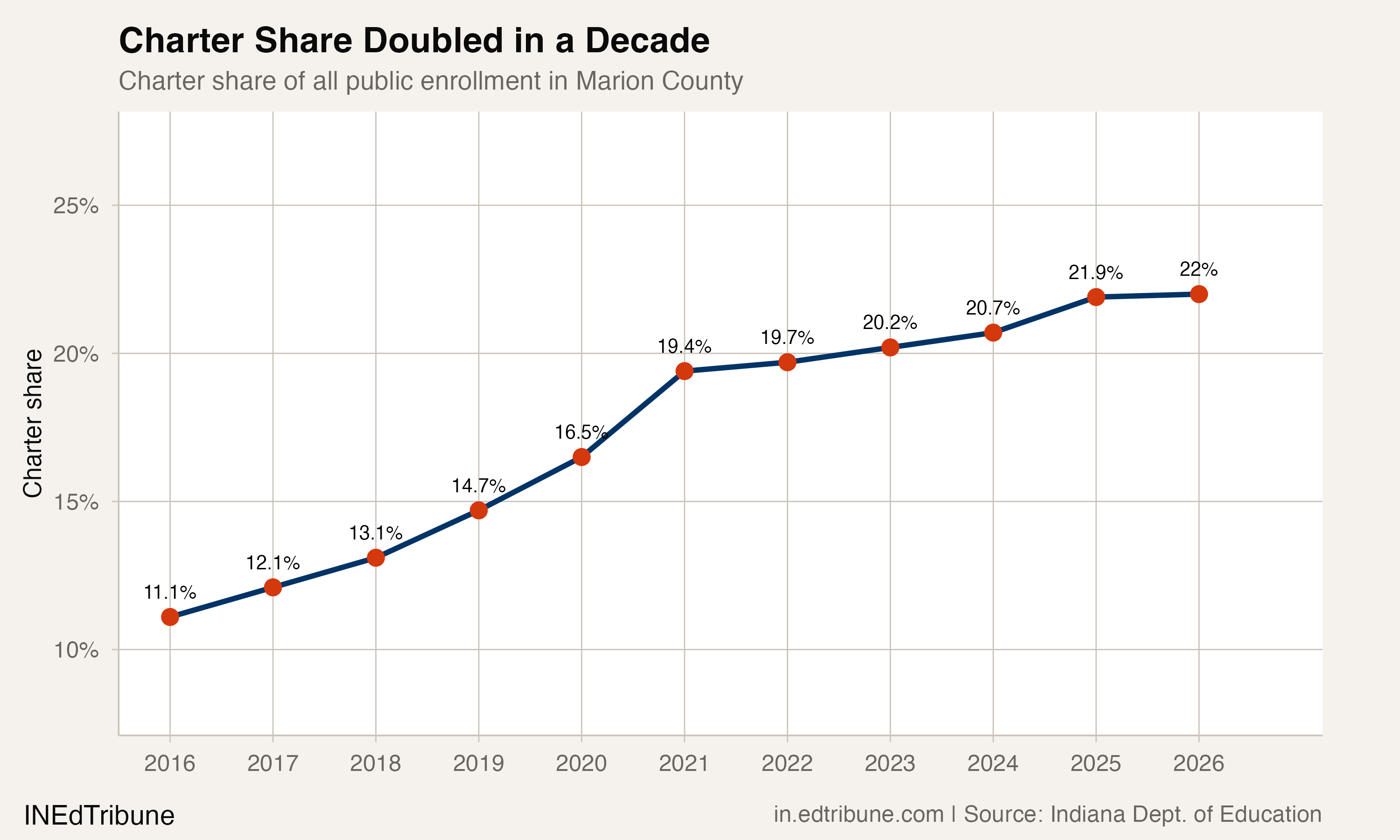
Charter enrollment as a share of all Marion County public enrollment doubled from 11.1% in 2016 to 22.0% in 2025-26. In 2021, the share crossed 19% and has climbed steadily since.
Different sectors, different students
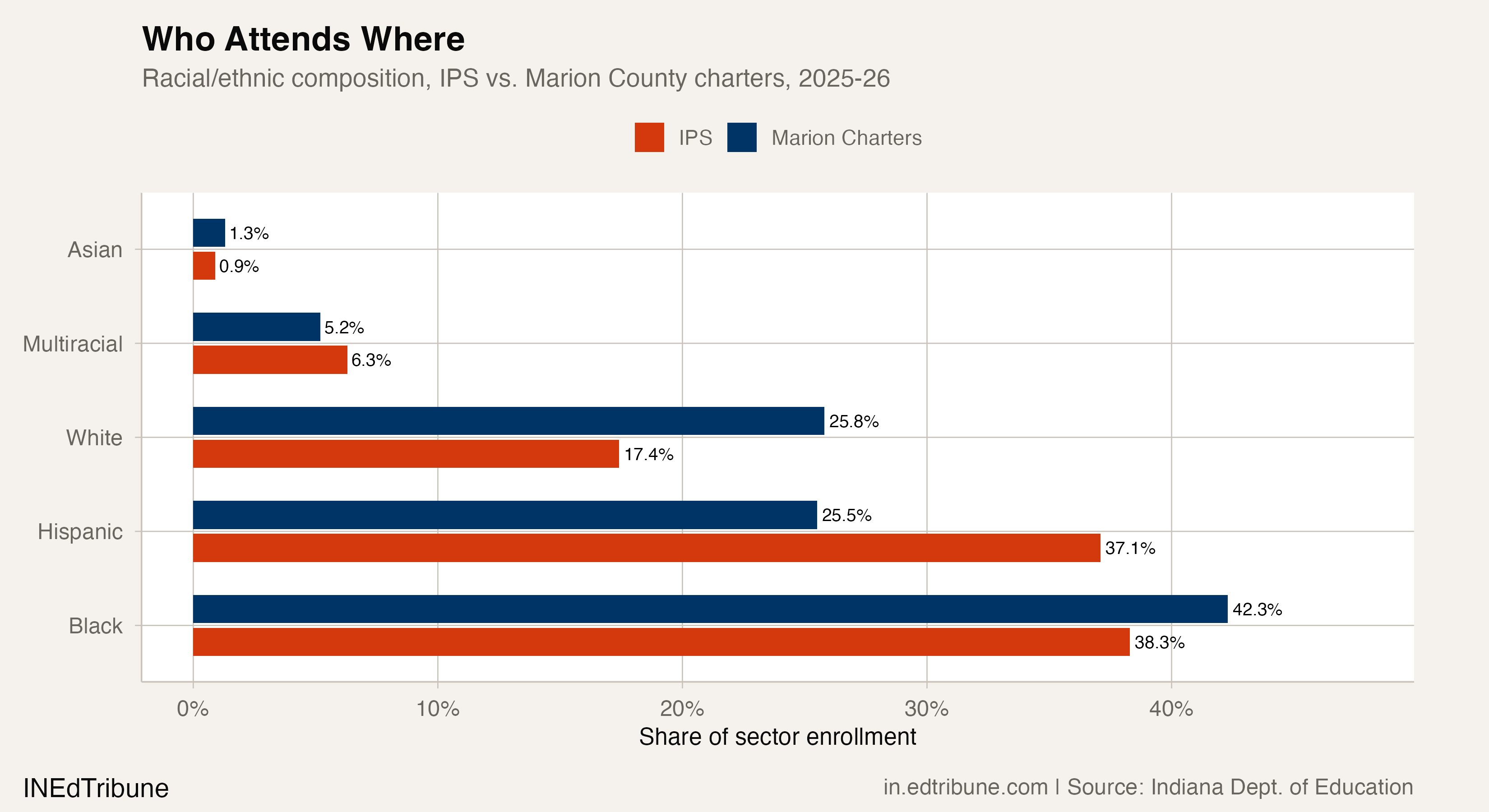
The two sectors serve overlapping but distinct student bodies. Black students make up 42.2% of charter enrollment and 38.3% of IPS. Hispanic students, by contrast, represent 37.1% of IPS but 25.5% of charters. White students are 25.8% of the charter sector and 17.4% of IPS.
The Mind Trust, the nonprofit that has supported the launch of more than 50 charter and innovation network schools in Indianapolis, reported in January 2025 that 61% of students attending public schools within or near IPS boundaries were enrolled in charter or innovation network schools rather than IPS-managed campuses. That figure includes both independent charters and IPS's own Innovation Network schools, which operate autonomously under contract with nonprofit boards but are technically part of the district.
The grade-level data reveals another dimension. Charter corporations enrolled 5,710 twelfth-graders in 2025-26, compared to 1,252 at IPS. Much of that comes from adult-serving programs like Christel House DORS and the Excel Center network, which serve students who have dropped out of traditional schools. The charter sector has, in effect, built a parallel pipeline that catches students the traditional system loses.
How Indianapolis became a charter city
The roots of this transformation predate the charter era. When Indianapolis created Unigov in 1969, merging city and county government, lawmakers deliberately excluded schools, leaving IPS as a stand-alone district surrounded by 13 other Marion County school corporations. A federal desegregation order in 1971 accelerated white flight. IPS enrollment fell from 108,000 to 47,000 by the early 1990s, weakening the district's financial base for a generation.
Indiana's 2001 charter school law then did something unusual: it gave the Indianapolis mayor authorization power over charter schools. Democratic Mayor Bart Peterson used that power aggressively. When Peterson left office, he co-founded The Mind Trust, which has since catalyzed the launch of dozens of charter and innovation network schools.
The non-IPS traditional districts in Marion County, meanwhile, have been largely stable. The 14 traditional school corporations other than IPS enrolled 107,792 students in 2025-26, barely changed from 103,060 a decade earlier. The charter expansion has not noticeably eroded their enrollment. The competition has been, overwhelmingly, a two-player game between charters and IPS.
The governance question
The enrollment data lands in the middle of a governance upheaval. The Indiana legislature passed HB 1423 in February 2026, creating the Indianapolis Public Education Corporation, a nine-member, mayor-appointed board that will oversee transportation, facilities, and school performance for both IPS and charter schools. The board must include three charter school leaders, three IPS board members, and three logistics or community experts.
"State policy decisions over the last decade have put IPS in a fiscally constrained space." — IPS Superintendent Aleesia Johnson, WFYI, February 2026
The legislation responds to a structural reality the enrollment data makes plain: IPS is no longer the primary provider of public education within its own boundaries. Seventy-three charter organizations, one shrinking traditional district, and a state-funded voucher pipeline all operate on the same territory, using the same buildings, drawing from the same neighborhoods.
The new corporation's first test will be concrete: which of IPS's half-empty buildings get reassigned to charter operators, and under what terms. State law requires districts to make unused facilities available to charters. HB 1423 exempts IPS from that requirement during the new board's startup period. That exemption has an expiration date. The buildings do not. Marion County's education system crossed from one governance era to another six years ago, when charter enrollment surpassed IPS. The legislation is the first acknowledgment that the old structure cannot hold.
Detailed code that reproduces the analysis and figures in this article is available exclusively to EdTribune subscribers.
Discussion
Sign in to join the discussion.
Loading comments...