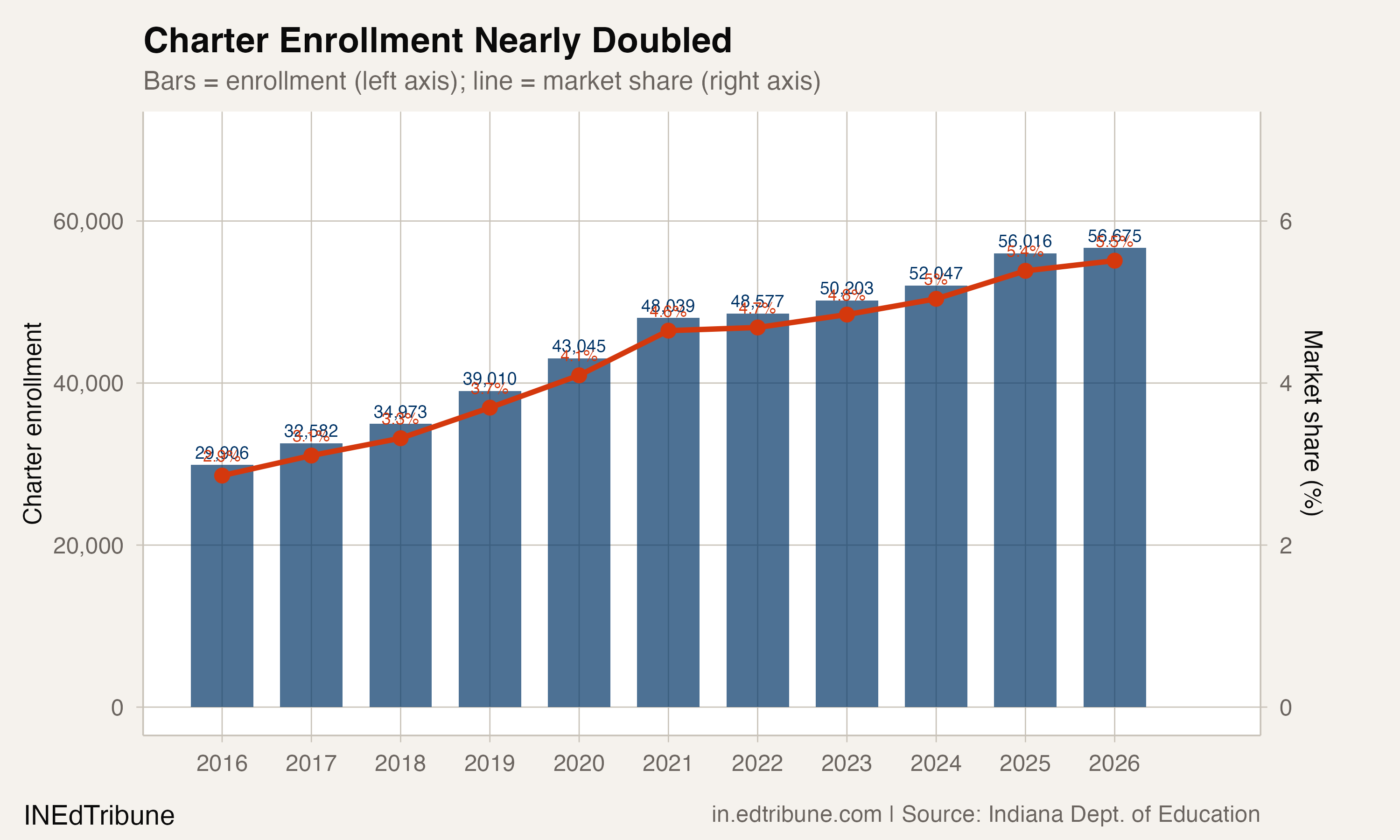
For every two students enrolled in an Indiana charter school a decade ago, there are now nearly four. The state's charter sector has grown from 29,906 students across 61 corporations in 2015-16 to 56,675 students across 132 corporations in 2025-26, an 89.5% increase that outpaced nearly every other sector of Indiana public education.
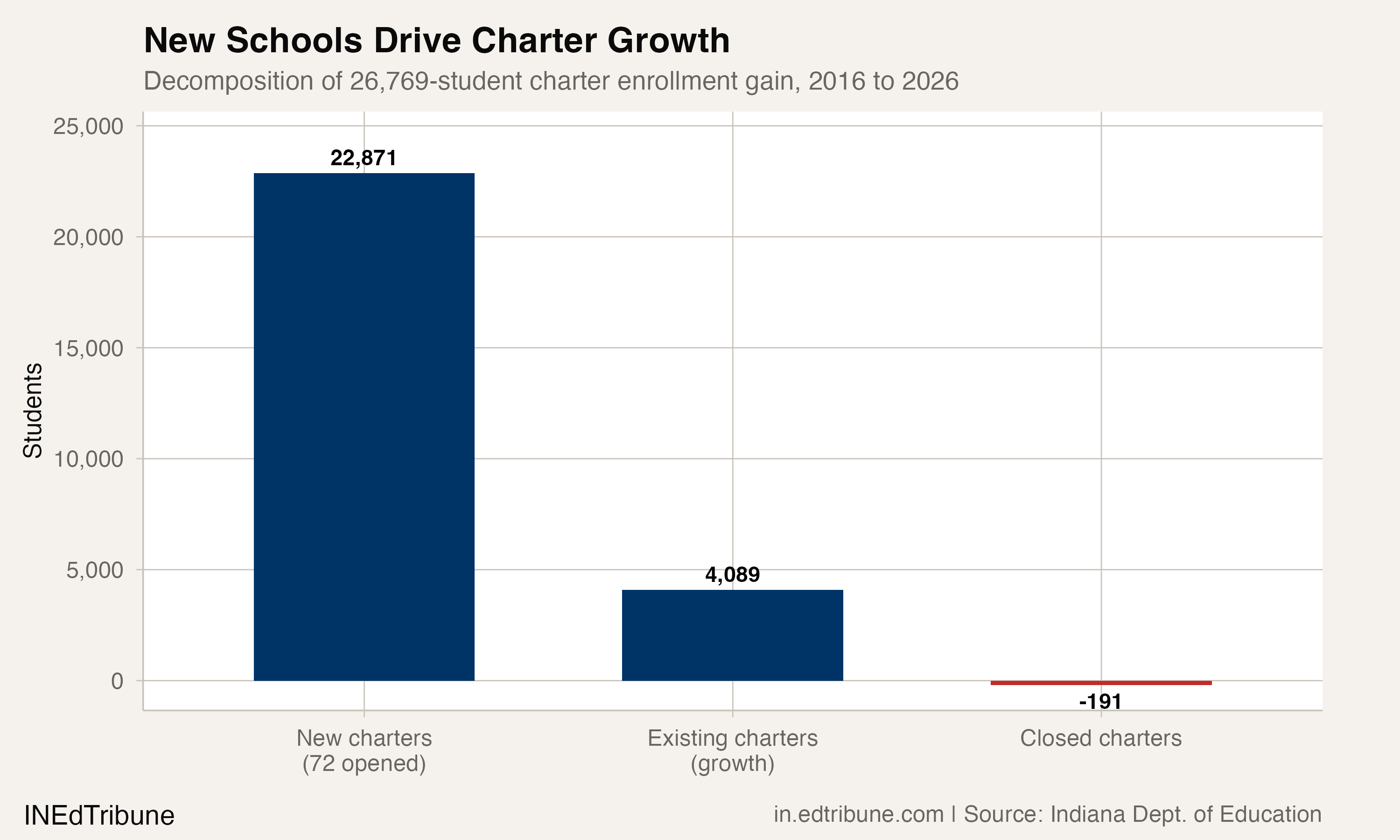
That growth did not come from existing schools getting bigger. It came from opening new ones. Of the 26,769 students the charter sector added over the past decade, 22,871 attend schools that did not exist in 2016. Only 4,089 came from enrollment gains at the 60 charter corporations that survived the full period. Just one charter closed.
5.5% and climbing
Charter market share has risen every year since 2016, from 2.9% to 5.5% of all public school enrollment. That share is modest by national standards, but the trajectory is unbroken. Even in 2022, when charter enrollment grew by just 538 students (1.1%), the share still ticked upward because traditional enrollment fell simultaneously.
The traditional sector lost 44,830 students over the same period, a 4.4% decline. The state as a whole shed 18,061 students. Charter growth absorbed more than the net loss, meaning that without charter expansion, Indiana's enrollment decline would have been steeper.
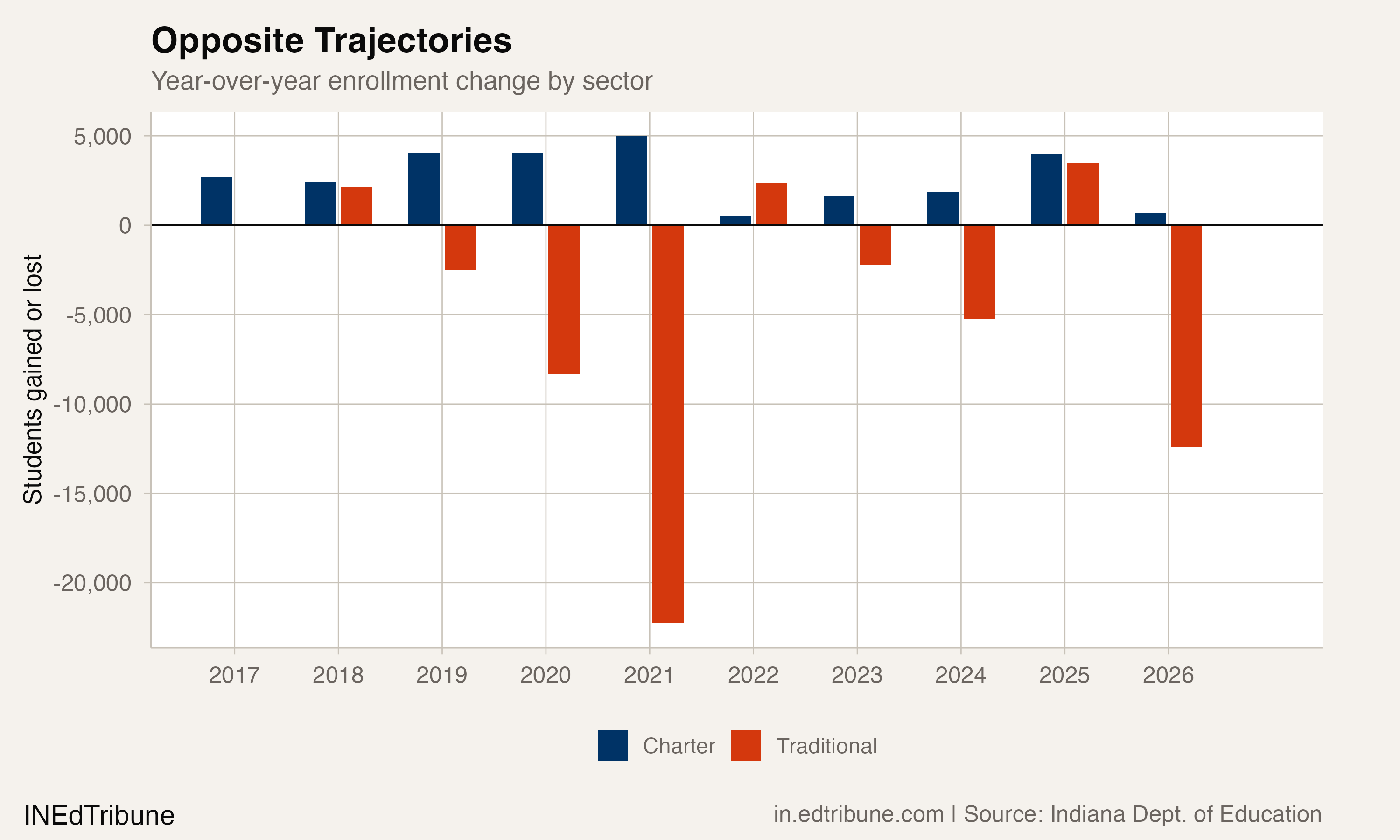
The two sectors diverged most sharply during the pandemic. In 2020-21, charters added 4,994 students (11.6% growth) while traditional corporations lost 22,264 (2.2%). That single year accounted for more than a quarter of the entire decade's charter gains.
A tale of two growth eras
The decade splits cleanly into two phases. From 2016 to 2021, charter enrollment surged at an average of 3,022 students per year, rising 60.6% in five years. Since 2021, growth has slowed to 1,727 students per year, an 18.0% gain over five years.
The deceleration is not a sign of declining demand. New charter authorizations continued, with 12 new corporations appearing in 2025 alone. The slowdown reflects a maturing sector: as the base grows larger, maintaining double-digit percentage gains requires correspondingly larger absolute additions. The 659 students added in 2026 represent the smallest annual gain since data begins, even as the sector is larger than ever.
Average charter size has declined steadily, from 490 students per corporation in 2016 to 429 in 2026. New charters are opening smaller, many as single-campus operations serving targeted populations or geographies.
Where the students are
The growth story is overwhelmingly a story of new schools. Seventy-two charter corporations that did not exist in 2016 now enroll 22,871 students, accounting for 85% of the sector's net gain. The remaining 15% came from organic growth at existing schools, led by Indiana Connections Academy 7-12 (+1,322 students), Options Charter Schools (+925), and Christel House DORS (+698).
Three distinct models anchor the sector.
Virtual schools enroll 8,582 students across five corporations, 15.1% of all charter enrollment. Indiana Connections Academy, split into K-6 and 7-12 divisions, is the single largest charter operation at 6,658 combined students. Virtual charter enrollment dropped sharply after 2019 legislation reduced funding for online schools to 85% of brick-and-mortar levels, but has since stabilized.
The Goodwill Excel Center network operates 24 campuses enrolling 6,639 adult learners, 11.7% of charter enrollment. Founded in 2010 as a tuition-free adult charter high school, Excel Centers award diplomas rather than GEDs to adults who return to complete their education. The network's statewide footprint, from Bloomington to South Bend to Evansville, makes it unique among Indiana charter operators.
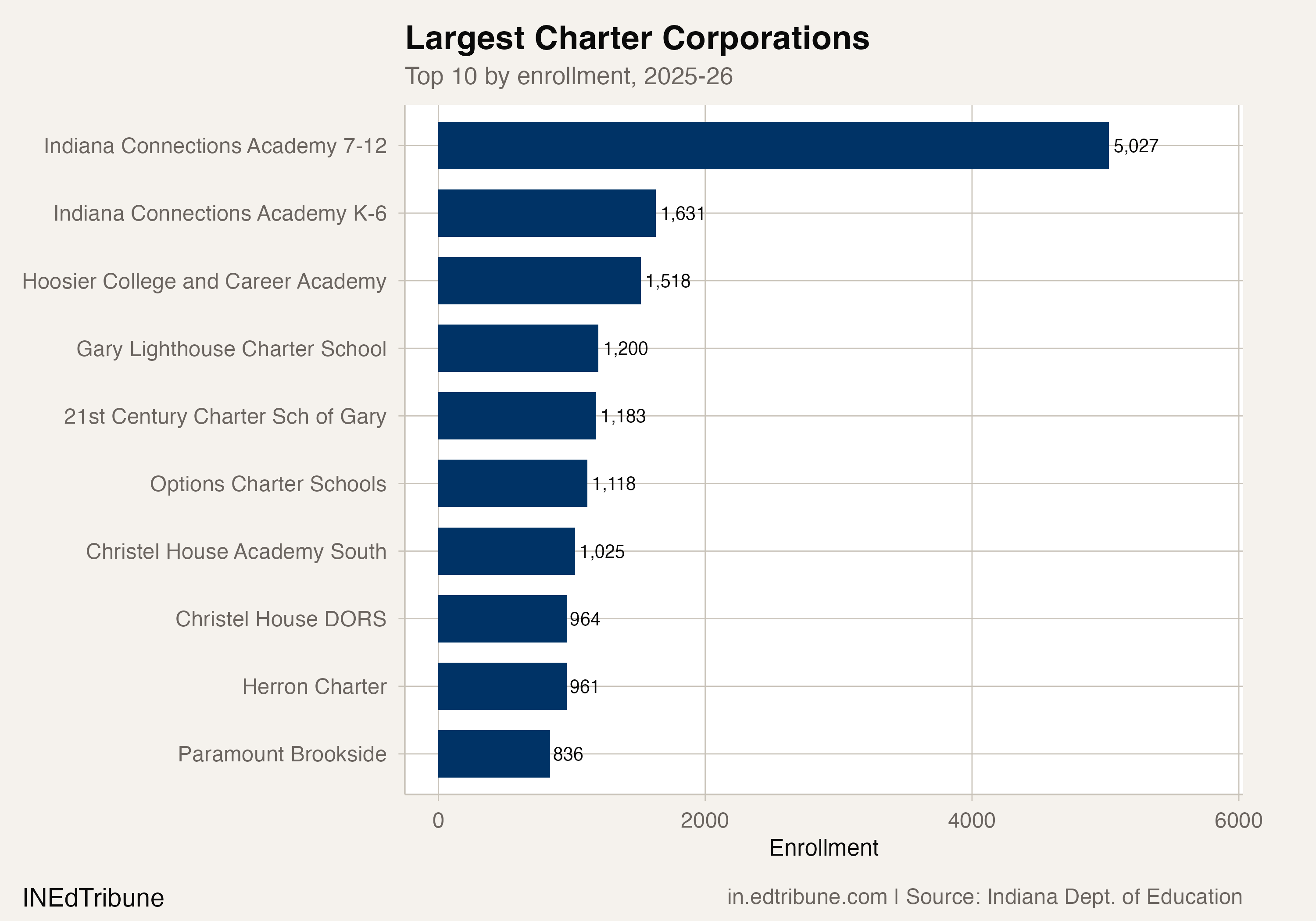
Brick-and-mortar K-12 charters make up the remainder, concentrated in Indianapolis and Gary. The largest individual charter corporation is Indiana Connections Academy 7-12 (5,027 students), followed by Hoosier College and Career Academy (1,518), Gary Lighthouse Charter School (1,200), and 21st Century Charter School of Gary (1,183).
A different student body
Indiana's charter sector serves a student population that looks strikingly different from the traditional system. Black students make up 39.4% of charter enrollment but just 12.4% of traditional enrollment, a ratio of more than three to one. Hispanic students represent 21.8% of charter enrollment versus 15.1% in traditional schools. White students, who comprise 63.2% of traditional enrollment, account for just 30.8% of the charter sector.
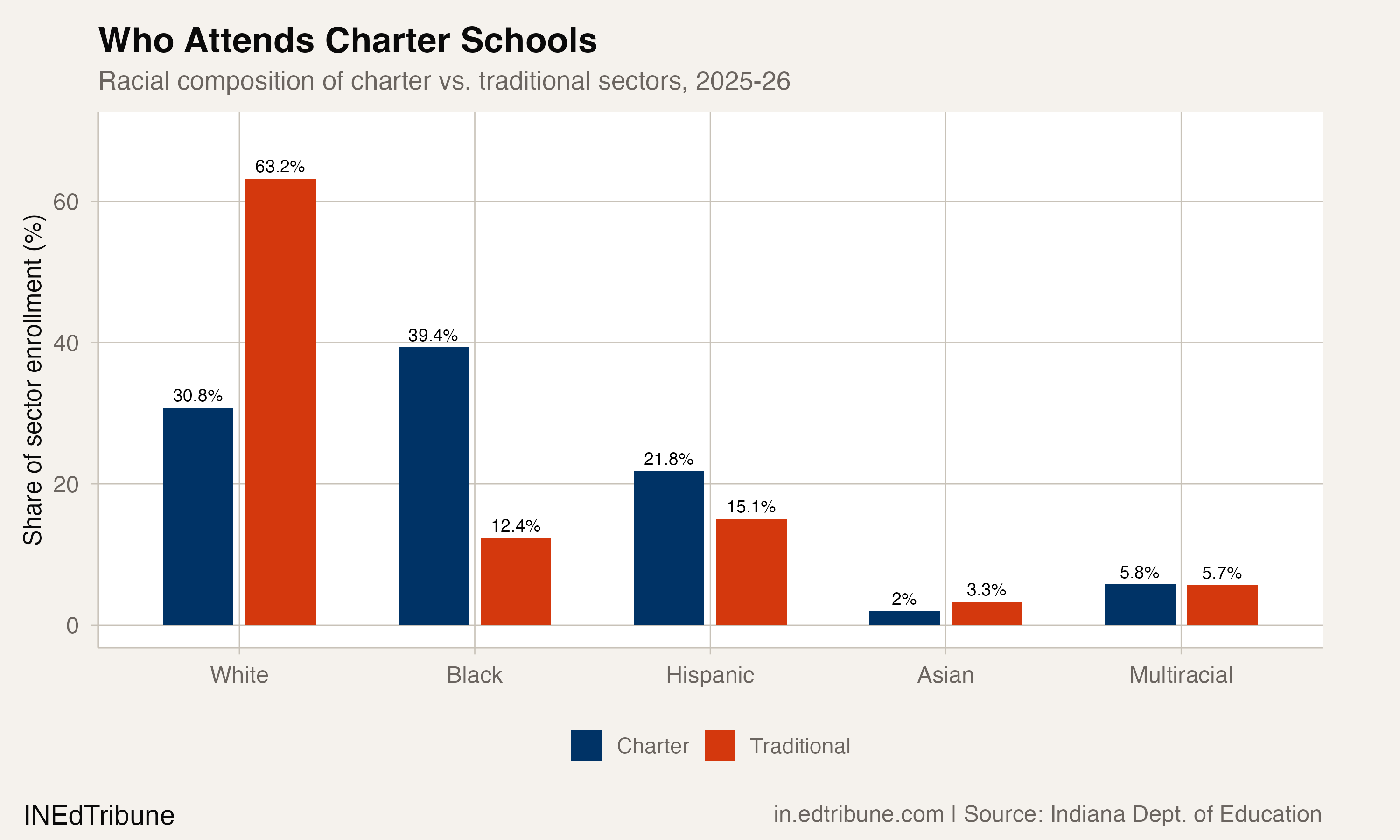
This disparity reflects geography. Charters are concentrated in Indianapolis and Gary, both majority-minority cities, while Indiana's traditional school landscape is predominantly suburban and rural. Within Indianapolis Public Schools boundaries, 61% of public school students now attend charter or innovation network schools, according to The Mind Trust, up from 51% in 2019-20.
The concentration has drawn scrutiny. A Chalkbeat investigation found that nearly half of Indianapolis charter schools had enrollment exceeding 75% Black students, with one in four exceeding 90%. Whether this represents community-driven choice or structural segregation remains contested. Chris Stewart, then of Education Post, characterized charters as "a boon for black choice and brown choice." Integration advocates counter that racially concentrated schools, regardless of sector, limit students' exposure to diverse peers.
The grade 12 anomaly
One of the most striking features of Indiana's charter data is the explosion in grade 12 enrollment. Charter twelfth-graders grew from 2,418 in 2016 to 10,357 in 2026, a 328.3% increase that dwarfs every other grade level. Grade 12 now accounts for 18.3% of all charter enrollment, far exceeding its natural share of a K-12 pipeline.
The explanation is the Excel Center model. Because Excel Centers serve adults returning to complete high school, their students are classified in the state data as grade 12 regardless of the credits they are working on. The 24 Excel Center campuses alone account for 6,639 of those grade 12 students. Add in other alternative and dropout recovery charters like Christel House DORS (964 students) and Options Charter Schools (1,118), and the majority of charter grade 12 enrollment serves a population that traditional high schools are not designed to reach.
This is not grade inflation or a data anomaly. It is a policy choice: Indiana counts adult learners in public charter schools as public school students, which means they appear in the same enrollment tables as kindergartners. Whether that classification inflates or accurately represents the charter sector's reach depends on how one defines the public school system's mission.
Vouchers, governance, and the next competitive shift
The charter sector's growth over the past decade occurred under a regulatory framework that already made Indiana one of the most charter-friendly states in the country. Multiple authorizers, including the Indiana Charter School Board, the Indianapolis mayor's office, Ball State University, and several other universities, can approve new schools.
But the policy landscape is shifting further. Universal vouchers take effect in July 2026, removing all income eligibility requirements for Indiana's Choice Scholarship program. The existing voucher program already serves roughly 70,000 students at a cost of approximately $439 million annually, according to WFYI reporting. The expansion is projected to cost an additional $190 million over the biennium.
"Even with a surprise shortfall in revenue we made sure we protected K-12. And yes, yes, yes, yes we are providing all parents a choice." — House Speaker Todd Huston, on the 2026-27 budget, via WFYI
Meanwhile, new legislation would create a mayor-appointed board with oversight of both IPS and charter school facilities and finances in Indianapolis, potentially reshaping the governance structure that has allowed the charter sector to grow as a parallel system.
The charter sector's 89.5% growth rate will not repeat in the next decade. The sector is larger, the easy-to-serve populations are enrolled, and the political terrain is being reshaped by vouchers competing for the same families seeking alternatives. Universal voucher eligibility, starting mid-2026, could redirect some of the demand that charters have captured. Or it could prove that the constraint was never funding but proximity: a voucher is useless if there is no private school within driving distance, and in rural Indiana there often is not. The charter sector's next decade will depend less on authorization rates and more on whether 5.5% market share is a natural ceiling or just where Indiana happened to be standing when the competitive landscape shifted underneath it.
Detailed code that reproduces the analysis and figures in this article is available exclusively to EdTribune subscribers.
Discussion
Sign in to join the discussion.
Loading comments...