Five years after the pandemic emptied classrooms across Indiana, the state's enrollment has not just failed to recover. It has gotten worse.
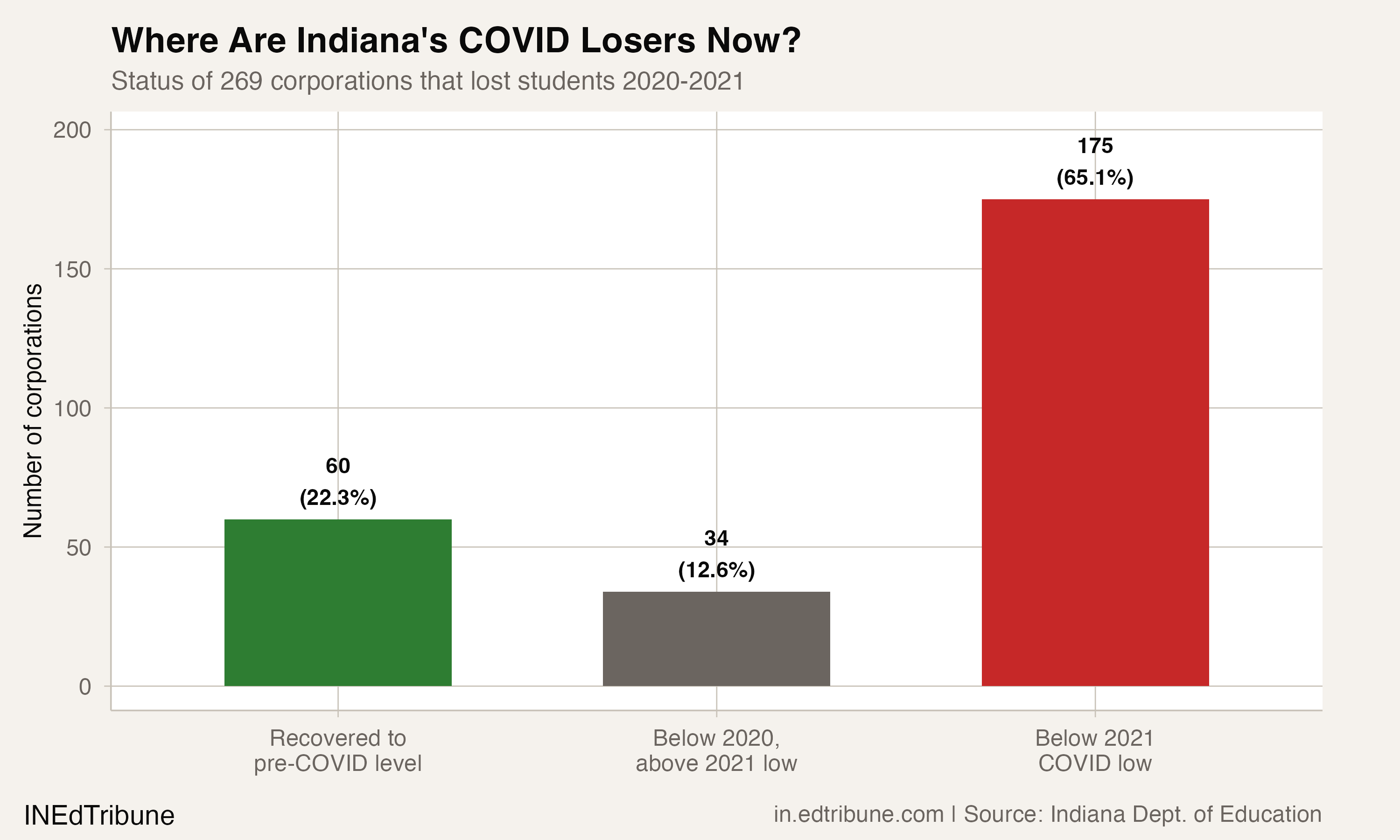
Of 269 school corporations that lost students between the 2019-20 and 2020-21 school years, only 60 had clawed back to their pre-COVID enrollment by 2025-26. The other 209, nearly 78%, remain below where they stood before the pandemic. And for 175 of those corporations, enrollment is now lower than the COVID trough itself.
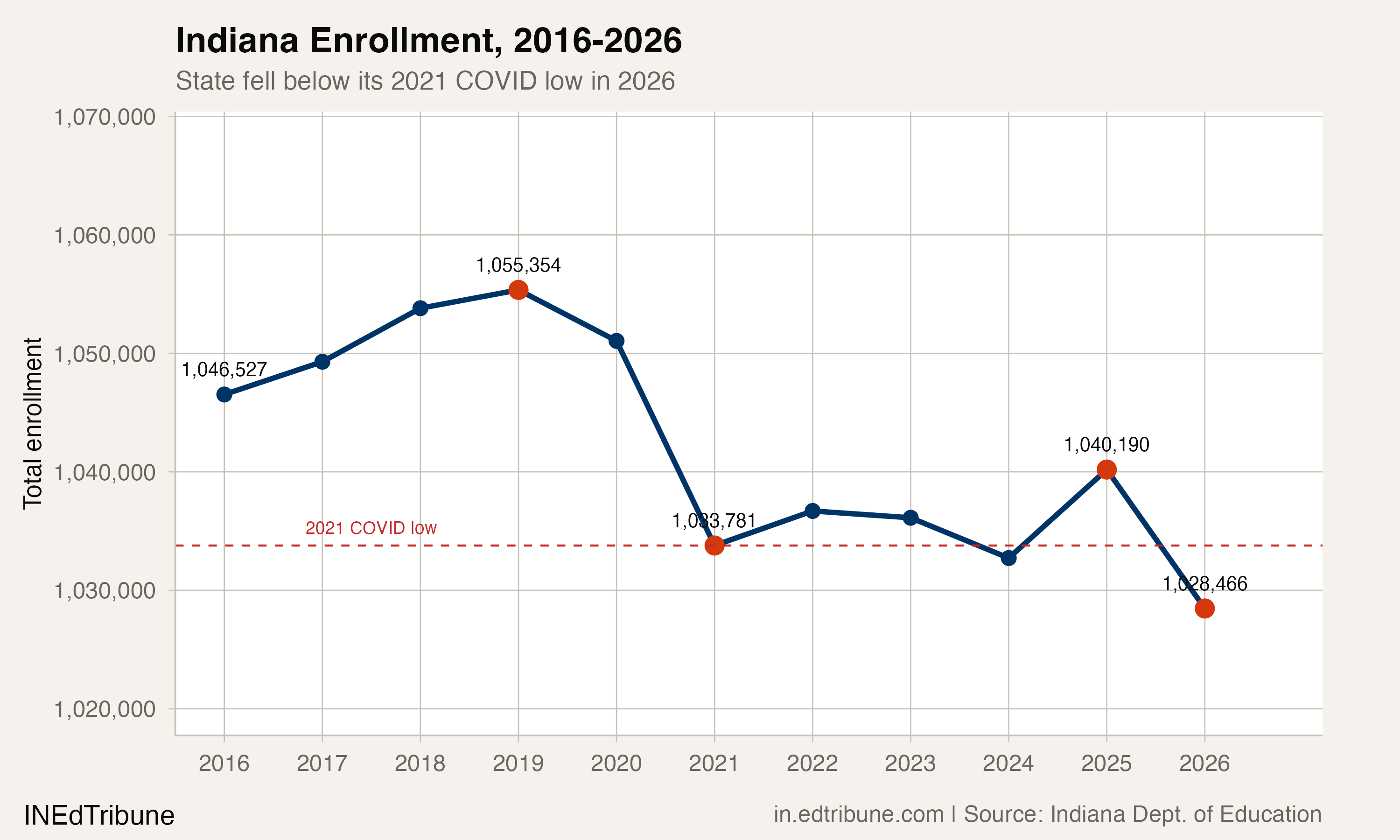
Indiana enrolled 1,028,466 students in 2025-26, 22,585 fewer than in 2019-20 and 5,315 fewer than the 2020-21 low of 1,033,781. The state did not just fail to bounce back. It fell through the floor.
The false rebound
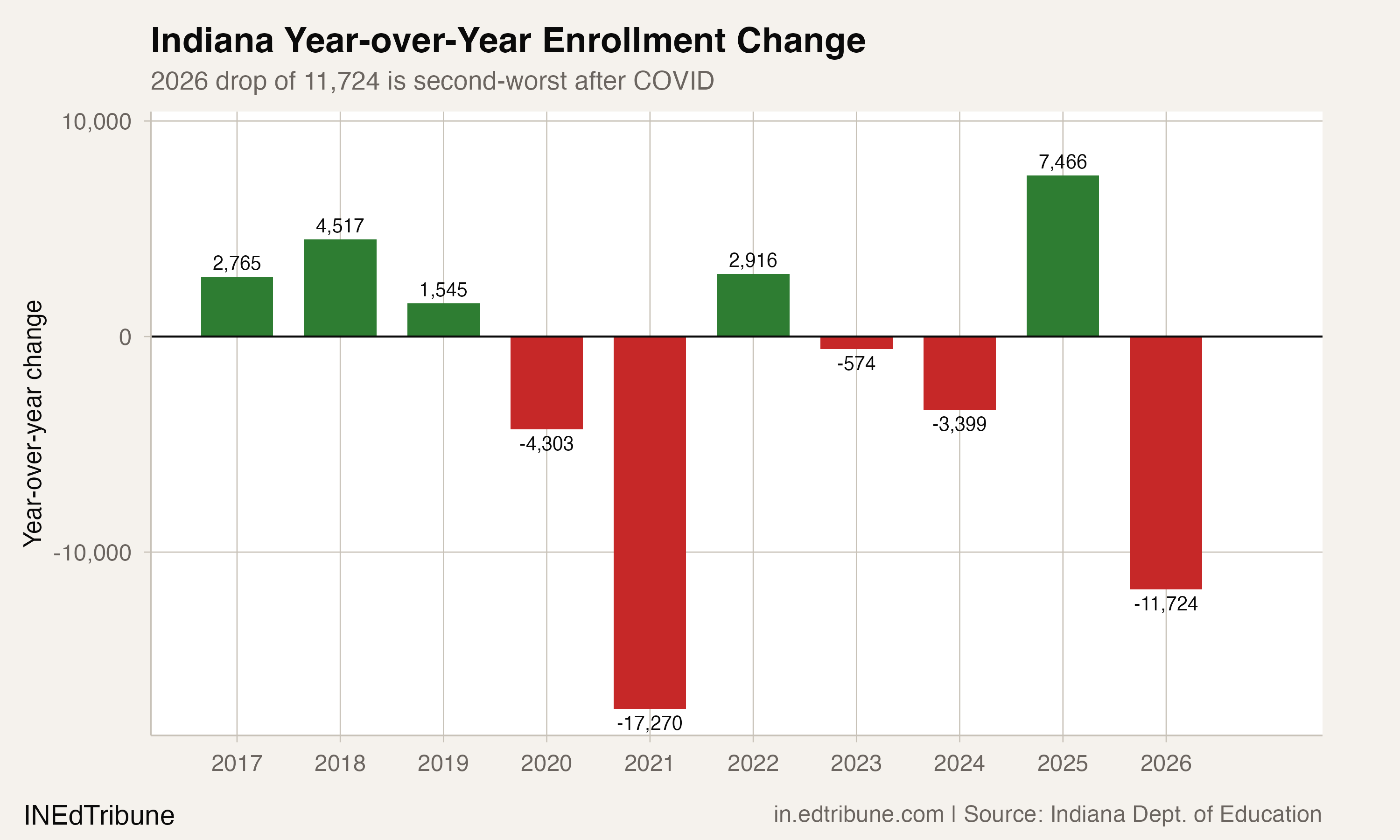
The trajectory looked different a year ago. In 2024-25, Indiana added 7,466 students, its best single-year gain in a decade, pushing enrollment to 1,040,190. Recovery appeared plausible. By that point, 73 of the 269 COVID-loser corporations, 27.1%, had returned to their pre-pandemic headcounts.
Then 2025-26 erased it. The state lost 11,724 students in a single year, the second-largest annual decline on record behind only the 17,270-student COVID plunge of 2020-21. The recovery rate collapsed from 27.1% back to 22.3% as 18 corporations that had been above their 2020 levels slipped below again.
What happened in 2025 was not a continuation of a slow decline. It was a reversal of what had appeared to be a turnaround.
The three tiers of non-recovery
Not all 209 unrecovered corporations are in the same position. The data sorts them into three distinct groups with very different outlooks.
Sixty corporations, 22.3%, have fully recovered or exceeded their 2020 enrollment. Another 34, 12.6%, sit between their 2020 and 2021 levels. They are down from pre-COVID but at least above the pandemic nadir. The largest group, 175 corporations at 65.1%, has fallen below even the 2021 low. For these districts, the pandemic was not the bottom. It was the beginning of a deeper slide.
That last category includes some of the state's largest urban systems. Indianapolis Public Schools↗ET enrolled 25,611 students in 2019-20. The COVID drop took that to 22,930. By 2025-26, the district was at 19,774, a 22.8% decline from its pre-pandemic level and 3,156 students below its worst pandemic year. South Bend Community School Corp↗ET has lost 23.2% since 2020, and School City of Hammond↗ET has lost 24.5%.
Who is driving the deficit
The losses are concentrated. Nineteen corporations account for half of the total 62,834-student deficit among unrecovered districts. The top 10 alone carry 38.0% of the shortfall.
Indianapolis Public Schools leads with a 5,837-student gap from its 2020 level. South Bend follows at 3,874, Hammond at 3,149, and Elkhart Community Schools↗ET at 2,227. The pattern is consistent: mid-size and large urban corporations losing students at rates far exceeding the state average.
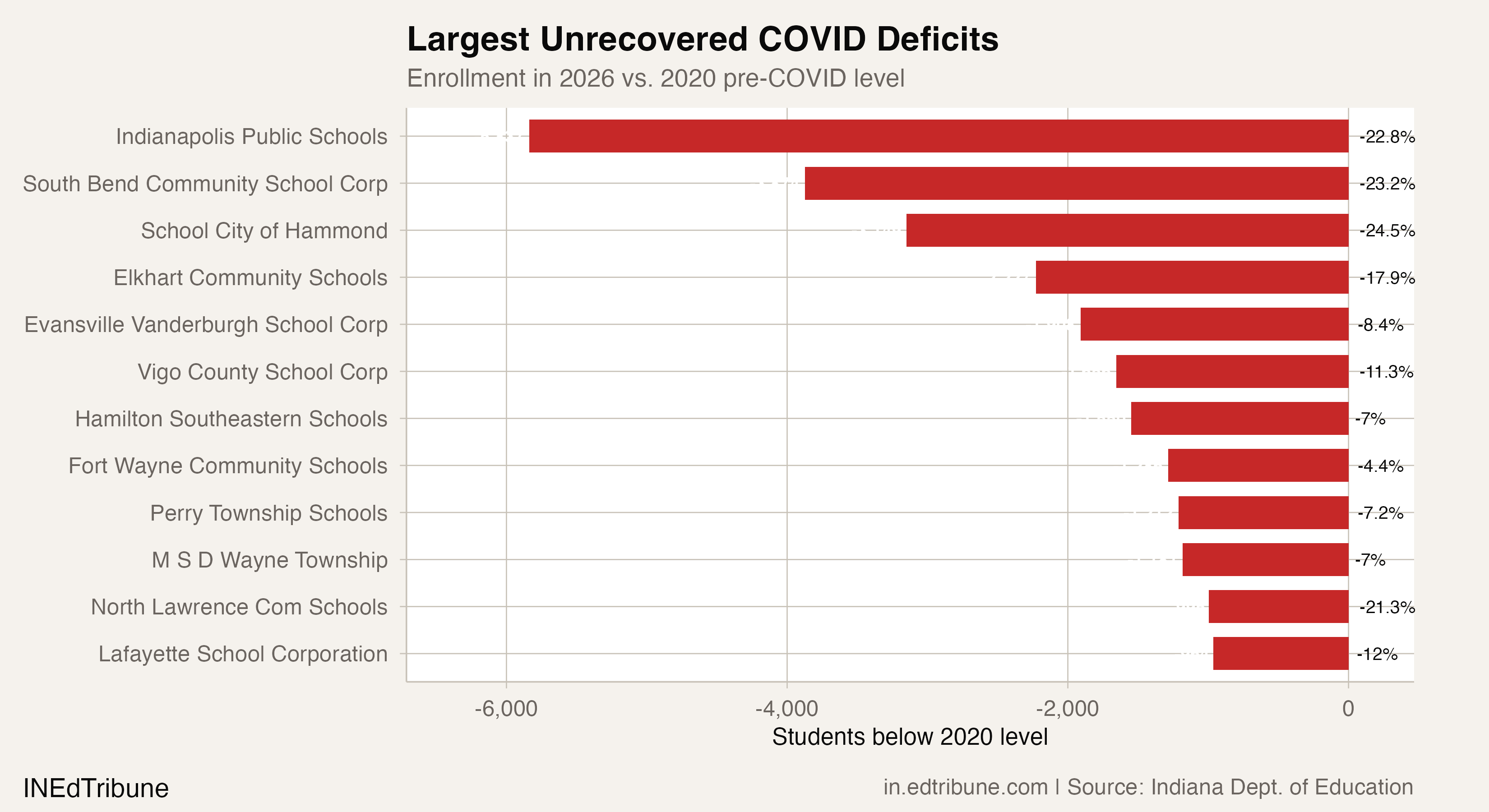
But suburban systems are not immune. Hamilton Southeastern Schools↗ET, one of the state's wealthiest districts, is 1,550 students below its 2020 level, a 7% decline. Perry Township Schools↗ET in Marion County is down 1,212, or 7.2%.
Shrinking pipelines, expanding exits
Two structural forces are compressing Indiana's enrollment from both ends.
At the front of the pipeline, kindergarten enrollment has fallen from 78,649 in 2019-20 to 69,849 in 2025-26, an 11.2% drop. Indiana recorded 79,000 births in 2023, its third-lowest total since 1946, down from a peak of 89,900 in 2007. If birth rates from the late 2000s had held, the state would have had roughly 151,000 additional births over the past 16 years. Each missing birth cohort is now arriving at kindergarten doors.
At the back end, 12th grade enrollment has grown from 76,288 to 85,006 over the same period. Indiana's kindergarten-to-12th-grade ratio has fallen from 1.03 in 2019-20, roughly even, to 0.82 in 2025-26. The state is graduating 15,157 more students per year than it is enrolling in kindergarten.
The result is a structural thinning that no recovery effort can reverse without new students entering the system.
Vouchers and the competitive landscape
Indiana's Choice Scholarship program grew to approximately 76,000 students in 2024-25, adding about 6,000 recipients at a cost of $497 million. That 8% growth rate was a sharp deceleration from the 30% surge the year before, when lawmakers expanded eligibility to households earning up to roughly $230,000. The legislature dropped the final income requirement in 2025, making the program fully universal starting mid-2026.
The voucher program's growth trajectory does not neatly explain the 2025-26 enrollment cliff. Voucher growth actually slowed in the same year that public enrollment cratered. The most likely driver of the 2025-26 drop is demographic: declining birth cohorts reaching school age, compounded by an already-depleted base that never recovered from 2020-21. The voucher program is a contributing factor in the broader non-recovery pattern, particularly for urban districts, but the 11,724-student single-year loss exceeds what voucher transfers alone can account for.
"The reality facing public schools across the U.S. is that enrollment has been decreasing. We will continue to thoughtfully navigate these shifts while also working hard to be the preferred choice for more families." — Indianapolis Public Schools, via WFYI, January 2026
In Indianapolis specifically, the decline extends beyond the traditional district. Chalkbeat reported that charter enrollment within IPS boundaries also fell nearly 3% in 2025-26, with independent charters posting their largest year-over-year drop in at least seven years. When both the district and its charter competitors are shrinking simultaneously, the problem is not market share. It is a shrinking market.
133 corporations at their lowest point ever
The non-recovery is not just a COVID story. One hundred thirty-three Indiana corporations recorded their lowest enrollment in the 11-year window from 2015-16 through 2025-26 during the 2025-26 school year. That is nearly one in three of all corporations with at least six years of data.
Meanwhile, only 83 of the 114 corporations that actually gained students during COVID are still above their 2020 levels. Thirty-one of those pandemic gainers have since fallen below where they started, meaning COVID-era gains proved temporary for more than a quarter of the districts that experienced them.
The demographic math is unforgiving. Indiana's school-age population is projected to decline by more than 105,000 by 2060, a 5.9% drop. White enrollment, which still represents the state's largest racial group, fell by 66,399 students, or 9.5%, between 2019-20 and 2025-26. Hispanic enrollment grew by 24,489 (18.2%) and Black enrollment by 8,713 (6.5%), but those gains offset barely half of the white student losses.
Recovery is no longer the right word
The 2025-26 data settled one question: Indiana's post-COVID enrollment trajectory is not a plateau. It is a decline that briefly paused. Two hundred eighty-one corporations shrank in 2025-26 while only 138 grew, a ratio that mirrors the worst pandemic years.
Universal voucher eligibility takes full effect in 2026-27, but the program's growth actually slowed even as eligibility broadened, suggesting the constraint is private school capacity, not family demand. Rural Indiana, where private school options are scarce, faces a different version of this problem entirely: declining enrollment with no competitive alternative to absorb the blame.
Five years out, "recovery" is the wrong frame. The 175 corporations now below their pandemic low are not waiting for students to come back. They are managing buildings, budgets, and bus routes designed for a student population that has moved on, aged out, or was never born. The October count is still the most important number on their calendar. It just keeps getting smaller.
Detailed code that reproduces the analysis and figures in this article is available exclusively to EdTribune subscribers.
Discussion
Sign in to join the discussion.
Loading comments...